
Am I Snobby Quiz
How the Scales are Structured
Who Usually Takes This Test?
See How You Compare
Below is a preview of how scores are typically distributed across each scale.
Example Questions From the Test
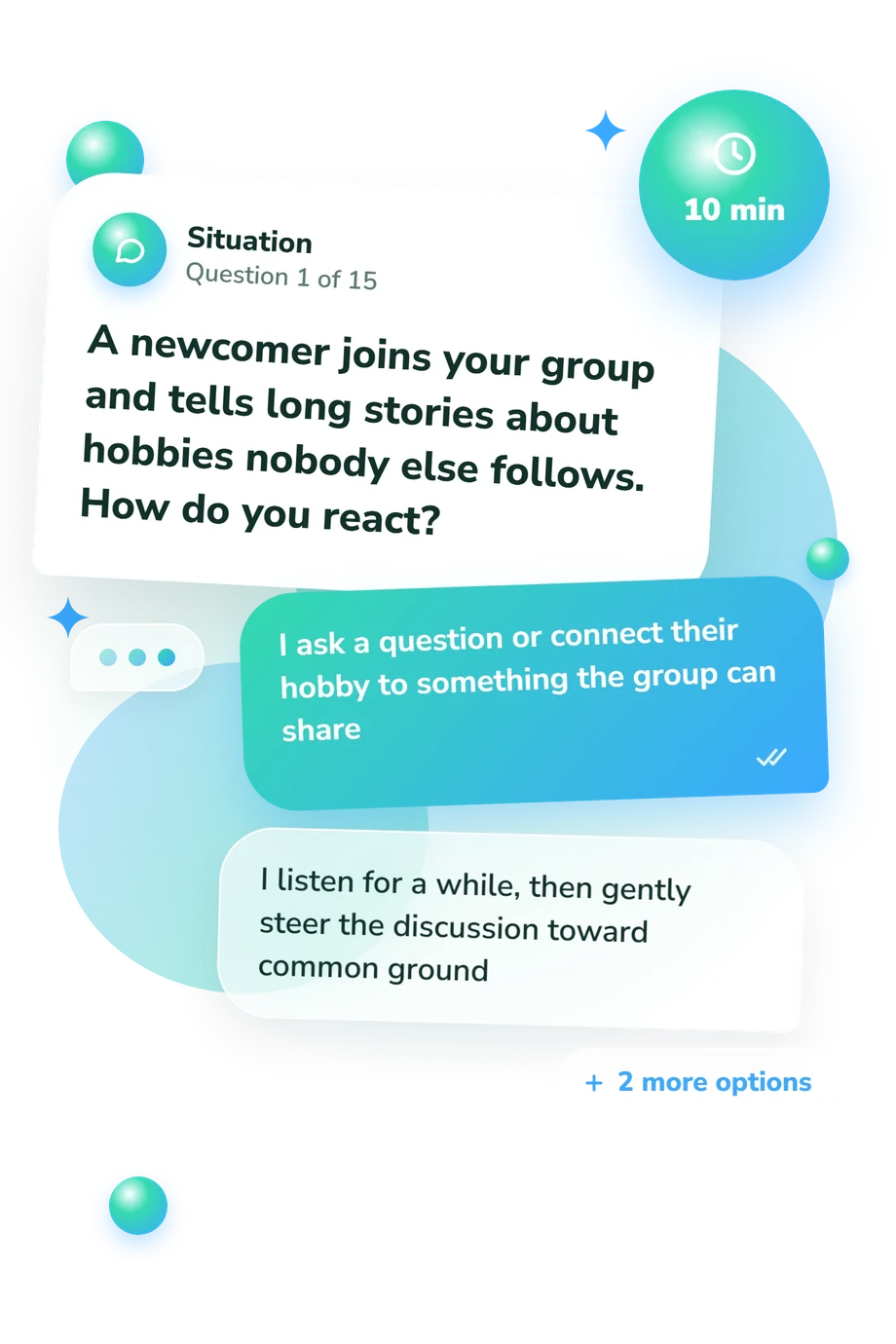
- I ask a question or connect their hobby to something the group can share
- I listen for a while, then gently steer the discussion toward common ground
- I become reserved and wait for them to adjust to the group's conversational style
- I avoid encouraging them because their manner does not fit the group
- I favor guests whose background and connections suit the image of the gathering
- I choose mostly from circles where people share similar ambitions and norms
- I consider social fit, but also invite someone simply because I enjoy them
- I focus on who is kind, interesting, and likely to engage with others
- I focus on the idea and ask questions where clarification is useful
- I notice the delivery but keep listening for the substance
- I find it difficult to take the point as seriously as a more polished explanation
- I assume the conversation is unlikely to offer much intellectual value
Am I Snobby Quiz - Description and methodology of the test
People who wonder whether their standards quietly affect how they treat others can use the Am I Snobby Quiz as a structured prompt for self-examination. As a snob personality test, it is intended for readers reflecting on reactions to status, manners, cultural taste, and social fit. The result does not assign a fixed identity; it highlights patterns that may merit closer attention in everyday relationships.
What This Assessment Explores
The questions examine whether social polish, prestige, etiquette, and cultural preference influence warmth, attention, inclusion, or patience. Situations involving speech, credentials, neighborhoods, occupations, service, clothing, music, books, and hosting show how reactions change when someone falls outside a preferred norm. Read as an are you a snob quiz, the exercise is most useful as a mirror for tendencies, not a verdict on character.
Its three dimensions are presented as follows:
- Everyday Interpersonal Distance (0-15) measures whether polish, knowledge, or etiquette reduce warmth: Equal-footed (0-5), Selectively distant (6-10), or Frequently distancing (11-15).
- Social Status Filtering (0-15) measures whether background, occupation, prestige, or fit shape inclusion: Status-light (0-5), Status-aware (6-10), or Status-led (11-15).
- Taste Superiority (0-15) measures whether preferences stay personal or become judgments of worth: Preference-minded (0-5), Taste-conscious (6-10), or Taste as hierarchy (11-15).
Methodology and Scientific Basis
Each item presents a social situation followed by four response options. The choices move from accepting the person on their terms to noticing a difference, correcting it, withdrawing, or treating it as evidence of lower fit or sophistication. This self-report structure shows how the respondent interprets social cues; the scores summarize tendencies across situations rather than isolated answers.
The conceptual frame aligns most closely with Jarness and Friedman (2017), whose work on class boundaries helps explain why people may soften, conceal, or rationalize distinctions in ordinary interaction. Patridge’s account of aesthetic snobbery clarifies the role of taste judgments, while Bourdieu’s Distinction provides a broader theory of how preferences can signal social position. The social status and taste quiz has a theoretical context, but it is not an adaptation or validation of those works.
Interpretation is limited by self-report: answers can shift with mood, self-awareness, and the desire to appear fair, and this online questionnaire is not presented as a standardized instrument. Because its response-to-point conversion is not stated, the result bands are best read as reflective categories rather than fixed judgments.
- Jarness, Vegard, and Sam Friedman. 2017. “I’m Not a Snob, But...”: Class Boundaries and the Downplaying of Difference. Poetics 61: 14-25. 10.1016/j.poetic.2016.11.001
- Patridge, Stephanie. 2023. “Aesthetic Snobbery.” Philosophy Compass 18(9): e12940. 10.1111/phc3.12940
- Bourdieu, Pierre. 1984. Distinction: A Social Critique of the Judgement of Taste. Translated by Richard Nice. Cambridge, MA: Harvard University Press.
Updated: