
After Twenty Years Quiz
How the Scales are Structured
Who Usually Takes This Test?
See How You Compare
Below is a preview of how scores are typically distributed across each scale.
Example Questions From the Test
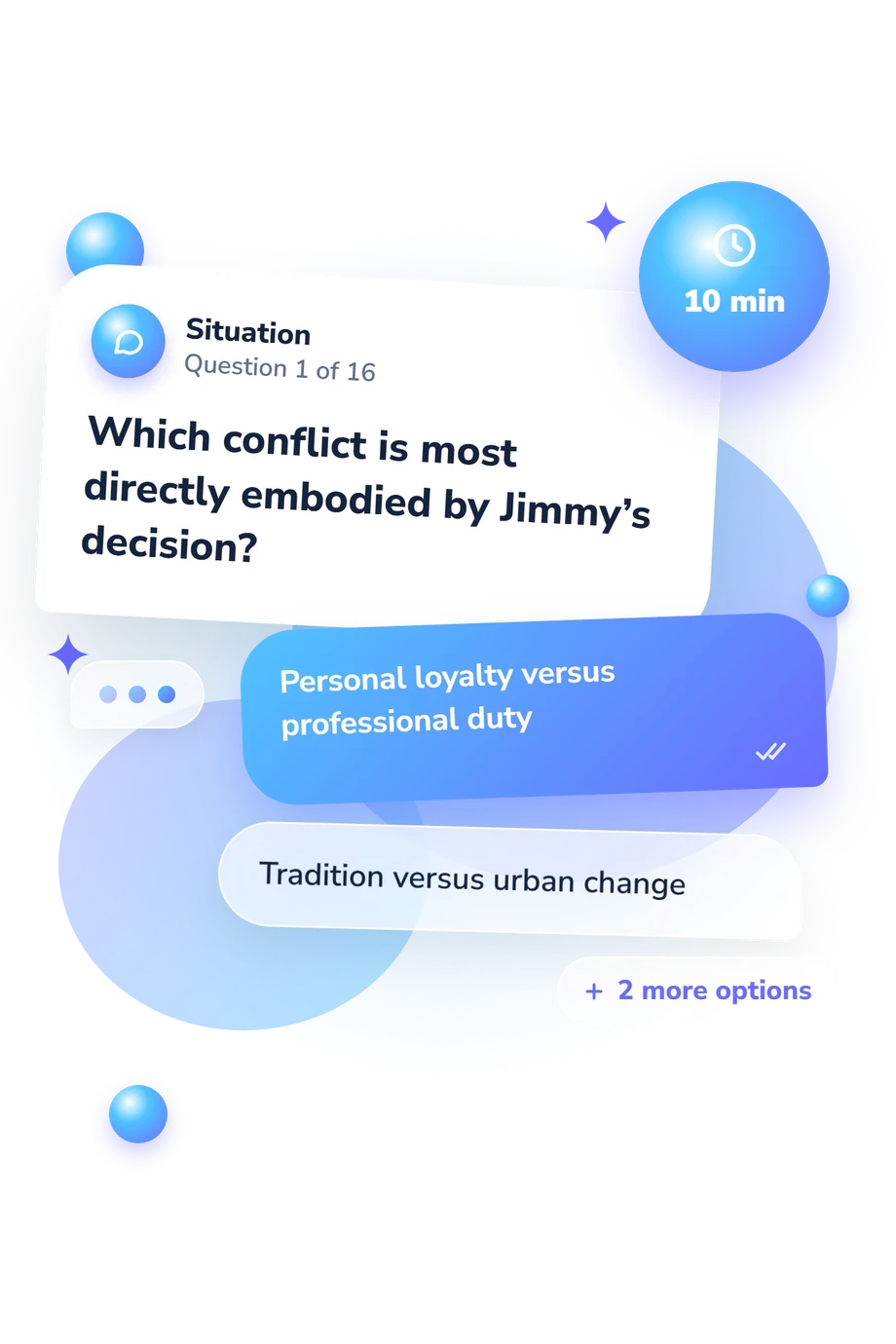
- Personal loyalty versus professional duty
- Tradition versus urban change
- Ambition versus contentment
- Wealth versus social status
- Five minutes
- Ten minutes
- Twenty minutes
- One hour
- He is sheltering from the weather while waiting for a train
- He is watching the patrol officer’s route
- He expects a Chicago contact to deliver money
- He intends to honor a promise made twenty years earlier
After Twenty Years Quiz - Description and methodology of the test
For readers revisiting O. Henry’s story, the After Twenty Years Quiz offers a focused way to examine how clearly details, motives, and turning points connect. It suits students, teachers, and independent readers who want an O. Henry story quiz that brings those relationships into focus. The result gives a structured indication of how successfully those connections are recognized.
What This Assessment Explores
The questions test links among events, decisions, and clues in O. Henry’s story. The assessment suits students, teachers, and independent readers; an After Twenty Years comprehension quiz covers factual details and interpretation, so missed answers can suggest topics for review.
The items cover four areas:
- Plot and sequence recall show whether the meeting, arrival, arrest, and reveal are placed correctly.
- Characterization and motivation indicate how well Jimmy’s duty and Bob’s choices are understood.
- Setting and time details measure recognition of the changed neighborhood and twenty-year interval.
- Irony and theme reveal whether the promise, mistaken identity, and arrest connect to the story’s meaning.
The catalogue reports After Twenty Years Knowledge on a 0-16 scale: Plot Foundations 0-6, Developing Story Insight 7-12, and Strong Story Insight 13-16. These bands describe command of plot, characterization, irony, and themes.
Methodology and Evidence Base
Each item is a four-option multiple-choice question. Some ask for timing, appearance, setting, or action; others test conflict, situational irony, narrative function, and theme. Together, they require readers to connect factual details with interpretation.
The questionnaire’s literary foundation is O. Henry (1906), whose story supplies the events, characters, and ending. Sexton and Soles (2019) explain its structure and literary effects, while Syed et al. (2025) analyze narrative voice and construction. These sources support the content domains, but they do not validate this online questionnaire as a standardized instrument.
The displayed result places performance on that knowledge scale, with higher bands indicating stronger command of the tested plot relationships and interpretive clues. No point value per option is specified. Reviewing After Twenty Years story questions can help locate missed details, but performance may vary with memory, familiarity with literary terminology, and current attention. Several items connect changing identities, police duty, and the final revelation. The questionnaire has no stated norms or reliability estimate, so its descriptive bands are best used to guide rereading and discussion.
- Henry, O. (1906). "After Twenty Years." In The Four Million. New York: Doubleday, Page & Company.
- Sexton, James, and Derek Soles. (2019). "O. Henry (1862-1910): After Twenty Years." In Composition and Literature: A Handbook and Anthology. Victoria, BC: BCcampus Open Education.
- Syed, Imran, Nayab Zafar, Farzana Gulzar, and Anoosha Sajjad Jadoon. (2025). "Narrative Structures and Voices: A Comparative Narratological Analysis of O. Henry’s After Twenty Years and Chekhov’s The Lament." Qlantic Journal of Social Sciences and Humanities, 6(4), 22-30. 10.55737/qjssh.vi-iv.25414
Updated: