
Capitalization Quiz for Middle School
How the Scales are Structured
Who Usually Takes This Test?
See How You Compare
Below is a preview of how scores are typically distributed across each scale.
Example Questions From the Test
- I finished Charlotte’s web on Monday.
- We discussed The Giver last friday.
- I finished The Lion, the Witch and the Wardrobe on Friday.
- Sam borrowed A wrinkle in Time on Wednesday.
- The gallery displays Ancient Egyptian jewelry beside Roman coins.
- Visitors compared ancient roman mosaics with Greek pottery.
- The museum exhibit compares ancient Roman and Greek art.
- Our class studied ancient Maya tools and Egyptian Art.
- “Please wait for me, Dad,” called mia.
- “Would you read this, Uncle Ben?” asked Sofia.
- “I packed your lunch, Grandma,” said noah.
- “Can you help me, mom?” asked Elena.
Capitalization Quiz for Middle School - Description and methodology of the test
Designed for middle school learners, this assessment helps students check whether they can apply capitalization rules in ordinary school writing. It is not a cartilage histology quiz; it focuses on names, titles, places, subjects, holidays, and other context-sensitive choices. The result gives a practical snapshot of strengths and review needs, making the middle school capitalization quiz useful for guided practice or independent study.
What This Assessment Explores
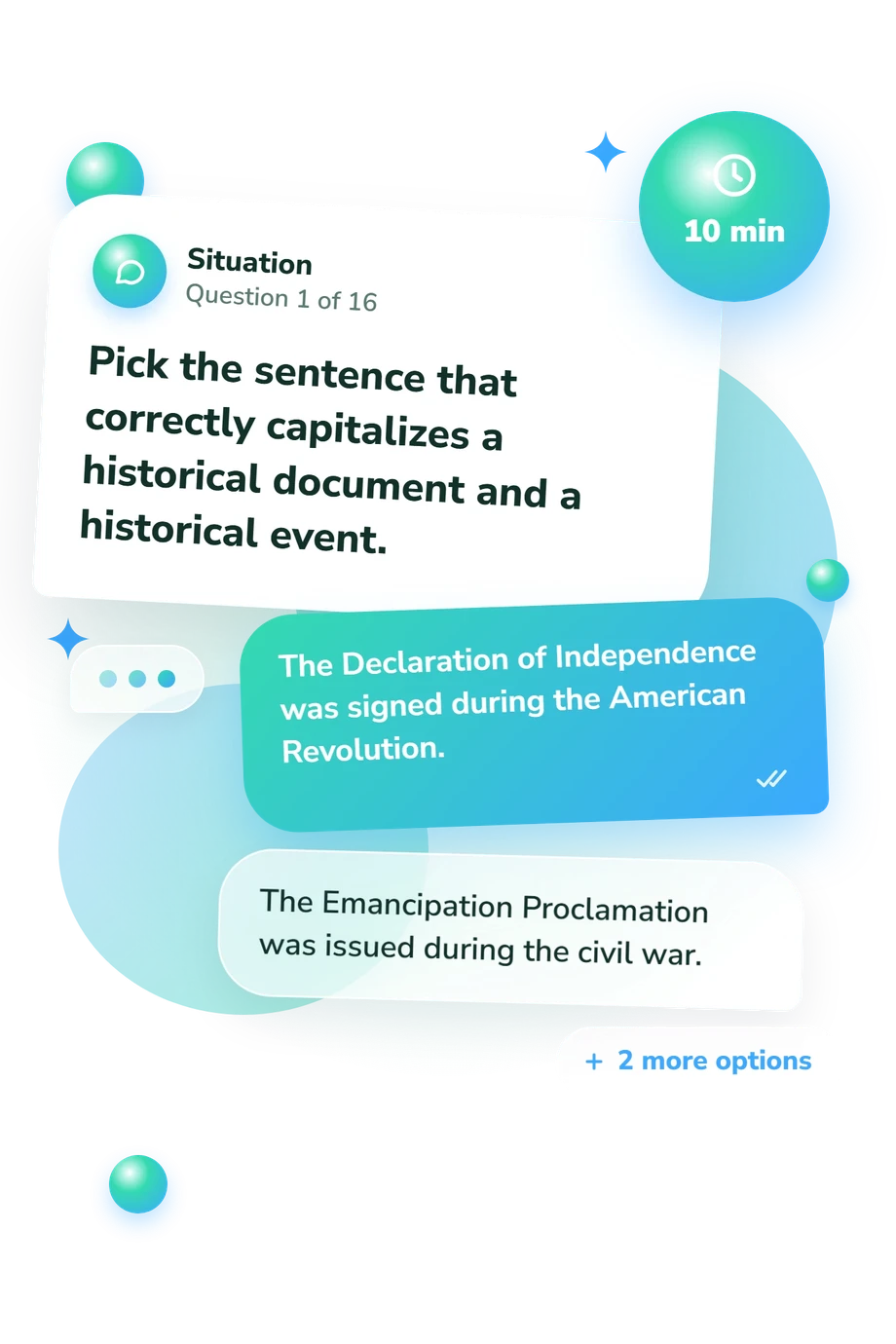
Students can use the result to see whether they distinguish ordinary words from names that require capitals. The questions place rules in context through historical documents and events, titles, courses, family terms, organizations, holidays, geography, dialogue, and languages.
Capitalization Knowledge (0-16) is reported in three bands: Foundations to build (0-6), Developing command (7-12), and Strong command (13-16). These labels describe consistency with middle school conventions, not overall writing ability.
These are the areas a capitalization rules test can highlight:
- Historical names and events show whether formal civic and cultural references are capitalized.
- Titles and family terms reveal whether context changes capitalization in address and dialogue.
- Subjects, languages, and courses show whether general disciplines are separated from official names.
- Places, dates, regions, and landmarks show how consistently geographic and calendar names are handled.
Methodology and Evidence Base
Each item presents a complete sentence with four answer choices. The learner selects the version that follows standard capitalization conventions, so the format tests contextual judgment: a word may stay lowercase as a general subject or become capitalized as a course name, region, title, or proper name.
Responses are judged against the rule represented by each item, and the overall result reflects correct choices. The result offers a practical reading of performance for this questionnaire; it is not presented as a population norm or clinical classification.
This is an educational self-assessment, not a personality measure. Its conventions align with Hacker and Sommers’ handbook and Common Core English Language Arts expectations. Hawkey et al. (2026) offers the closest research context by examining children’s capitalization use and instruction, but this questionnaire is not described as a reproduction or validated adaptation of that study.
Results can direct review toward proper nouns, titles, course names, regions, and other context-dependent expressions. A capitalization practice quiz score remains a snapshot: attention, guessing, familiarity with conventions, and recent writing experience can influence performance. Reviewing missed items and applying the rules in new sentences makes the result more useful for learning.
- Hawkey, Emilia, Annie Carter, Matthew A. Palmer, and Nenagh Kemp. 2026. “That’s Capital! An Intervention Study of Children’s Capitalization Use.” Scientific Studies of Reading 30 (1): 78-94. 10.1080/10888438.2025.2603257
- Hacker, Diana, and Nancy Sommers. 2023. The Bedford Handbook. 12th ed. Boston: Bedford/St. Martin’s.
- National Governors Association Center for Best Practices and Council of Chief State School Officers. 2010. Common Core State Standards for English Language Arts & Literacy in History/Social Studies, Science, and Technical Subjects. Washington, DC: National Governors Association Center for Best Practices and Council of Chief State School Officers.
Updated: