
Algebra 2 Factoring Quiz
How the Scales are Structured
Who Usually Takes This Test?
See How You Compare
Below is a preview of how scores are typically distributed across each scale.
Example Questions From the Test
- (3x + 3)(2x + 1)
- (6x + 1)(x + 3)
- (3x + 1)(2x + 3)
- (6x + 3)(x + 1)
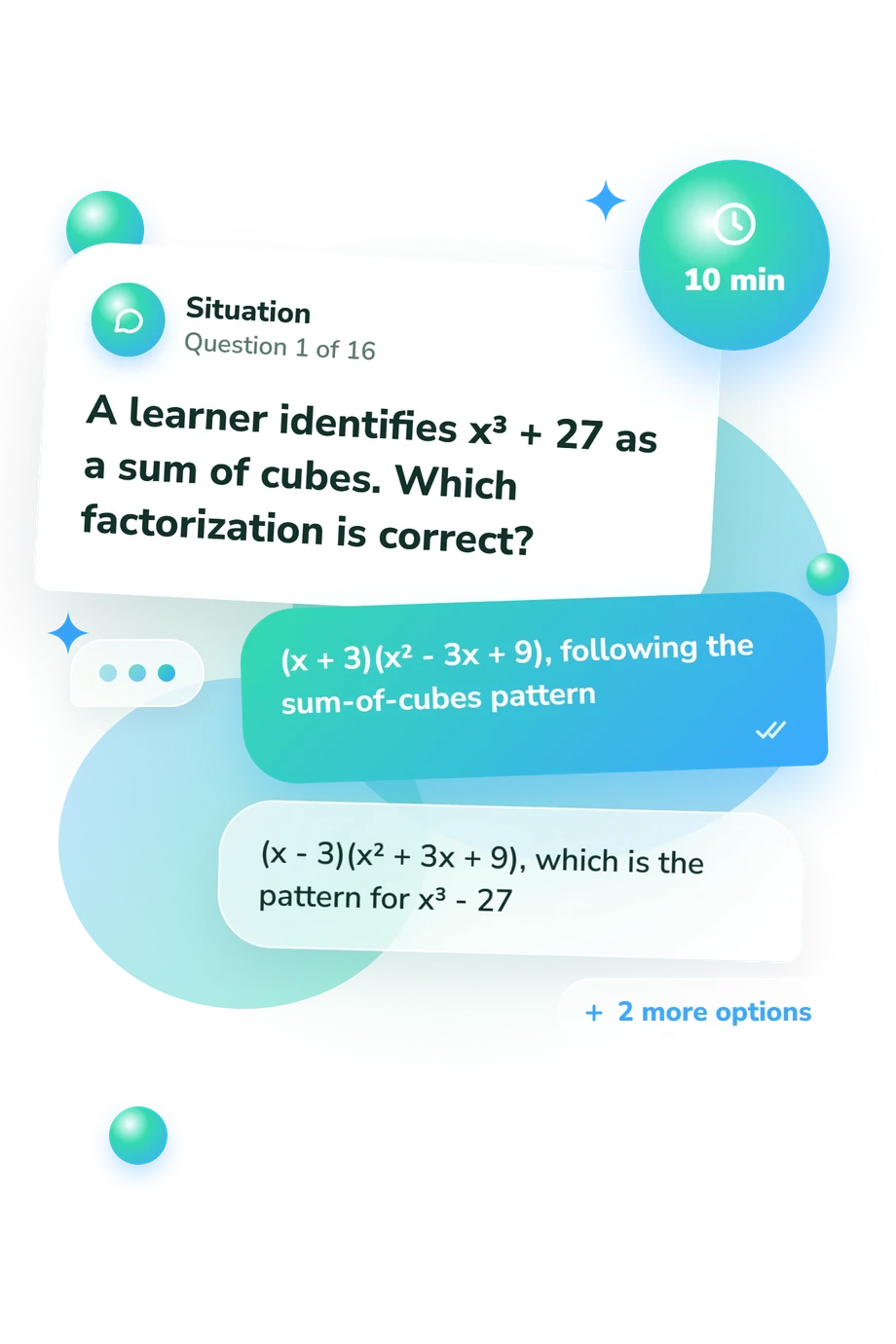
- (x + 2)(x² + 3), whose expansion has different middle terms
- (x + 3)(x² - 2), which gives negative terms after expansion
- x(x + 3)(x + 2), which introduces an extra x² term
- (x + 3)(x² + 2), obtained from x²(x + 3) + 2(x + 3)
- (2x - 9)(2x - 1), which has the wrong middle term
- (4x - 3)(x - 3), which produces a middle coefficient of -15
- (2x - 3)², which matches the pattern a² - 2ab + b²
- (2x + 3)², which produces a positive middle term
Algebra 2 Factoring Quiz - Description and methodology of the test
Students reviewing secondary-school algebra may use the Algebra 2 Factoring Quiz when deciding whether a short skills check fits their current study goal. Learners returning to algebra 2 factoring practice can use it before moving to more advanced quadratic work, after classroom instruction, or when choosing a focused review session. Its compact format supports a concrete study decision for the next stage of study.
What This Assessment Measures
The items examine structure recognition, factor selection, sign control, and complete factorization. Factoring polynomials in algebra 2 includes greatest common factors, trinomials, grouping, perfect-square trinomials, differences of squares, and sums or differences of cubes. Some tasks connect factors with roots, substitution, or dimensions, so the result also reflects method choice.
The catalogue reports Algebra 2 Factoring Knowledge (0-16): Foundational (0-6) signals ideas to review; Developing (7-12) signals growing control with room to improve selection and checking; Strong (13-16) signals consistent application across problems. This unvalidated snapshot is not a course grade or placement result.
The skill groups represented are:
- Pattern recognition shows how readily you identify square, cube, and perfect-square structures.
- Factor selection shows how well you match integer pairs, signs, and shared factors.
- Completion and application show whether you finish the factorization and connect it with roots or dimensions.
Methodology and Scientific Basis
Each item presents an expression, equation, or applied situation with four choices. Correct selection requires preserving the original polynomial while applying a method; distractors represent reversed signs, incomplete factoring, unsuitable pairs, or unchecked expansion. The questionnaire specifies one scale but not how individual answers contribute to it.
The set includes algebra 2 factoring problems that ask learners to select a complete factorization, identify a pattern, or connect factors with roots or dimensions. Those types indicate methods for renewed practice.
The questionnaire uses no standardized factoring instrument. Booth (1984) examines algebraic strategies and errors relevant to factoring expressions, providing context for distractors involving factor choice, signs, and incomplete work. Didis and Erbas (2015) examine quadratic equations, while Yahya and Shahrill (2015) discuss algebra-solving strategies; these sources offer adjacent context, not validation evidence for this questionnaire.
Reviewing your answers can show which sampled problem types were difficult and which methods they represent. Recent practice, notation familiarity, and current problem-solving performance can influence the result, so use difficult item types to choose what to revisit.
- Didis, Makbule Gozde, and Ayhan Kursat Erbas. "Performance and Difficulties of Students in Formulating and Solving Quadratic Equations with One Unknown." Educational Sciences: Theory & Practice, vol. 15, no. 4, 2015, pp. 1137-1150. 10.12738/estp.2015.4.2743.
- Yahya, Noorelawati, and Masitah Shahrill. "The Strategies Used in Solving Algebra by Secondary School Repeating Students." Procedia - Social and Behavioral Sciences, vol. 186, 2015, pp. 1192-1200. 10.1016/j.sbspro.2015.04.168.
- Hu, Qintong, Ji-Won Son, and Lynn Hodge. "Algebra Teachers’ Interpretation and Responses to Student Errors in Solving Quadratic Equations." International Journal of Science and Mathematics Education, vol. 20, no. 3, 2022, pp. 637-657. 10.1007/s10763-021-10166-1.
Updated: