
26 Letters of the Alphabet Quiz
How the Scales are Structured
Who Usually Takes This Test?
See How You Compare
Below is a preview of how scores are typically distributed across each scale.
Example Questions From the Test
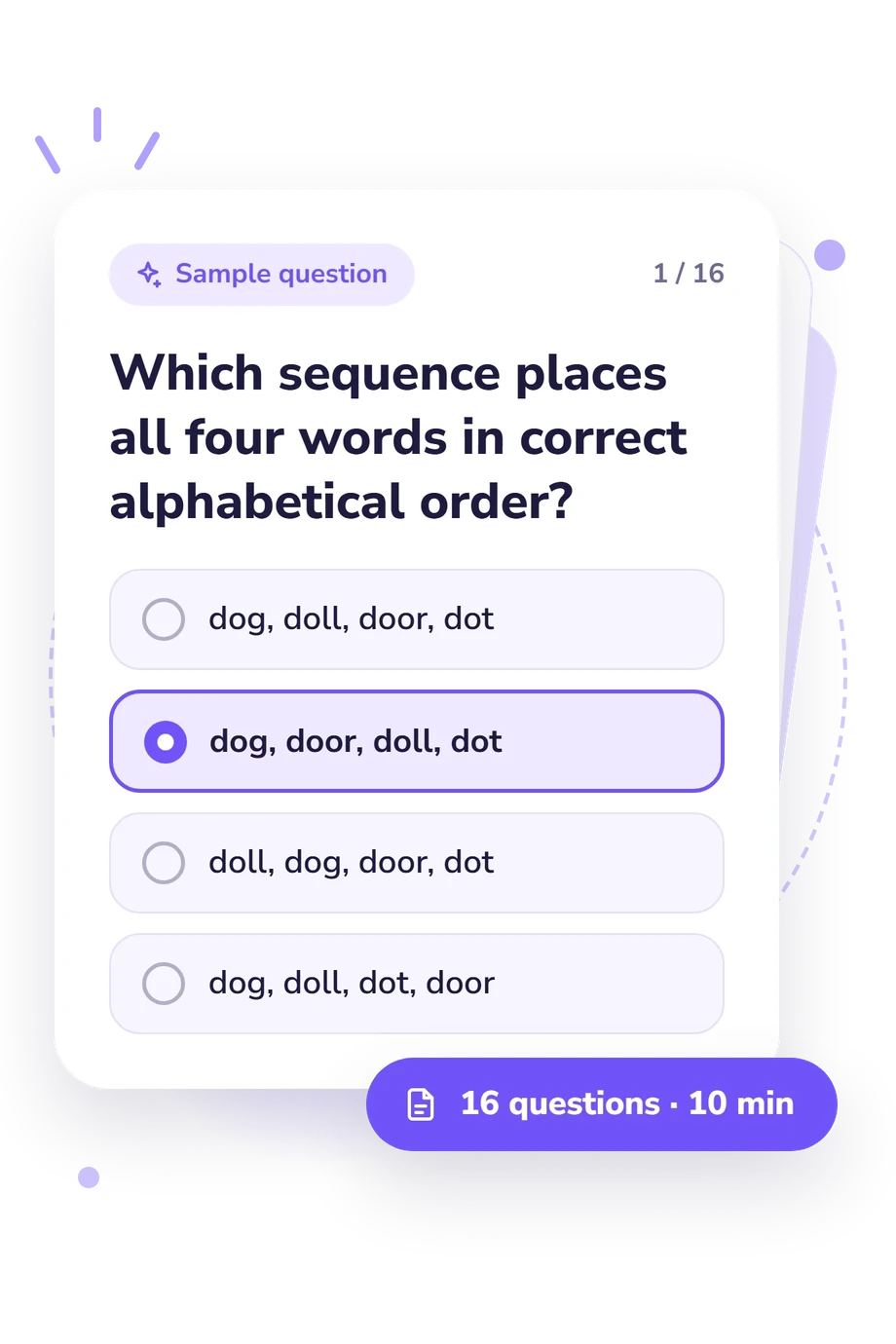
- dog, doll, door, dot
- dog, door, doll, dot
- doll, dog, door, dot
- dog, doll, dot, door
- car
- cap
- can
- cat
- 12th
- 13th
- 15th
- 14th
26 Letters of the Alphabet Quiz - Description and methodology of the test
For learners, parents, educators, and adults refreshing basic literacy skills, this assessment checks how confidently English letters can be recalled, compared, and arranged. The 2 Corinthians Bible Quiz Questions assessment is useful as a focused snapshot of performance on alphabet tasks, not as a measure of biblical knowledge. An English alphabet quiz format can make specific practice needs easier to notice.
What This Assessment Measures
The questions examine practical English-alphabet operations. Respondents identify letter positions, recognize vowels, match uppercase and lowercase forms, compare words at the first differing letter, and preserve order when labels or words are rearranged. An alphabet knowledge test therefore reflects applied conventions, not simple recitation.
This result suits learners, families, tutors, and teachers who want a focused picture of these skills. The dimensions are:
- English Alphabet Knowledge: 0-16 records correct answers; Foundations (0-6) signals a need to review core features, Developing (7-12) reflects solid working knowledge with some gaps, and Strong (13-16) reflects accurate alphabet-order use.
- Alphabetical sorting shows how well words can be compared and sequenced.
- Letter positions and sequences show recall of neighbors, gaps, and individual locations.
- Vowels, letter forms, and codes show application beyond straightforward recall.
It describes task performance, not overall literacy.
Methodology and Evidence Base
Each item uses four-answer selected response. Tasks alternate among direct recall, word comparison, sorting, and one-step letter transformations, so respondents apply order rules rather than repeat a sequence. The total reflects correct answers; no separate weighting or item-level formula is stated.
The structure is conceptually consistent with Quick Letter Name Knowledge Assessment (Tortorelli et al., 2017), but this questionnaire is not presented as an adaptation. Horner and Shaffer (2021) underscore transparent reporting for researcher-developed measures, while Piasta and Wagner (2010) place alphabet learning in a broader instructional context. These sources support conceptual fit, not validation of this online questionnaire.
An alphabet order quiz can guide targeted review, but the bands are catalogue-defined interpretations rather than published norms. No normative sample, standardized conversion, reliability estimate, or validity study is stated for this score. English exposure, classroom conventions, attention, and guessing may affect performance, so the result is a focused snapshot of the included skills.
- Tortorelli, Laura S., Ryan P. Bowles, and Lori E. Skibbe. "Easy as AcHGzrjq: The Quick Letter Name Knowledge Assessment." The Reading Teacher, vol. 71, no. 2, 2017, pp. 145-156. 10.1002/trtr.1608
- Horner, Sherri L., and Sharon A. Shaffer. "Evaluating the Reporting Quality of Researcher-Developed Alphabet Knowledge Measures: How Transparent and Replicable Is It?" Frontiers in Psychology, vol. 12, 2021, article 601849. 10.3389/fpsyg.2021.601849
- Piasta, Shayne B., and Richard K. Wagner. "Developing Early Literacy Skills: A Meta-Analysis of Alphabet Learning and Instruction." Reading Research Quarterly, vol. 45, no. 1, 2010, pp. 8-38. 10.1598/RRQ.45.1.2
Updated: