
Brand Mascots Quiz
How the Scales are Structured
Who Usually Takes This Test?
See How You Compare
Below is a preview of how scores are typically distributed across each scale.
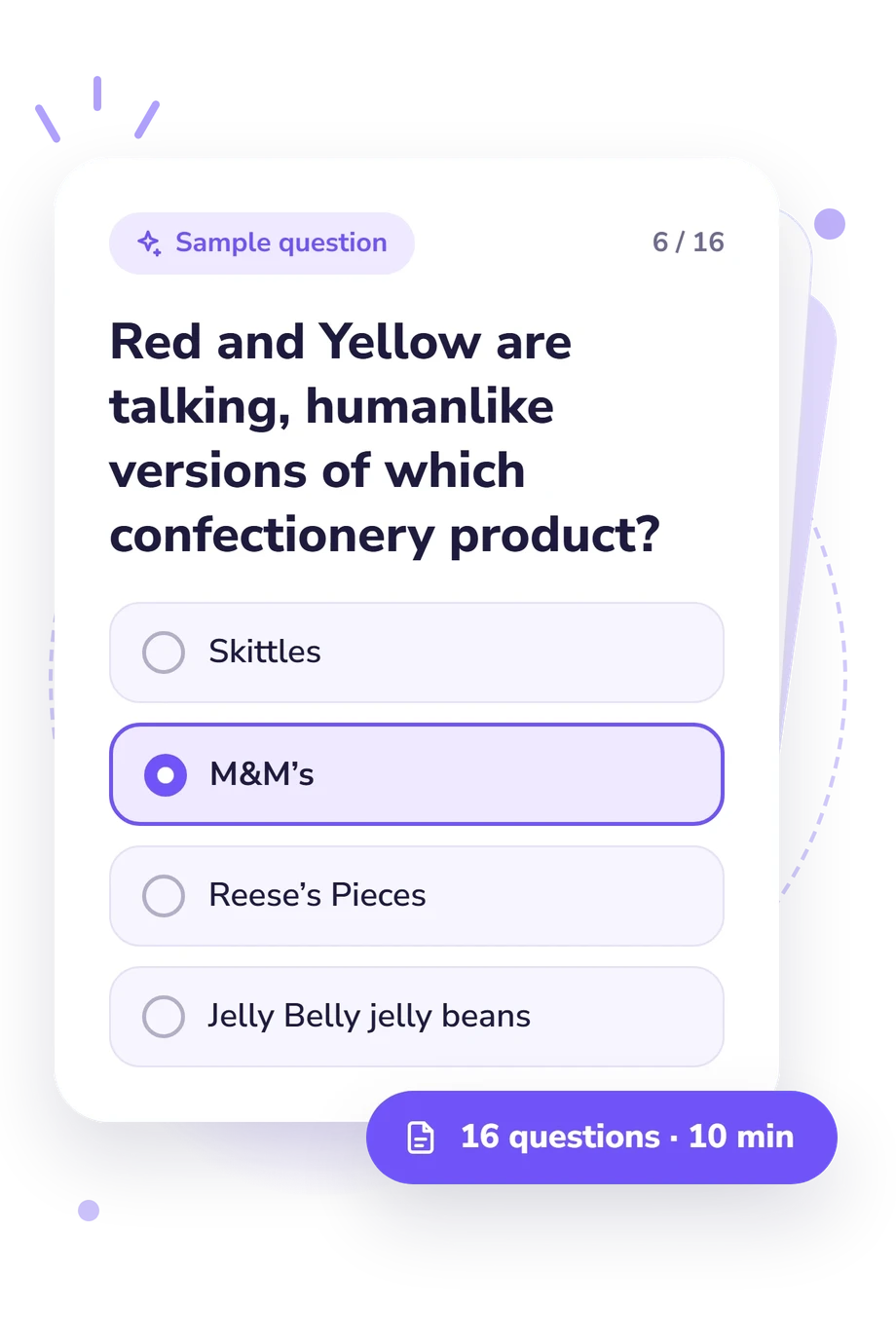
Example Questions From the Test
- Goodyear
- Michelin
- Bridgestone
- Pirelli
- Cinnamon Toast Crunch
- Cheerios
- Corn Flakes
- Rice Krispies
- Chester Cheetah
- Julius Pringles
- Mr. Peanut
- The Keebler Elves
Brand Mascots Quiz - Description and methodology of the test
Readers interested in advertising history, packaging, or everyday visual culture can use this assessment to connect familiar characters with products and companies. This assessment offers a practical snapshot of those associations. The Brand Mascots Quiz focuses on these commercial links. It is distinct from british music quiz questions and answers. The outcome reflects mascot recognition across those connections.
What This Assessment Explores
The questionnaire measures recognition of advertising characters and the brand associations that make them identifiable. Clues span batteries, cereals, snacks, confectionery, insurance, restaurants, and household products. It tests familiarity with advertising mascots, commercial imagery, slogans, products, and companies.
Results indicate how broadly a respondent connects familiar mascots with the brands behind them, not how persuasive or valuable those brands are.
Brand Mascots Knowledge (0-16) is interpreted through these bands:
- Emerging Recognition (0-6) shows recognition of some major advertising characters, while similar product categories may still cause confusion.
- Developing Knowledge (7-12) indicates that many familiar mascots connect correctly with their brands, while less familiar associations remain uneven.
- Strong Knowledge (13-16) reflects broad and accurate recognition of mascots, slogans, character traits, and brand connections.
This is an entertainment-based knowledge result, not an official brand assessment.
Methodology and Evidence Base
Each item uses a short clue about a slogan, product, company, or visual detail, followed by four answer choices. Respondents choose the mascot or company completing the association, so the task uses recognition and categorical matching rather than agreement ratings or open-ended recall. Together, these clues form a brand mascot test focused on commercial characters and brand connections.
The questionnaire reports one overall result through the three named bands; it states no separate item-by-item point rule. The outcome describes this question set, not intelligence, consumer expertise, or brand loyalty.
Garretson and Burton (2005) offer the closest conceptual reference by treating spokescharacters as advertising and package cues. Hosany, Prayag, Martin, and Lee (2013) examine anthropomorphic brand characters; Garretson and Niedrich (2004) link spokes-characters with trust and brand attitudes; Bishop (2015) discusses brand mascots. This questionnaire is conceptually consistent with these works, not an adaptation or validation of any one instrument.
The online questionnaire has no stated norms or standardization. Results can vary with cultural exposure, attention, familiarity, and recall, so the outcome is best read as an entertainment-based snapshot of recognition.
- Garretson, Judith A., and Scot Burton. "The Role of Spokescharacters as Advertisement and Package Cues in Integrated Marketing Communications." Journal of Marketing 69, no. 4 (2005): 118-132. 10.1509/jmkg.2005.69.4.118
- Hosany, Sameer, Girish Prayag, Drew Martin, and Wai-Yee Lee. "Theory and Strategies of Anthropomorphic Brand Characters from Peter Rabbit, Mickey Mouse, and Ronald McDonald, to Hello Kitty." Journal of Marketing Management 29, nos. 1-2 (2013): 48-68. 10.1080/0267257X.2013.764346
- Garretson, Judith A., and Ronald W. Niedrich. "Spokes-Characters: Creating Character Trust and Positive Brand Attitudes." Journal of Advertising 33, no. 2 (2004): 25-36. 10.1080/00913367.2004.10639159
- Bishop, Rebecca. "Brand Mascots." In The Wiley Blackwell Encyclopedia of Consumption and Consumer Studies, edited by Daniel Thomas Cook and J. Michael Ryan (2015). 10.1002/9781118989463.wbeccs029
Updated: