
Boba Quiz
How the Scales are Structured
Who Usually Takes This Test?
See How You Compare
Below is a preview of how scores are typically distributed across each scale.
Example Questions From the Test
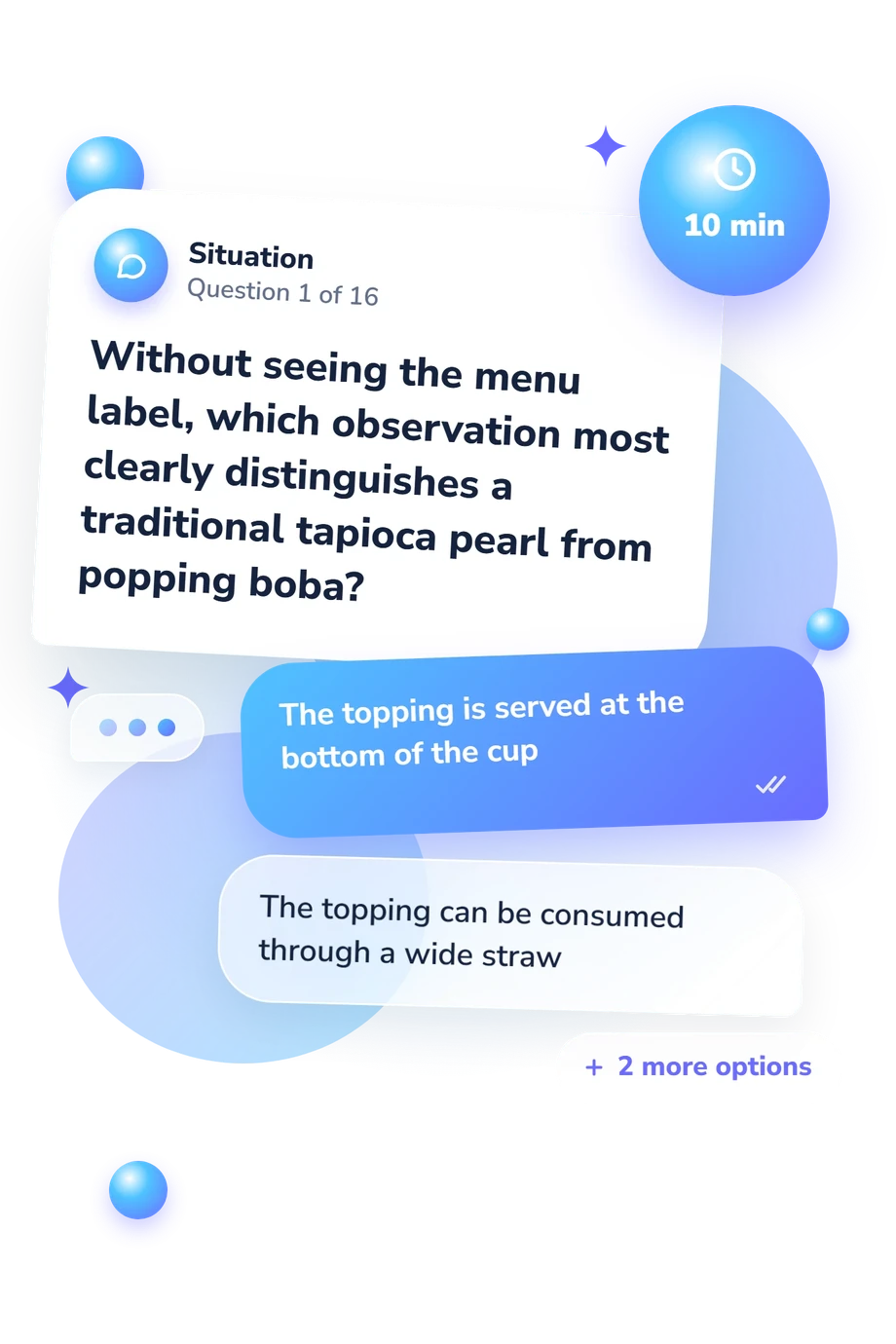
- The topping is served at the bottom of the cup
- The topping can be consumed through a wide straw
- The topping has been added to a cold fruit tea
- It stays chewy when bitten instead of releasing a liquid center
- Nata de coco
- Grass jelly
- Popping boba
- Red bean paste
- It keeps hot tea from cooling too quickly
- It separates milk from the brewed tea
- It allows large toppings such as tapioca pearls to pass through
- It prevents sweetener from settling at the bottom
Boba Quiz - Description and methodology of the test
People curious about bubble tea can use Boba Quiz to check practical knowledge rather than personality traits or preferences. Its material can support a brand logo quiz ppt for a group activity. As a bubble tea knowledge quiz, it offers a concise picture of current understanding and points to areas that may merit review.
What This Assessment Explores
Bubble-tea literacy is the central construct. The items examine toppings, starch and gel textures, sweetness, preparation, regional origins, and ordering choices such as checking ingredients when dairy may be a concern. The result reflects familiarity with boba drinks, not taste preference.
Boba Quiz can support a logo quiz with answers ppt, testing boba ingredients, terms, textures, and preparation mechanisms. Items connect those facts with ordering decisions, including sweetness and ingredient checks. One scale organizes the result:
- Boba Knowledge (0-16) measures recognition of ingredients, terminology, preparation, and ordering considerations. Foundation (0-6) reflects basic recognition with some confusion; Developing (7-12) reflects everyday understanding with details to review; Boba Savvy (13-16) reflects strong knowledge across tested topics.
Higher scores indicate broader command of the content, while lower scores highlight learning gaps. This recreational scale does not assess food safety, allergy risk, or dietary suitability.
Methodology and Evidence Base
Each item presents a short knowledge question or practical scenario with four answer choices. The topics cover identification, cause and effect, origin, terminology, and ordering decisions, so the quiz checks recognition as well as application. The questionnaire reports the result on the displayed 0-16 scale; its interpretation follows the descriptive bands stated above.
The content is conceptually consistent with research on sugar and calorie considerations in boba milk tea, the processing and behavior of tapioca starch pearls, and bubble tea’s Taiwan-centered development and cross-border movement. These studies support the subject areas, but they do not validate this online questionnaire or establish score norms.
The four-choice online format presents bubble tea quiz questions about ingredients and toppings, texture and preparation changes, terminology and origins, and ordering knowledge involving sweetness or dietary concerns. Guessing, prior exposure to shop terminology, regional menu differences, and carefulness when reading can affect the result, which is best treated as a snapshot of current knowledge.
- Min, Jae Eun, David B. Green, and Loan Kim. (2017). Calories and sugars in boba milk tea: implications for obesity risk in Asian Pacific Islanders. Food Science & Nutrition, 5(1), 38-45. 10.1002/fsn3.362
- Fu, Yi-Chung, Li Dai, and Binghuei B. Yang. (2005). Microwave finish drying of (tapioca) starch pearls. International Journal of Food Science and Technology, 40(2), 119-132. 10.1111/j.1365-2621.2004.00898.x
- Hung, Po-Yi. (2022). Food nationalism beyond tradition: Bubble tea and the politics of cross-border mobility between Taiwan and Vietnam. Asian Journal of Social Science, 50(3), 222-228. 10.1016/j.ajss.2022.08.008
Updated: