
Are You a Gentleman Quiz
How the Scales are Structured
Who Usually Takes This Test?
See How You Compare
Below is a preview of how scores are typically distributed across each scale.
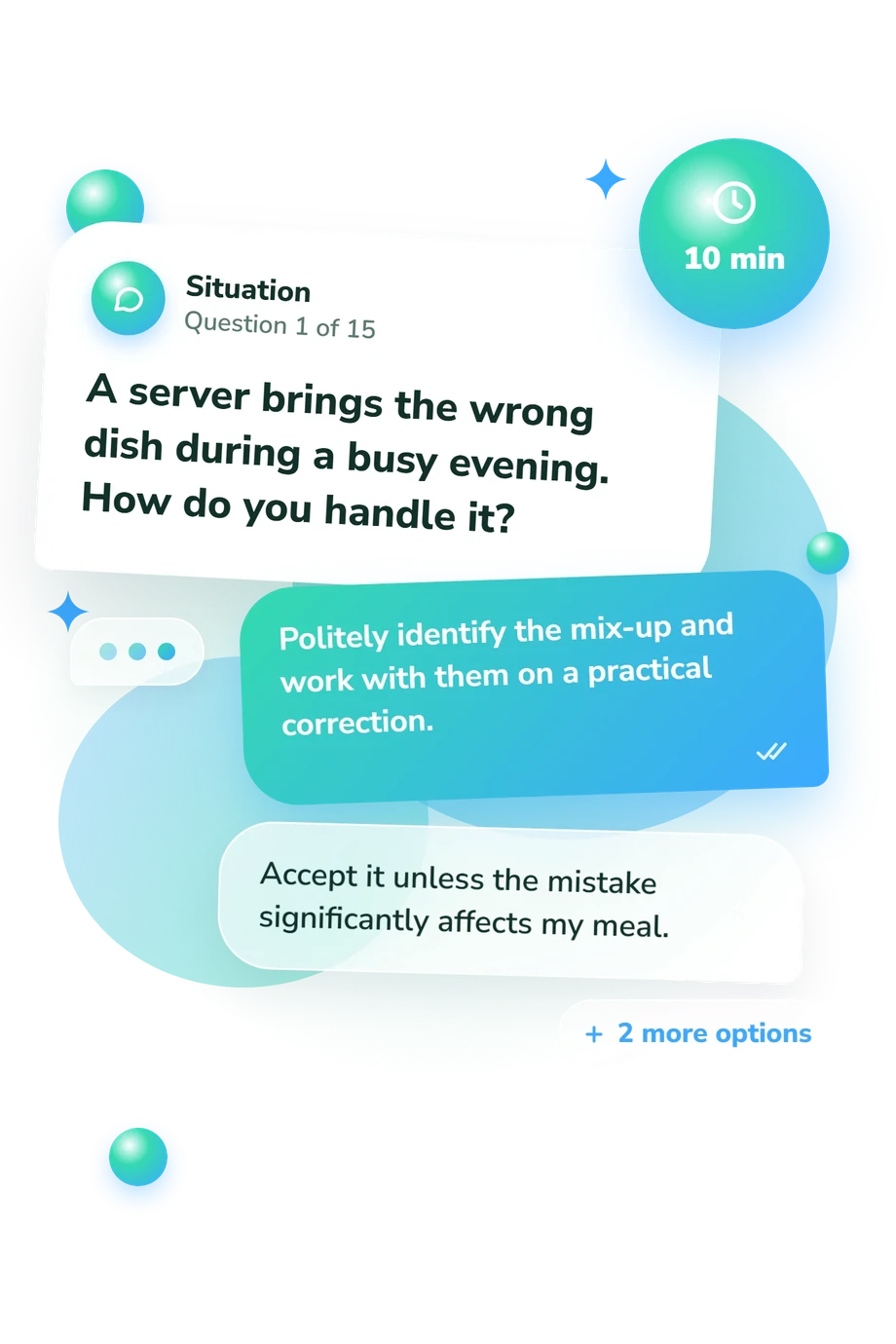
Example Questions From the Test
- Politely identify the mix-up and work with them on a practical correction.
- Accept it unless the mistake significantly affects my meal.
- State exactly what was ordered and expect it to be replaced promptly.
- Mention the error calmly while recognizing that the restaurant is under pressure.
- Say nothing because correcting the system is the retailer’s responsibility.
- Point out the discrepancy and let the staff decide how to handle it.
- Mention it if the amount is significant or the correction would be simple.
- Review the receipt first, then raise it if I am confident an error occurred.
- Eat what I comfortably can and express appreciation for the host’s effort.
- Quietly leave most of it and compliment another part of the occasion.
- Explain my preferences honestly if the host notices I am not eating.
- Ask whether there is a simple alternative available.
Are You a Gentleman Quiz - Description and methodology of the test
Readers examining their conduct during difficult interactions can use the Are You a Gentleman Quiz to consider how they respond when expectations, feelings, or social pressure collide. This assessment of gentlemanly conduct supports a reflective look at personal choices, especially moments when intention and impact may differ. It helps respondents connect individual situations with broader patterns in their own social conduct.
What This Assessment Explores
These situations make respectful behavior visible in choices about errors, credit, refusals, apologies, and tense plans. The result has three dimensions:
- Integrity and Accountability (0-15) reflects honesty, reliability, and responsibility; Context-dependent follow-through (0-5), Developing consistency (6-10), and Grounded integrity (11-15) are the result bands.
- Respect and Boundaries (0-15) reflects autonomy, consent, perspectives, and limits; Situational respect (0-5), Growing awareness (6-10), and Consistent regard (11-15) are the result bands.
- Social Consideration and Composure (0-15) reflects awareness of other people’s comfort, inclusion, tact, and steadiness under awkward or stressful social conditions; Personal-style led (0-5), Adaptable presence (6-10), and Thoughtful composure (11-15) are the result bands.
Together, these dimensions describe response patterns rather than fixed character, charm, class, or formal etiquette. They show where social habits appear steady and where reflection may help.
Methodology and Scientific Basis
Each scenario presents an interpersonal dilemma with four response choices that vary in directness, accountability, boundary awareness, or composure during tension. The item groups move from honesty and repair to consent, inclusion, and social pressure. These are situational self-report prompts rather than adjectives. Responses are organized into three dimensions, and the result displays three profile scores with the descriptive bands for each dimension; the labels summarize response patterns rather than fixed traits.
The evidence base is conceptual, not a claim that this online test reproduces an instrument. Its closest reference is the Gentleness Questionnaire, which defines gentleness as a positive, humanity-oriented tendency involving softness, support, and a constructive experience for others. These scenarios are conceptually consistent with that work, not an adaptation of it.
Integrity-related content also connects with Honesty-Humility in HEXACO. Lee and colleagues examined that factor in relation to integrity outcomes, while Lee and Ashton established the inventory’s psychometric foundation. As a social conduct assessment, this tool can organize a thoughtful profile, but mood, relationships, self-awareness, and response bias may shape the result; behavior remains relevant.
- Niemiec, Ryan M., Alyssa Cangemi, and Robert E. McGrath. (2024). A new science of gentleness: conceptual analysis and measurement. The Journal of Positive Psychology, 19(4), 712-723. 10.1080/17439760.2023.2257647
- Lee, Kibeom, Michael C. Ashton, David L. Morrison, John Cordery, and Patrick D. Dunlop. (2008). Predicting integrity with the HEXACO personality model: Use of self- and observer reports. Journal of Occupational and Organizational Psychology, 81(1), 147-167. 10.1348/096317907X195175
- Lee, Kibeom, and Michael C. Ashton. (2004). Psychometric properties of the HEXACO personality inventory. Multivariate Behavioral Research, 39(2), 329-358. 10.1207/S15327906MBR3902_8
Updated: