
Are You a Criminal Quiz
How the Scales are Structured
Who Usually Takes This Test?
See How You Compare
Below is a preview of how scores are typically distributed across each scale.
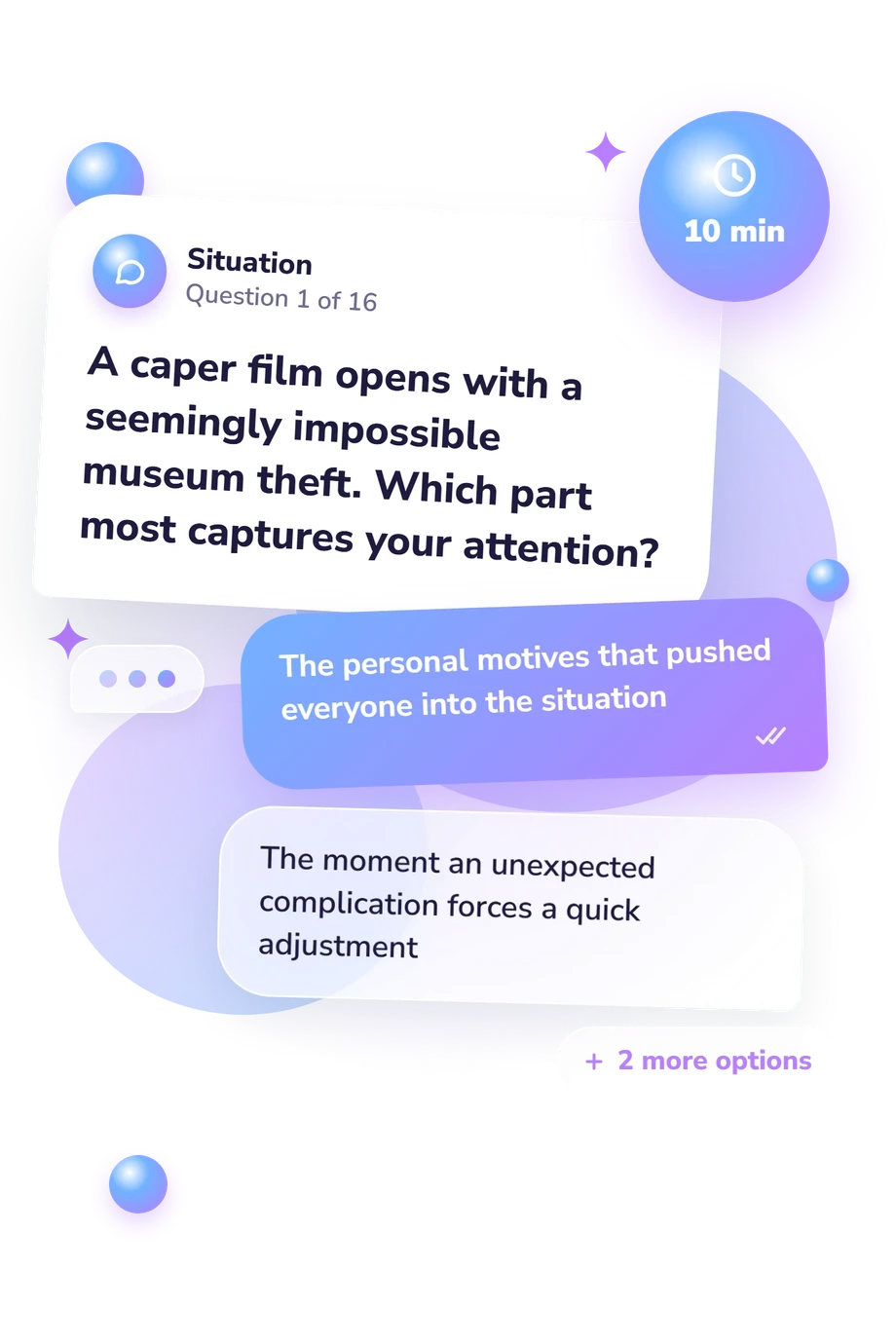
Example Questions From the Test
- The personal motives that pushed everyone into the situation
- The moment an unexpected complication forces a quick adjustment
- The crew members learning whether they can trust one another
- The reveal showing how every earlier detail fitted the plan
- The specialist responsible for one important piece
- The newcomer who brings unpredictable energy
- The coordinator who sees how every piece connects
- The lookout who keeps everyone aware of changing conditions
- Keeping the mood lively when the mission starts going wrong
- Working out the order in which every objective should be handled
- Choosing a bold move and accepting whatever follows
- Tracking resources and pointing out gaps in the current plan
Are You a Criminal Quiz - Description and methodology of the test
For readers who enjoy testing their reactions to fictional lawbreakers, the Are You a Criminal Quiz offers a playful way to identify the caper dynamics that hold their attention. It suits anyone curious about story preferences and how planning, escape, rebellion, or persuasion shape engagement with a narrative. The fictional crime quiz format gives those preferences a clear profile to reflect on.
What This Assessment Explores
The questionnaire examines four attractions in caper fiction: planning, escape, rebellion, and deception. Its scenarios address motives, crew roles, choices, reversals, and dramatic payoffs. Taken together, the items make this crime fiction quiz a profile of fictional narrative preference, not a measure of real-world character or conduct.
The four displayed dimensions are:
- Meticulous Heist (0-12) measures appeal of precise planning: Behind the Scenes (0-4), Crew Strategist (5-8), or Heist Architect (9-12).
- Outlaw Getaway (0-12) measures enjoyment of mobility and escape: Grounded Operator (0-4), Escape Adventurer (5-8), or Outlaw Getaway (9-12).
- Rebel Sabotage (0-12) measures attraction to challenging powerful systems: System Skeptic (0-4), Rule Disruptor (5-8), or Rebel Saboteur (9-12).
- Silver-Tongued Con (0-12) measures enjoyment of persuasion and invented identities: Straight Shooter (0-4), Persuasive Player (5-8), or Silver-Tongued Con (9-12).
The highest total marks the strongest affinity; totals within one point form a blend.
Methodology and Scientific Basis
Each item presents a fictional situation with four answer choices. Motives, roles, decisions, and dramatic payoffs vary, so respondents choose the story energy they find most engaging. This forced-choice self-report format asks for a comparative narrative preference.
Responses produce four totals. The highest identifies the leading affinity, while totals within one point create a blend. The visible bands are descriptive entertainment categories that give each numerical range a story-oriented label.
The crime-story quiz format groups fictional narrative preferences into four themes and is conceptually consistent with Black and colleagues’ study, which links enjoyment of dark fictional characters with morality, Machiavellianism, and imaginative resistance. Oliver and Armstrong’s findings support attention to crime-entertainment engagement, while Hoorn and Konijn’s findings explain fictional-character experience. These studies provide adjacent conceptual context; they do not establish or validate the four original scales, and this questionnaire is not their adaptation.
Current mood, familiarity with caper stories, and willingness to imagine roles can shape answers, so the result is most useful when read alongside the particular scenarios and choices that prompted it.
- Black, Jessica E., Yomna Helmy, Olivia Robson, and Jennifer L. Barnes. "Who Can Resist a Villain? Morality, Machiavellianism, Imaginative Resistance and Liking for Dark Fictional Characters." Poetics 74 (2019): 1-13. 10.1016/j.poetic.2018.12.005
- Oliver, Mary Beth, and G. Blake Armstrong. "Predictors of Viewing and Enjoyment of Reality-Based and Fictional Crime Shows." Journalism & Mass Communication Quarterly 72, no. 3 (1995): 559-570. 10.1177/107769909507200307
- Hoorn, Johan F., and E. A. Konijn. "Perceiving and Experiencing Fictional Characters: An Integrative Account." Japanese Psychological Research 45, no. 4 (2003): 250-268. 10.1111/1468-5884.00225
Updated: