
Am I the Antichrist Quiz
How the Scales are Structured
Who Usually Takes This Test?
See How You Compare
Below is a preview of how scores are typically distributed across each scale.
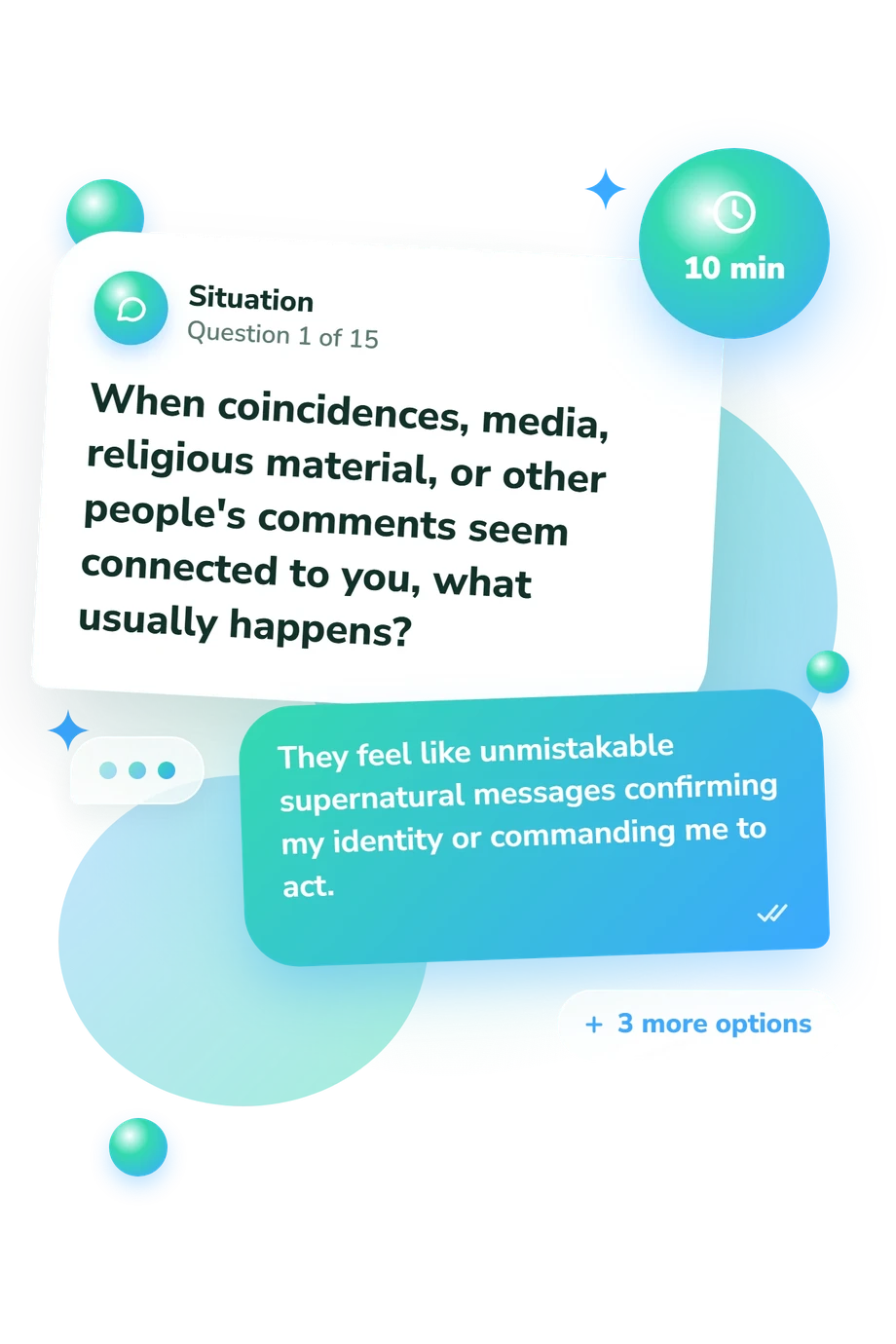
Example Questions From the Test
- I would avoid them because I feared I might expose, endanger, or be targeted by others.
- I might feel distracted but would probably participate as usual.
- I would likely withdraw because interpreting the thought felt more urgent.
- The concern would not affect my decision.
- It has regularly kept me awake, caused major sleep loss, or made me afraid to sleep.
- It has not affected my sleep.
- It has delayed sleep or disturbed a night once or twice.
- It has disrupted several nights or led me to change my sleep routine.
- I have had urges that worried me enough to need distance from possible means or from another person.
- I have not had thoughts of harming myself or anyone else in connection with it.
- I have formed a plan, taken steps toward harm, injured someone, or injured myself.
- An unwanted image or thought has occurred, but I have no wish or intention to act on it.
Am I the Antichrist Quiz - Description and methodology of the test
People troubled by a fear or belief that they may be the Antichrist can use the Am I the Antichrist Quiz to organize what is happening and decide what support feels appropriate. The person experiencing the concern should answer the questions; a trusted supporter can help them understand the result or act on safety concerns. Its antichrist quiz format organizes reflection on conviction, distress, and safety, clarifying which experiences deserve closer attention.
What This Assessment Explores
It examines conviction, interpretation of coincidences or messages, and the effect of the concern on sleep, concentration, relationships, responsibilities, and decision-making. Items also address checking for confirmation, withdrawal, confrontation, commands, harmful urges, and access to grounded support. Results describe answer patterns, not supernatural truth.
Three displayed dimensions structure this Antichrist belief assessment:
- Belief Conviction and Interpretation (0-15) reflects certainty, personally directed meaning, commands, and difficulty considering alternatives; bands are No items endorsed (0), Worth discussing (1-2), and Prompt support advised (3-15).
- Distress and Daily Impact (0-15) reflects fear, sleep disruption, withdrawal, and impaired responsibilities; bands are No disruption (0), Noticeable strain (1-2), and Prompt support advised (3-15).
- Urgent Safety and Support (0-15) reflects loss of control, dangerous action, harmful urges, or blocked access to help; bands are No indicators (0), Support recommended (1-2), and Urgent action advised (3-15).
Methodology and Evidence Base
Each item uses a situation or statement with four response options. The options cover no endorsement or an ordinary explanation through stronger conviction, disruption, compulsion, or danger. They distinguish the content of the fear from its emotional, behavioral, functional, and safety effects. The displayed scores are unvalidated reflective summaries, not evidence of supernatural identity, a diagnosis, or clinical severity; they summarize reported patterns and should be read as prompts for reflection rather than clinical cutoffs.
Conceptually, the content is consistent with Iyassu et al. (2014), which examined psychological characteristics associated with religious delusions. Themes overlap conceptually with the PDI's unusual-belief ideation, the PSYRATS' dimensions of psychotic experiences, and the GPTS' persecutory and social-reference thinking. This online Antichrist questionnaire is not a standardized administration or adaptation of those instruments; they provide contextual comparison only, not validation or provenance for these items.
Self-report can be influenced by stress, sleep, shame, religious exposure, self-awareness, and willingness to disclose. Read each band alongside the answers because a single score-3 red-flag response overrides the total. If anyone may be harmed or you cannot remain in control, contact local emergency or crisis services now.
- Iyassu R, Jolley S, Bebbington P, Dunn G, Emsley R, Freeman D, Fowler D, Hardy A, Waller H, Kuipers E, Garety P. Psychological characteristics of religious delusions. Social Psychiatry and Psychiatric Epidemiology. 2014;49(7):1051-1061. 10.1007/s00127-013-0811-y
- Peters E, Joseph S, Day S, Garety P. Measuring delusional ideation: the 21-item Peters et al. Delusions Inventory (PDI). Schizophrenia Bulletin. 2004;30(4):1005-1022. 10.1093/oxfordjournals.schbul.a007116
- Haddock G, McCarron J, Tarrier N, Faragher EB. Scales to measure dimensions of hallucinations and delusions: the psychotic symptom rating scales (PSYRATS). Psychological Medicine. 1999;29(4):879-889. 10.1017/S0033291799008661
- Green CEL, Freeman D, Kuipers E, Bebbington P, Fowler D, Dunn G, Garety PA. Measuring ideas of persecution and social reference: the Green et al. Paranoid Thought Scales (GPTS). Psychological Medicine. 2008;38(1):101-111. 10.1017/S0033291707001638
Updated: