
Boat Licence Quiz
How the Scales are Structured
Who Usually Takes This Test?
See How You Compare
Below is a preview of how scores are typically distributed across each scale.
Example Questions From the Test
- It improves confidence without affecting reaction time
- It can impair judgment, balance, vision, and reaction time, with boating conditions adding strain
- It affects passengers but not an experienced operator
- Its effects are canceled by fresh air and engine noise
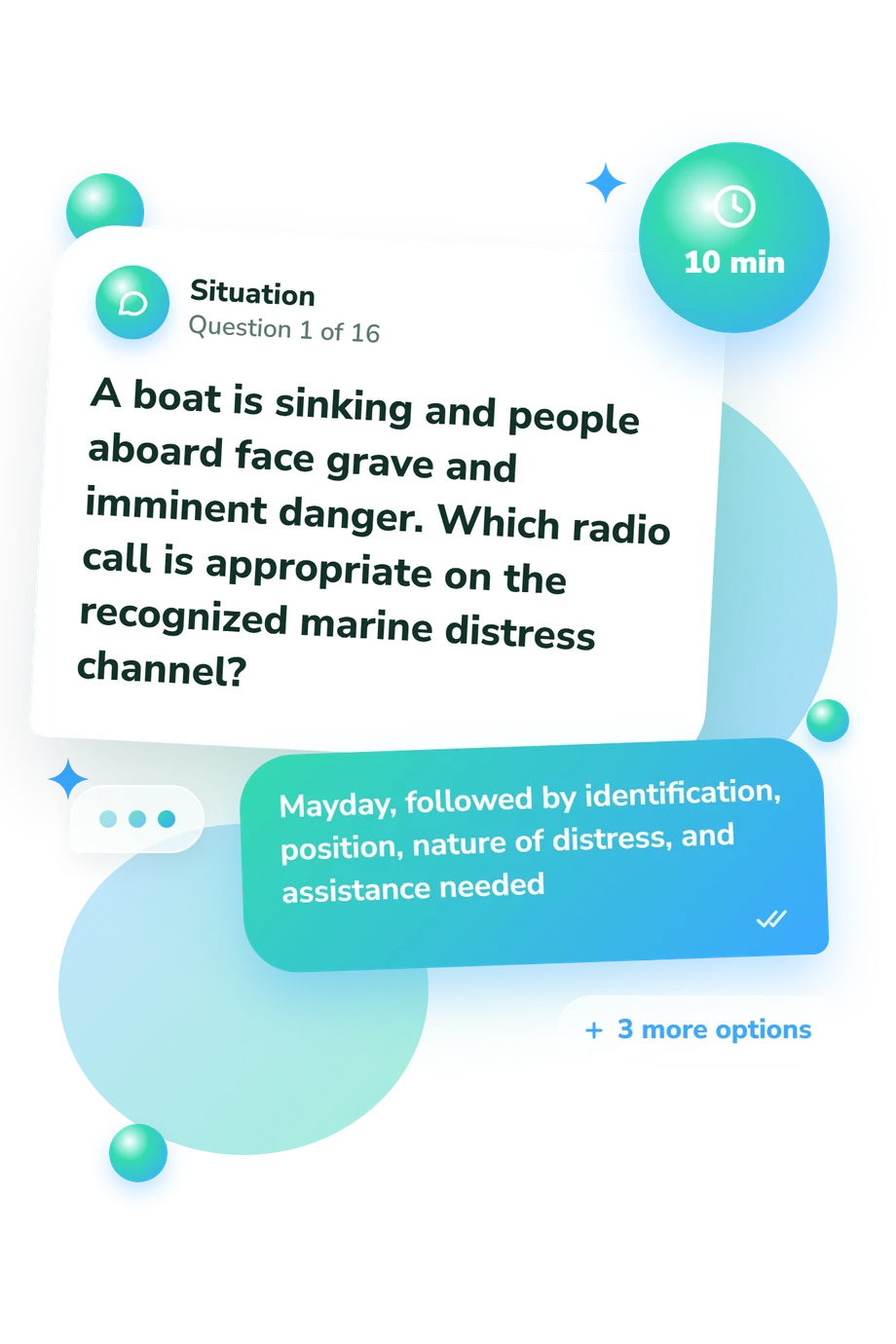
- Mayday, followed by identification, position, nature of distress, and assistance needed
- Pan-Pan, because all equipment failures use the same urgency call
- Sécurité, used for routine docking arrangements
- A general conversation request without stating the emergency
- Use any adult life jacket if the passenger can hold it closed
- Choose it mainly by color so the passenger can be identified easily
- Check that it is comfortable when worn loosely over one shoulder
- Confirm it is approved for the activity, fits securely, and is appropriate for the passenger's size
Boat Licence Quiz - Description and methodology of the test
Before enrolling in a boating course or planning time on the water, a learner can use this boating safety quiz to decide whether core safety principles need another review. This book of daniel quiz presents practical situations that require judgment rather than simple recall, making it useful when you want to gauge readiness for further study or a recreational outing. The result can help set a sensible starting point for preparation.
What This Assessment Explores
Safe operation depends on recognizing hazards and choosing timely actions, not simply memorizing terminology. Questions cover impairment, distress calls, life jackets, carbon-monoxide response, capacity, man-overboard recovery, collision avoidance, cold-water survival, weather, fueling, navigation lights, lookout duties, and float plans. Together, these topics make this a useful boat licence practice test for someone building practical boating awareness.
The displayed result uses Boat Licence Knowledge (0-16), divided into three bands:
- Foundations to review (0-6) shows that core navigation, preparation, or emergency topics need review before operation.
- Developing knowledge (7-12) indicates that many essentials are understood, while gaps remain for an approved local course.
- Strong foundation (13-16) reflects broad command of the covered principles, but it is not proof of licensing competence across jurisdictions.
That result points to review priorities rather than predicting performance in every vessel, waterway, or emergency.
Methodology and Evidence Base
Each scenario offers four alternatives and asks which action is safest, most appropriate, or required. As a boating knowledge test, the format separates sound procedures from plausible but hazardous choices involving right-of-way, distress calls, equipment, weather, and emergencies. The displayed level directs review toward knowledge gaps rather than establishing licensing competence.
Methodologically, the content is conceptually consistent with Reichle's recreational boating safety knowledge test, the closest named precedent for this subject; it is not presented as an adaptation. A 2010 retention study associated with that work examined what learners remembered after boating education, while ANSI/NASBLA 103-2022 provides a framework for basic powerboating knowledge. These sources offer context for the subject matter, but neither validates the online assessment.
This online assessment is a structured self-check, not a standardized administration with published norms for this exact version. Honest responses and current circumstances affect performance, while jurisdiction-specific rules require confirmation from the relevant boating authority.
- Reichle, Marvin Noel. (1980). Development of an instrument to measure knowledge in recreational boating safety. Journal of Safety Research, 12(4), 157-162.
- Deatz, Richard C., Gossman, James R., and Trippe, D. Matthew. (2010). Assessing the Efficacy of Boating Education Courses: Retention Study. National Association of State Boating Law Administrators and Human Resources Research Organization.
- National Association of State Boating Law Administrators. (2022). ANSI/NASBLA 103-2022: Basic Boating Knowledge - Plus Power. Lexington, KY: National Association of State Boating Law Administrators.
- Gabe, Todd M., and Hite, Diane. (2003). The Effects of Boating Safety Regulations. Coastal Management, 31(3), 247-254. 10.1080/08920750390198487
Updated: