
Camp Half-Blood or Camp Jupiter Quiz
How the Scales are Structured
Who Usually Takes This Test?
See How You Compare
Below is a preview of how scores are typically distributed across each scale.
Example Questions From the Test
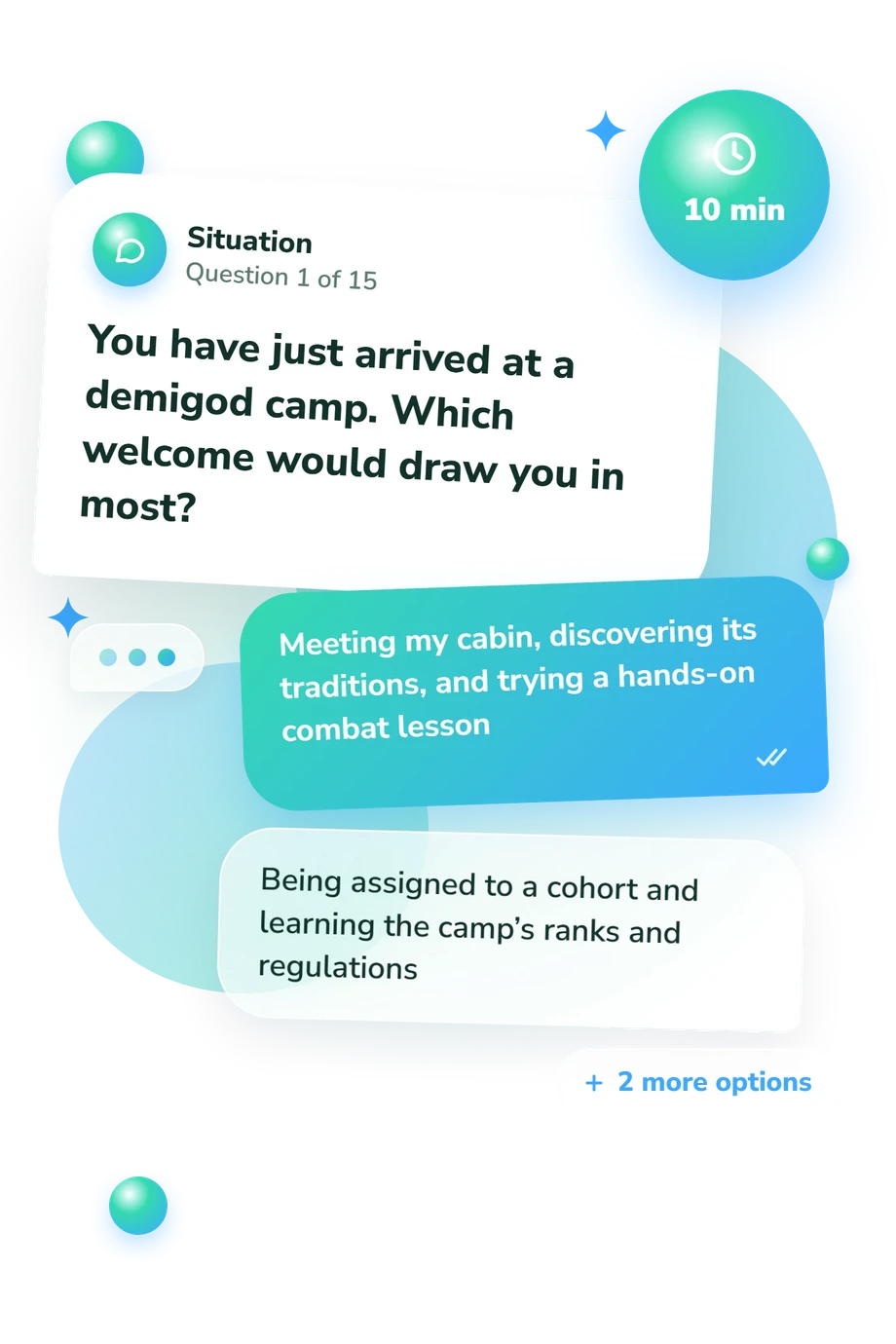
- Meeting my cabin, discovering its traditions, and trying a hands-on combat lesson
- Being assigned to a cohort and learning the camp’s ranks and regulations
- Taking a guided tour before deciding which community feels natural
- Joining a casual activity where individual talents shape the team
- Master the version tied to my preferred camp and leave the other aside
- Study my preferred version closely and use the other as background context
- Present both accounts side by side without trying to combine them
- Compare their differences and look for a fuller interpretation that respects both
- Cohort drills, legion standards, and ceremonies honoring shared service
- Informal campfires where campers creatively reshape old myths
- A reliable training structure that still leaves room for personal methods
- Joint events designed equally around Greek and Roman customs
Camp Half-Blood or Camp Jupiter Quiz - Description and methodology of the test
Designed for fans who enjoy personality-style fandom questions, this assessment turns the Greek-Roman divide into a reflection on belonging, leadership, and cooperation. The capital cities quiz and answers framing may sound geographic, but the result actually explores fictional camp affiliation rather than factual recall. Readers encountering a countries and capitals quiz with answers label should expect a preference profile instead: a playful interpretation of how independence, structure, and cultural translation fit their outlook.
What This Assessment Explores
Scenarios about training, responsibility, myth, home, and joint missions separate cabin-based independence, Roman civic structure, and cooperation between traditions. Here, the capital city quiz wording is secondary; the meaningful result concerns imagined social choices.
The three displayed outcomes are:
- Camp Half-Blood Affinity, 0-15, measures preference for cabin identity and improvisation: Distant from the Cabins (0-5), Cabin-Curious (6-10), or Strong Half-Blood Affinity (11-15).
- Camp Jupiter Affinity, 0-15, measures preference for structured service and shared duty: Outside the Legion (0-5), Cohort-Curious (6-10), or Strong Jupiter Affinity (11-15).
- Greek-Roman Bridge Affinity, 0-15, measures attraction to translating perspectives: Single-Tradition Focus (0-5), Camp Connector (6-10), or Strong Bridge Affinity (11-15).
Together, the outcomes show whether your imagined belonging leans toward one camp, the other, or deliberate connection.
Methodology and Evidence Base
Each prompt offers four response choices, asking you to select the welcome, responsibility, planning style, home, or team arrangement that best matches your instinct. The format is structured self-report: it organizes imagined preferences rather than testing mythology knowledge or factual recall.
Responses are compared across three outcome scores. The highest is your strongest affinity; when two or more outcomes are within one point of the highest, interpret them together as a blended result, with no tie-breaker. The displayed bands are interpretive categories, not population norms or clinical cutoffs.
The fictional framework is anchored in the Greek-Roman camp world presented in Son of Neptune (Riordan, 2011) and continued in Riordan’s 2012 narrative. The questionnaire is conceptually consistent with those distinctions, but it is not an adaptation of either novel. Its fan-oriented self-report approach can be read alongside Vinney and colleagues’ 2019 measure of popular-media fan identity, which did not validate this quiz.
Because answers depend on imagined situations, mood, current interests, and self-awareness can influence the profile. Read the result as a snapshot of preference rather than a fixed identity; the world capitals quiz result should be understood through the camp-affinity interpretation.
- Riordan, Rick. The Son of Neptune. Disney-Hyperion Books, 2011.
- Riordan, Rick. The Mark of Athena. Disney-Hyperion Books, 2012.
- Vinney, Cynthia, Karen E. Dill-Shackleford, Courtney N. Plante, and Anne Bartsch. “Development and Validation of a Measure of Popular Media Fan Identity and Its Relationship to Well-Being.” Psychology of Popular Media Culture, vol. 8, no. 3, 2019, pp. 296-307. 10.1037/ppm0000188
Updated: