
1000 Quiz
How the Scales are Structured
Who Usually Takes This Test?
See How You Compare
Below is a preview of how scores are typically distributed across each scale.
Example Questions From the Test
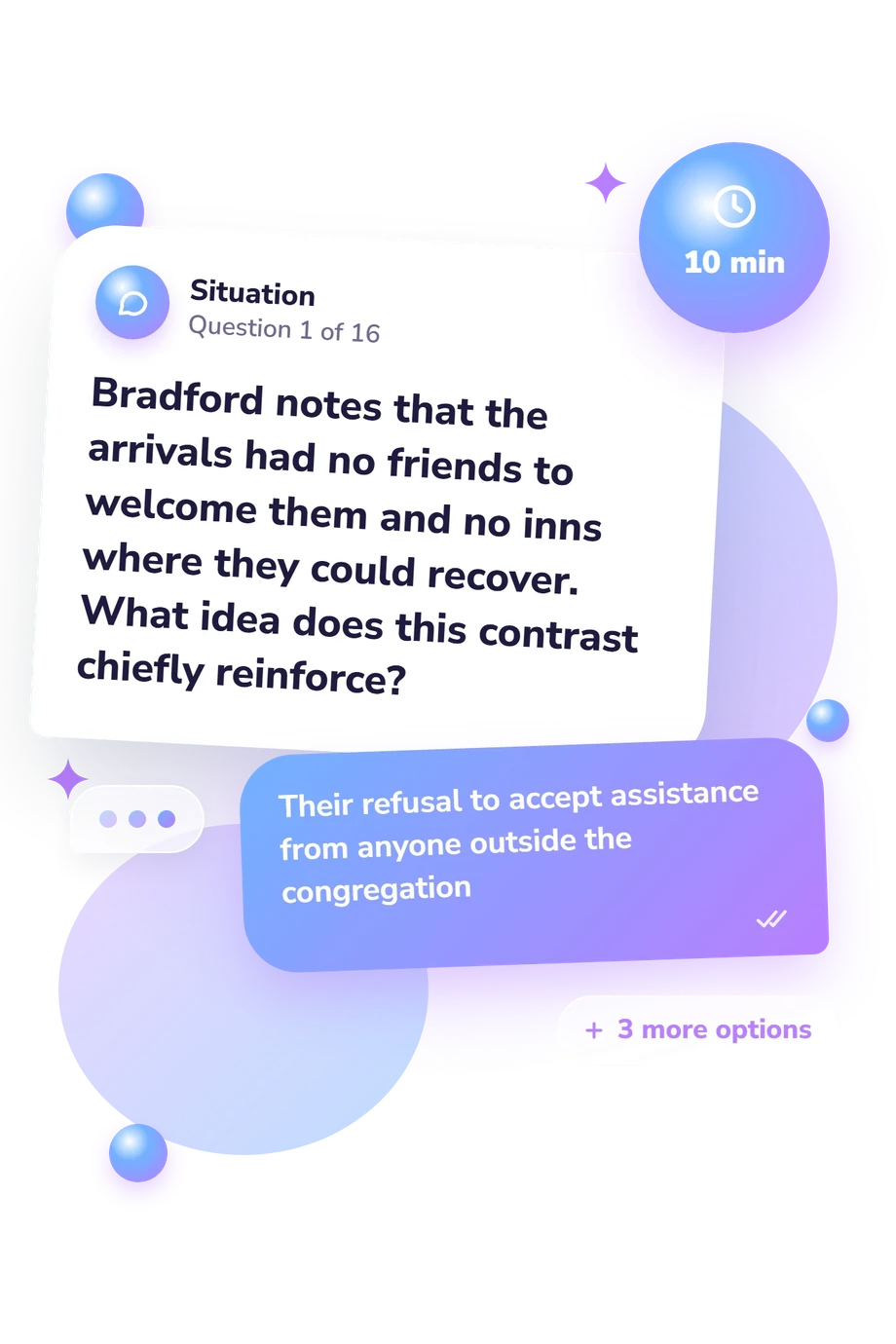
- Their refusal to accept assistance from anyone outside the congregation
- Their isolation and lack of an established support system
- Their plan to earn money by opening inns of their own
- Their surprise that English law prohibited lodging houses overseas
- They immediately began building permanent houses
- They argued about whether to return to the Netherlands
- They knelt and thanked God for bringing them across the ocean
- They held a feast using food obtained from nearby settlements
- William Bradford
- John Winthrop
- William Brewster
- Edward Winslow
1000 Quiz - Description and methodology of the test
Students, teachers, and independent readers can use the 1.03 Plymouth Plantation Reading Quiz when they need a focused check on a classroom reading of Bradford’s account. This Plymouth Plantation reading test summarizes performance across factual and interpretive questions, helping users see which parts of the text may warrant another look.
What This Assessment Explores
It examines whether readers can connect major events with Bradford’s choices as a narrator. Questions cover the Mayflower crossing, arrival, illness, rescue, migration from England and the Netherlands, Squanto’s assistance, communal care, and the Mayflower Compact. Other items distinguish reported events from religious interpretation and identify the text as a retrospective historical source. This assessment is an Of Plymouth Plantation comprehension quiz that supports close reading rather than factual recall alone.
The Of Plymouth Plantation Knowledge scale runs from 0 to 16 and groups performance into three bands:
- Foundation to Build (0-6) indicates a need to revisit the voyage, settlement challenges, major figures, and Bradford’s viewpoint.
- Developing Understanding (7-12) indicates grasp of much of the narrative and context, with room to strengthen source analysis.
- Strong Command (13-16) indicates clear understanding of major events, themes, historical context, and Bradford’s interpretation.
Methodology and Evidence Base
Each item presents a focused question with four answer choices, requiring the reader to select the best-supported interpretation or factual response. The questionnaire produces one knowledge result; its item-weighting rule is not stated. The format rewards attention to context, chronology, characterization, genre, and Bradford’s providential framework.
Bradford’s historical narrative is the primary textual basis, and the quiz is conceptually consistent with that work without being an adaptation of it. Its emphasis on publication context is conceptually consistent with Anderson’s scholarship, while its treatment of providential interpretation is conceptually consistent with Daly’s analysis.
Reviewing this questionnaire’s Of Plymouth Plantation quiz answers can direct readers back to relevant passages rather than relying on the score alone. Interpret the result as a reading snapshot: familiarity with the excerpt, vocabulary, classroom teaching, and the ability to separate evidence from interpretation can affect performance. The displayed bands are descriptive levels for this questionnaire rather than norm-referenced educational grades; reviewing missed concepts about events, historical context, source type, and Bradford’s interpretation alongside the result gives a more useful picture than the number alone.
- Bradford, William. Of Plymouth Plantation, 1620-1647: The Complete Text, with Notes and an Introduction by Samuel Eliot Morison. New York: Alfred A. Knopf, 1952.
- Anderson, Douglas. William Bradford’s Books: Of Plimmoth Plantation and the Printed Word. Baltimore: Johns Hopkins University Press, 2003.
- Daly, Robert. “William Bradford’s Vision of History.” American Literature, vol. 44, no. 4, 1973, pp. 557-569. 10.2307/2924304
Updated: