
Africa Facts Quiz
How the Scales are Structured
Who Usually Takes This Test?
See How You Compare
Below is a preview of how scores are typically distributed across each scale.
Example Questions From the Test
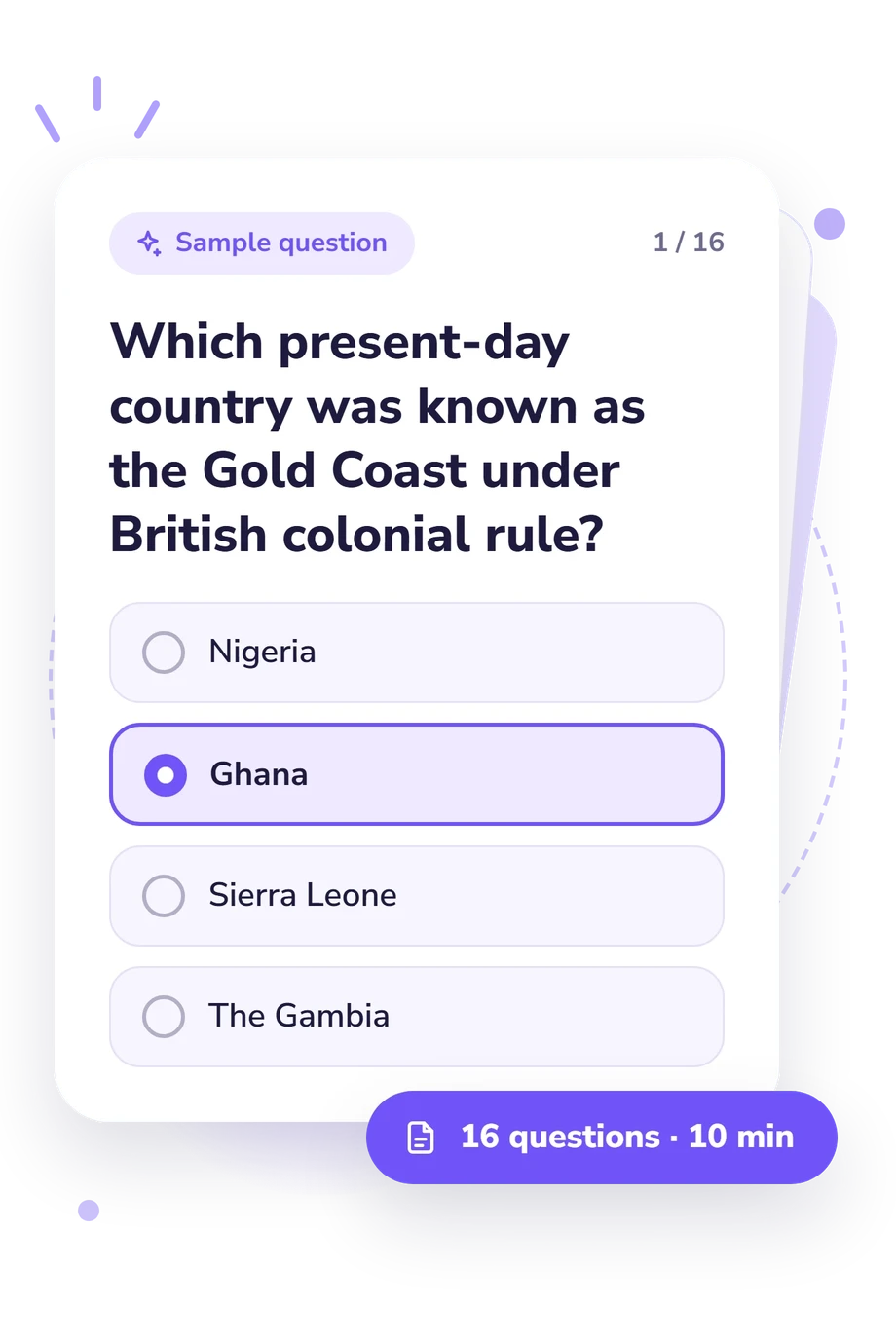
- Nigeria
- Ghana
- Sierra Leone
- The Gambia
- Eritrea
- Ethiopia
- Djibouti
- South Sudan
- Kenya, Tanzania, and Uganda
- Kenya, Ethiopia, and Uganda
- Rwanda, Burundi, and Tanzania
- Tanzania, Zambia, and Malawi
Africa Facts Quiz - Description and methodology of the test
For learners, travelers, and anyone curious about the continent, this Africa Facts Quiz offers a focused way to check how confidently you recognize countries, capitals, borders, physical geography, historical episodes, languages, and landmarks. The overall result provides a broad knowledge band that can guide general review rather than identify scored areas. Its broad coverage also makes it useful as an Africa general knowledge quiz during informal self-testing.
What This Assessment Explores
Taken as an African geography quiz, this questionnaire checks recognition rather than essays or map drawing. Items link countries with capitals, borders, physical features, landmarks, historical episodes, and official languages. It suits learners, travelers, and curious adults seeking a broad snapshot of factual knowledge.
The result reports one overall assessment scale, Africa Facts Knowledge, scored from 0-16. Its bands describe breadth and accuracy across those domains:
- Building Foundations (0-6) shows some key facts, with room to strengthen map, capital, and country knowledge.
- Developing Knowledge (7-12) shows broad working knowledge, although some regional details remain unfamiliar.
- Strong Command (13-16) shows accurate, wide-ranging knowledge across the covered areas.
The overall result can guide informal study or travel preparation, but it reflects current recall rather than overall ability or interest.
Methodology and Evidence Base
Each item presents a factual prompt with four answer choices. The tasks require selecting the best response, so the method measures recognition and retrieval rather than written explanation, map drawing, or extended reasoning. As an Africa trivia quiz, it samples several content areas within one overall result instead of producing separate topic scores.
The displayed result is interpreted through the stated bands; no extra points, weighting, or topic-level formula is claimed; a higher result indicates more accurate recall on these items.
The quiz is conceptually consistent with the factual-knowledge study by De Witte and colleagues, but it is not a direct adaptation or validation. Its varied content aligns with Lane and Bourke's 2019 work in geography assessment, while the National Assessment Governing Board's 2018 Geography Framework supplies an educational frame for geographic concepts.
The questions combine map, capital, country, and regional knowledge with historical, linguistic, and landmark facts, giving the result a broad content scope. Guessing, prior exposure, language familiarity, and concentration may affect performance, so read the result as a descriptive snapshot that can guide further learning.
- De Witte, Benjamin, Vincent Reynaert, Jerome Hutain, Danny Kieken, Joseph Jabbour, and Jalal Possik. 2024. “Immersive learning of factual knowledge while assessing the influence of cognitive load and spatial abilities.” Computers & Education: X Reality 5: 100085. 10.1016/j.cexr.2024.100085
- Lane, Rod, and Terri Bourke. 2019. “Assessment in geography education: a systematic review.” International Research in Geographical and Environmental Education 28(1): 22-36. 10.1080/10382046.2017.1385348
- National Assessment Governing Board. 2018. 2018 Geography Framework. Washington, DC: National Assessment Governing Board.
Updated: