
Biology Quiz for Class 10
How the Scales are Structured
Who Usually Takes This Test?
See How You Compare
Below is a preview of how scores are typically distributed across each scale.
Example Questions From the Test
- All tall
- One tall to one dwarf
- Three tall to one dwarf
- All dwarf
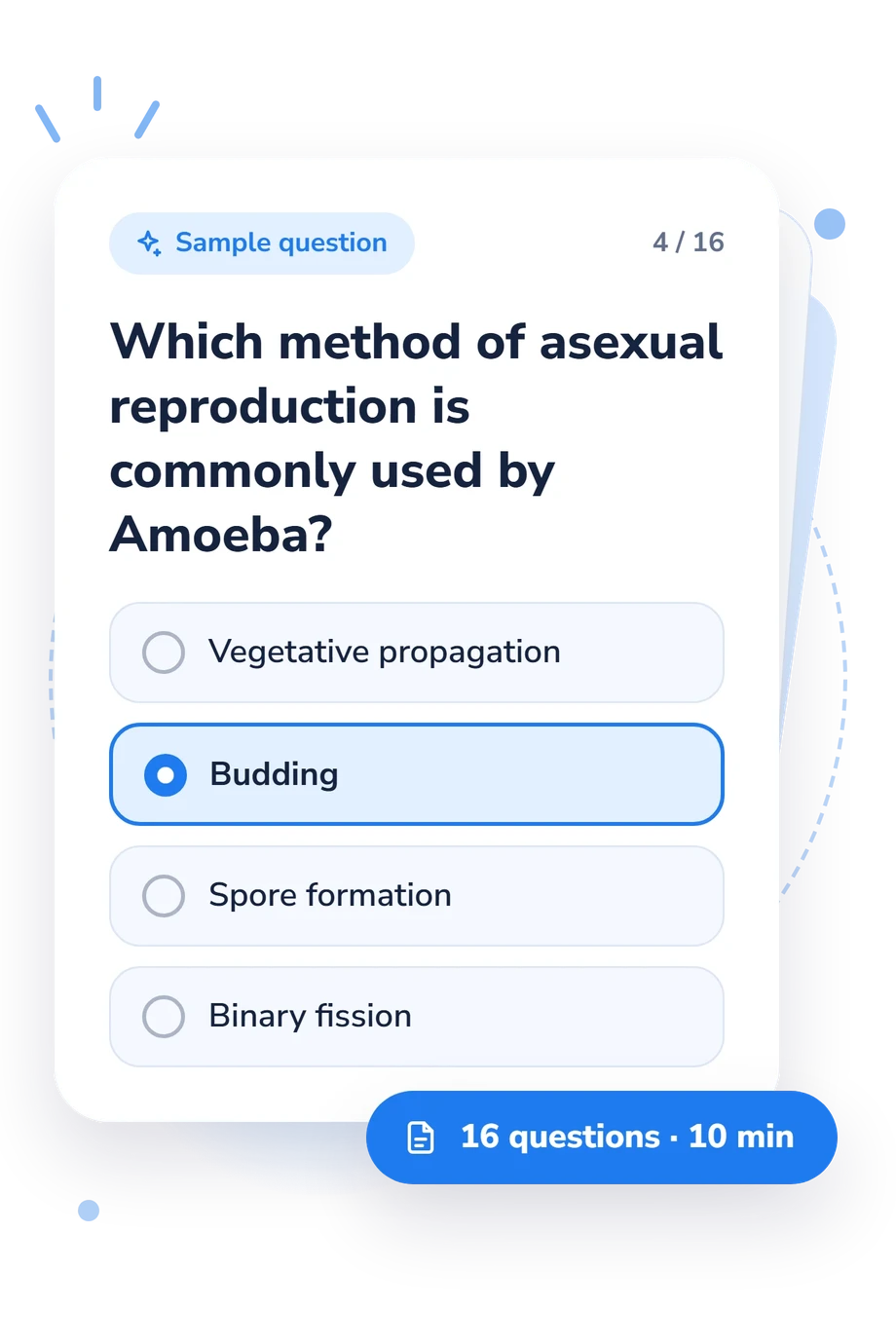
- Vegetative propagation
- Budding
- Spore formation
- Binary fission
- Carbon dioxide
- Oxygen
- Glucose
- Chlorophyll
Biology Quiz for Class 10 - Description and methodology of the test
Students preparing for Class 10 biology can use this assessment to check how confidently they connect facts, processes, and applications across the syllabus. The Blog Name Generator Quiz offers a self-check for learners who want to identify revision priorities rather than rely on a general impression. Its answer to what should I name my blog quiz is a topic profile, not a title suggestion, so the result can direct study.
What This Assessment Explores
The questions sample core school biology through short situations requiring recall or the best explanation. They cover coordination, plant transport, genetics, reproduction, photosynthesis, gas exchange, digestion, contraception, energy flow, biomagnification, exercise, and nutrient cycling. They suit Class 10 revision and classroom readiness.
The Class 10 Biology Knowledge scale runs from 0 to 16. Foundations to Review (0-6) marks core ideas to revisit; Developing Knowledge (7-12) indicates partial command; Strong Knowledge (13-16) indicates consistently accurate understanding. The themes are:
- Human biology shows how well body systems and health choices are understood.
- Plant biology shows whether transport, photosynthesis, and growth responses connect.
- Genetics and reproduction show how confidently inheritance is applied.
- Ecology shows how energy flow, biomagnification, and nutrient cycling fit together.
- Biological reasoning shows whether facts transfer to brief scenarios.
As a biology blog quiz, it works best as a map for further practice.
Methodology and Evidence Base
Each item presents a short stem with four answer choices, asking the learner to select the best response. The questions combine factual recognition with application, such as identifying a reflex centre, predicting inheritance, interpreting an iodine test, and tracing energy through a food chain. This is a structured multiple-choice educational assessment rather than a clinical measure.
The result reports overall performance across the quiz. No separate weighting system, item-level profile, reliability estimate, or normative comparison is provided, so the band is best used to choose revision priorities. Concentration, prior teaching, memory, and test-taking habits can affect performance.
Its content is conceptually consistent with NCERT Class X Science Exemplar Problems (2009), especially its combination of knowledge and application in school science. The revised NCERT Class X science textbook and CBSE Science Subject Code 086 provide curricular context, while Kaur’s 2019 discussion of school science helps explain how subject knowledge is organized. These sources support Class 10 alignment; they do not establish that this online questionnaire is a standardized adaptation of a cited instrument. The blog quiz generator format is most useful when students review missed concepts and explain why the correct option fits.
- National Council of Educational Research and Training, Department of Education in Science and Mathematics. Exemplar Problems: Science, Class X. New Delhi: NCERT, 2009. ISBN 978-81-7450-967-3. Development team member: Dinesh Kumar.
- National Council of Educational Research and Training, Textbook Development Committee. Science: Textbook for Class X. Revised edition. New Delhi: NCERT, 2022. ISBN 81-7450-636-5. Committee member: Dinesh Kumar.
- Central Board of Secondary Education. Science, Subject Code 086: Classes IX and X (2025-26). New Delhi: CBSE, 2025.
- Kaur, Gurjeet. Textual Texture of School Science. In: Koul, Rekha, Verma, Geeta, and Nargund-Joshi, Vanashri, editors. Science Education in India: Philosophical, Historical, and Contemporary Conversations. Singapore: Springer, 2019, pp. 49-66. 10.1007/978-981-13-9593-2_3.
Updated: