
Am I Sweet or Sour Quiz
How the Scales are Structured
Who Usually Takes This Test?
See How You Compare
Below is a preview of how scores are typically distributed across each scale.
Example Questions From the Test
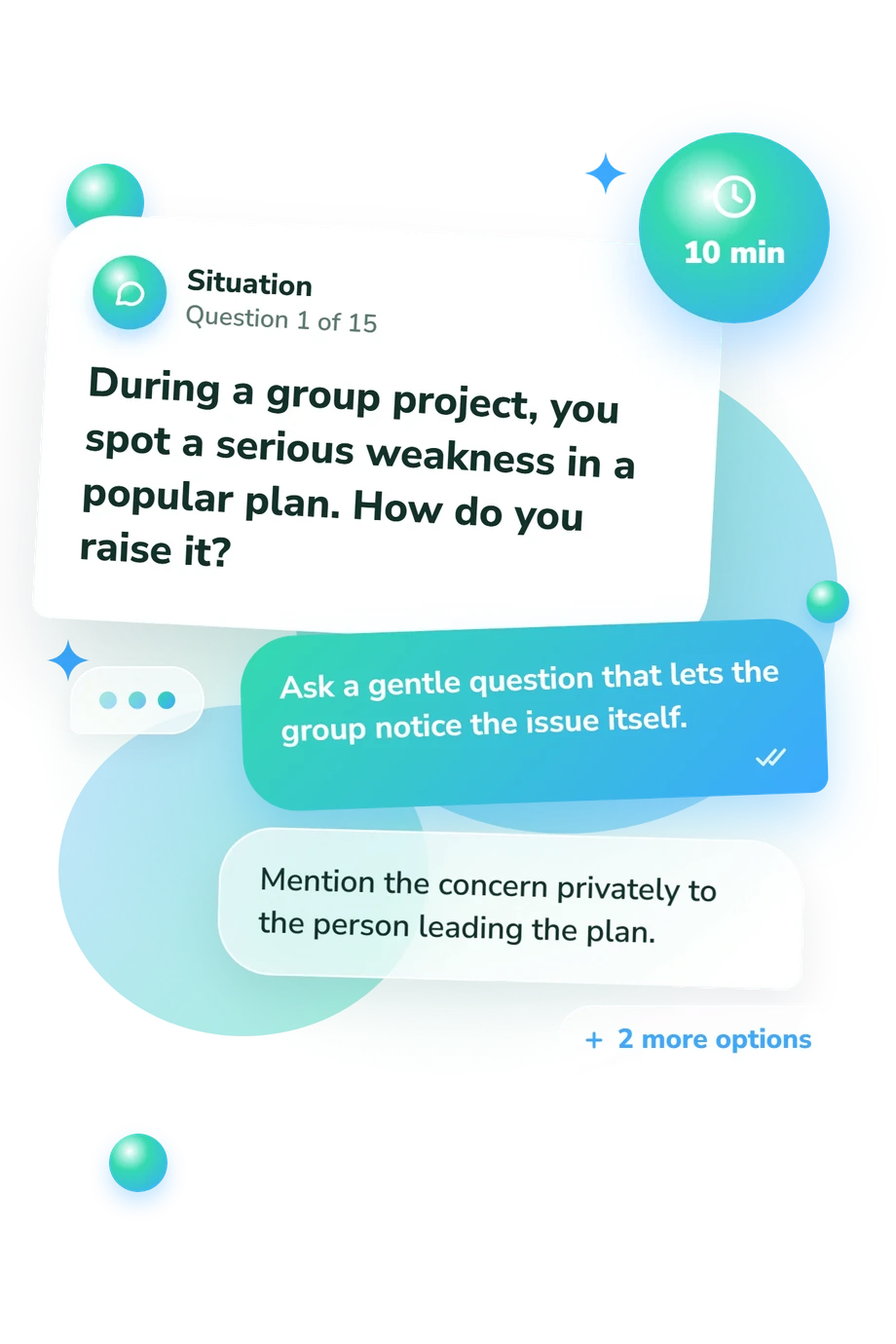
- Ask a gentle question that lets the group notice the issue itself.
- Mention the concern privately to the person leading the plan.
- State the flaw clearly and suggest the group reconsider it.
- Challenge the plan on the spot and emphasize exactly why it will not work.
- I thank them sincerely but keep the moment understated.
- I light up, explain why it means so much, and make my appreciation obvious.
- I thank them and later find a quiet way to return the kindness.
- I appreciate the gesture internally, though my reaction may be hard to read.
- Focus on what others enjoyed rather than pressing my criticism.
- Say it was not for me and mention one or two reservations.
- Lay out a candid critique even if the group strongly disagrees.
- Puncture the hype with my sharpest observations and jokes.
Am I Sweet or Sour Quiz - Description and methodology of the test
Designed for readers curious about everyday interpersonal style, the Am I Sweet or Sour Quiz helps you examine how warmth, candor, humor, and situational flexibility appear in ordinary interactions. This quiz gives you language for patterns in how you respond to friends, groups, disagreement, appreciation, and changing social moods. It functions as a warmth and candor questionnaire about expressed style rather than fixed identity.
What This Assessment Explores
Scenarios cover criticism, appreciation, boundaries, teasing, support, disagreement, and group entry. Their choices contrast tact, directness, warmth, humor, and shifts in social energy, so the profile describes a sweet or sour interpersonal style rather than personal worth or private feeling.
These are the three dimensions represented in the result:
- Flavor Flexibility (0-15) measures adjustment across people, settings, and needs: Steady Flavor (0-5) stays consistent; Selective Blend (6-10) adjusts noticeably; Adaptive Mix (11-15) shifts readily among warmth, restraint, humor, and candor.
- Sour Edge (0-15) measures candor, skepticism, pointed humor, and firm opinions: Soft Edge (0-5) favors tact; Zesty Candor (6-10) moderates bite; Bold Tartness (11-15) centers sharp observations or wit.
- Sweet Warmth (0-15) measures expressed affection, encouragement, welcome, and emotional warmth: Reserved Sweetness (0-5) is selective; Gentle Warmth (6-10) is tempered; Full Sweetness (11-15) is prominent.
Methodology and Evidence Base
The format is an interpersonal-style questionnaire: each scenario presents four response choices that differ mainly in warmth, directness, humor, or adaptability. The items ask about social decisions, inviting a self-report of likely behavior in imagined situations.
Selected responses generate three displayed scores. Because point values for individual options are not stated, the ranges do not reveal a formula; the named bands are descriptive interpretations for this profile. Higher results are not better.
Conceptually, the questionnaire is consistent with Revised Interpersonal Adjective Scales (IAS-R; Wiggins et al., 1988), an interpersonal-style lens. Snyder’s self-monitoring work (1974) relates to expressive changes across situations, while Martin et al. (2003) relates to individual differences in humor use. These sources support comparison, not provenance: this questionnaire is not an adaptation or validation of the instruments.
The scoring is not standardised, so these bands are descriptive categories rather than population norms or clinical cutoffs. Mood, self-awareness, and the relationship imagined in a scenario can affect responses, so the result is best read as a structured snapshot of expressed style rather than a diagnostic result.
- Wiggins, Jerry S., Paul D. Trapnell, and Norman Phillips. (1988). Psychometric and Geometric Characteristics of the Revised Interpersonal Adjective Scales (IAS-R). Multivariate Behavioral Research, 23(4), 517-530. 10.1207/s15327906mbr2304_8
- Snyder, Mark. (1974). Self-monitoring of expressive behavior. Journal of Personality and Social Psychology, 30(4), 526-537. 10.1037/h0037039
- Martin, Rod A., Patricia Puhlik-Doris, Gwen Larsen, Jeanette Gray, and Kelly Weir. (2003). Individual differences in uses of humor and their relation to psychological well-being: Development of the Humor Styles Questionnaire. Journal of Research in Personality, 37(1), 48-75. 10.1016/S0092-6566(02)00534-2
Updated: