
Area of a Trapezoid Quiz
How the Scales are Structured
Who Usually Takes This Test?
See How You Compare
Below is a preview of how scores are typically distributed across each scale.
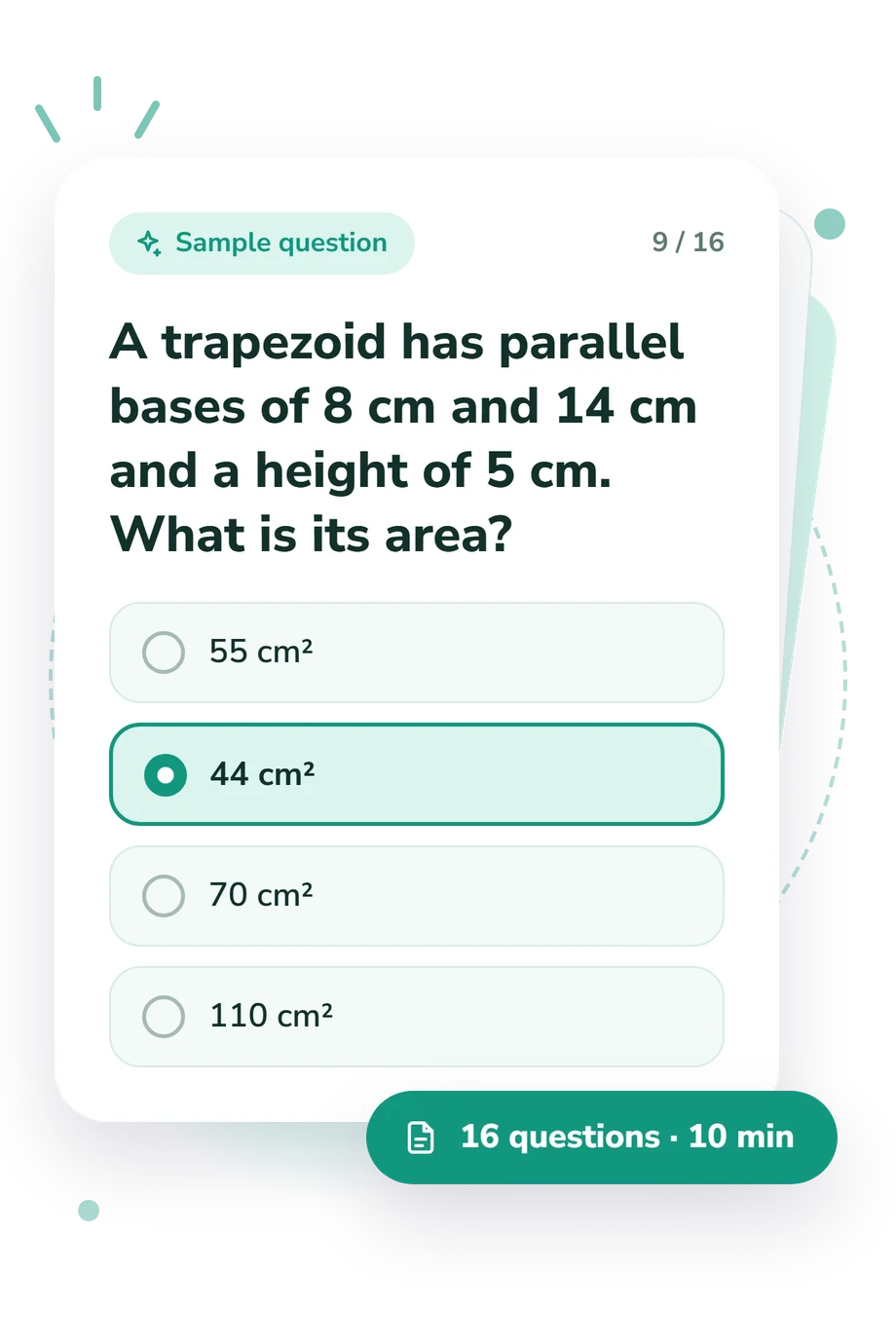
Example Questions From the Test
- It becomes 3 times as large.
- It remains unchanged.
- It becomes 6 times as large.
- It becomes 9 times as large.
- 20 square units
- 30 square units
- 40 square units
- 60 square units
- 5 cm²
- 70 cm²
- 91 cm²
- 182 cm²
Area of a Trapezoid Quiz - Description and methodology of the test
Students, teachers, and independent learners can use this trapezoid quiz for a structured check of geometry reasoning. The area of a trapezoid quiz examines whether you can apply relevant concepts correctly using measurements, coordinates, and real situations. The result is one overall knowledge level, with bands that organize your performance.
What This Test Measures
Questions test identifying parallel bases and perpendicular height, applying the half-product formula, and keeping units consistent. They also probe coordinates, scaling, missing dimensions, and insufficient data. The result describes trapezoid area knowledge rather than mathematical ability.
Four themes feed a knowledge score rather than separate subscores:
- Area of a Trapezoid Knowledge runs from 0-16 and equals the number of correct answers: Foundations to Review (0-6) marks skills to revisit; Developing Knowledge (7-12) indicates standard problems are manageable but unfamiliar forms may cause difficulty; Strong Knowledge (13-16) reflects accurate direct, inverse, coordinate, and real-world application.
- Formula reasoning shows whether you diagnose an error rather than guess.
- Representation and measurement show how you connect coordinates, mixed units, and square units.
- Transfer and inverse reasoning shows how you handle changed dimensions, scale factors, or find a missing measurement from known area.
Methodology and Evidence Base
Each question offers four answer choices and combines conceptual checks with numerical problems. You may diagnose a formula error, convert units, read coordinates, compare scaled areas, or solve backward from a known area. Together, these trapezoid area questions test reasoning as well as arithmetic.
The score is the number of correct responses, and the displayed bands organize performance as a review guide. This is an online content-based knowledge check rather than a norm-referenced psychological inventory; its bands are learning guides, not population norms or proof of mastery.
Manizade and Mason (2014) provide the closest subject-specific comparison because their work emphasizes conceptual understanding of trapezoid area. The relationships are also consistent with Marecek, Anthony-Smith, and Mathis (2020) and the 2010 mathematics standards for finding polygon areas and using coordinates. These sources support content alignment, but they do not make this online questionnaire an adaptation of a published instrument.
Reviewing the formula and identifying the failed step after a missed item can make the result more useful for learning. Performance may vary with prior instruction, attention, unit-conversion habits, and familiarity with coordinate or verbal problems, so treat it as a focused learning snapshot.
- Manizade, Agida G., and Marguerite M. Mason. “Developing the Area of a Trapezoid.” The Mathematics Teacher 107, no. 7 (2014): 508-514. 10.5951/mathteacher.107.7.0508.
- Marecek, Lynn, MaryAnne Anthony-Smith, and Andrea Honeycutt Mathis. Prealgebra 2e. Houston, TX: OpenStax, 2020. Section 9.4, “Use Properties of Rectangles, Triangles, and Trapezoids.”
- National Governors Association Center for Best Practices and Council of Chief State School Officers. Common Core State Standards for Mathematics. Washington, DC: National Governors Association Center for Best Practices and Council of Chief State School Officers, 2010. Standards 6.G.A.1 and 6.G.A.3.
Updated: