
Are You a Bridezilla Quiz
How the Scales are Structured
Who Usually Takes This Test?
See How You Compare
Below is a preview of how scores are typically distributed across each scale.
Example Questions From the Test
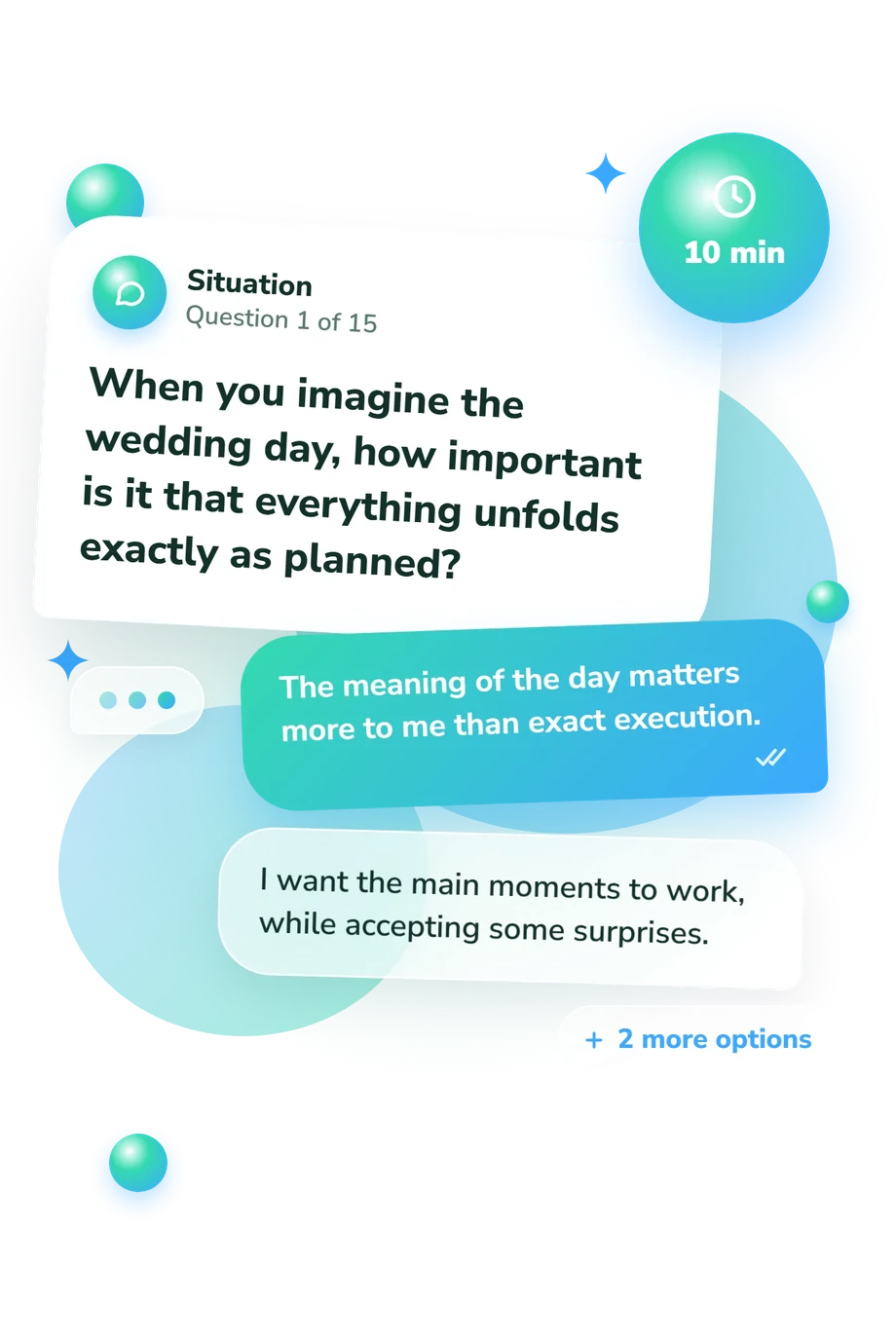
- The meaning of the day matters more to me than exact execution.
- I want the main moments to work, while accepting some surprises.
- I would be noticeably disappointed if several visible details changed.
- Exact execution feels essential to my ability to enjoy the day.
- Keep my current choice and stop comparing once the decision is sound.
- Save the idea only if it could improve something without disrupting the plan.
- Revisit the decision because I do not want to miss a better result.
- Consider changing plans even if it creates extra work or added cost.
- I can celebrate them without connecting it to my wedding attention.
- I am happy for them, though I may briefly wonder how plans or conversations will shift.
- I feel conflicted because I hoped this period would stay centered on the wedding.
- I feel overshadowed and wish they had chosen a different time to announce it.
Are You a Bridezilla Quiz - Description and methodology of the test
For engaged people wondering whether wedding planning has made them more demanding, the Are You a Bridezilla Quiz offers a structured way to examine that concern. This wedding-planning self-reflection questionnaire is intended for situational reflection on communication, compromise, flexibility, control, and emotional responses during planning. The result can help you notice separate patterns in communication, adaptation, and the way wedding stress shapes mood and priorities.
What This Assessment Explores
Questions place you in situations involving vendors, partners, relatives, budgets, schedules, delayed replies, competing preferences, and imperfections. They examine communication, adaptation to change, and keeping wedding details in proportion. Together, the scenarios make this bridezilla quiz a reflection on planning behavior, not a fixed judgment. The result summarizes patterns in communication, adaptation, and how wedding stress shapes mood and priorities.
Three scales are:
- Communication and Pressure (0-15) measures how you express wedding needs and how much pressure others may feel when budgets, timing, or opinions differ, from Collaborative Voice (0-5), Strong Advocate (6-10), and High-Pressure Voice (11-15).
- Flexibility and Control (0-15) measures adaptation when plans or choices conflict, from Adaptable Planner (0-5), Vision-Focused (6-10), and Firm-Grip Planner (11-15).
- Perspective and Emotional Balance (0-15) measures how stress shapes mood and priorities, from Grounded Perspective (0-5), Deeply Invested (6-10), and Wedding-Consumed (11-15).
Methodology and Evidence Base
Each scenario offers four response options, generally moving from accommodating a change to pressing for the original preference. This bridezilla questionnaire therefore captures degrees of insistence, adaptation, and emotional involvement rather than pass-fail correctness. The responses are grouped into separate dimensions, but the questionnaire does not state a universal point value for each answer.
Pierce’s thesis discusses perfectionistic pressure in contemporary wedding culture and provides conceptual context. The themes are conceptually consistent with Stafford, Faulkner, and Scott’s study of dominant expectations in brides’ wedding planning and Frost’s model of perfectionism. The questionnaire is not an adaptation or validated version of those works.
It is an online self-reflection tool with no stated standardization, population norms, reliability estimates, or clinical cutoffs. Interpret the result as a snapshot of planning style that may shift with wedding stage, relationship context, or current stress. Self-report is also shaped by self-image and awareness, so the most useful outcome is identifying priorities or conversations worth revisiting.
- Pierce, Amy Olivia. (2013). Contributing Factors To Perfection Hysteria on the Bride's Experience in Contemporary American Wedding Culture. Master of Fine Arts thesis, University of Maine.
- Stafford, Laura, Sandra L. Faulkner, and Allison M. Scott. (2020). It's the Best Day of Your Life: Dominant Discourses in Brides' Wedding Planning. Communication Studies, 71(2), 226-243. 10.1080/10510974.2020.1713186
- Frost, Randy O., Patricia Marten, Cathleen Lahart, and Robin Rosenblate. (1990). The dimensions of perfectionism. Cognitive Therapy and Research, 14(5), 449-468. 10.1007/BF01172967
Updated: