
Business Finance Quiz
How the Scales are Structured
Who Usually Takes This Test?
See How You Compare
Below is a preview of how scores are typically distributed across each scale.
Example Questions From the Test
- 0
- 0
- 33
- 0
- Its average accounts receivable increased
- Its average inventory decreased
- Its long-term borrowing increased
- Its gross margin percentage increased
- The annual audit fee
- Monthly factory rent
- A sales commission paid for each unit sold
- A manager's fixed annual salary
Business Finance Quiz - Description and methodology of the test
People who want a snapshot of practical business-finance knowledge can use this Business Finance Quiz to review skills for managing a company, studying accounting, or making decisions. As a business finance knowledge test, it addresses calculations and interpretations, not personality or career fit. For the can i be a politician quiz question, the result highlights strengths and topics for further study; its educational score is not professional financial advice.
What This Assessment Measures
Rather than assessing personality, this financial literacy assessment checks whether a reader can apply finance ideas to short business situations. It covers accounting relationships, cost behavior, cash conversion, profitability, funding, and investment decisions. The intended reader may be a student, manager, founder, or anyone building confidence with practical finance; the result describes knowledge shown on these items, not business performance.
The thematic groups are:
- Financial statements and cash flow connect reported performance with movement of money and resources.
- Costs and break-even show how expenses, margins, and pricing affect operating decisions.
- Ratios and working capital measure understanding of inventory, receivables, liquidity, and related calculations.
- Financing and investment examine borrowing, equity, leverage, and project value.
The displayed scale is Business Finance Knowledge, ranging from 0-16. The catalogue bands are Foundation-building (0-6), Developing knowledge (7-12), and Strong knowledge (13-16).
Methodology and Evidence Base
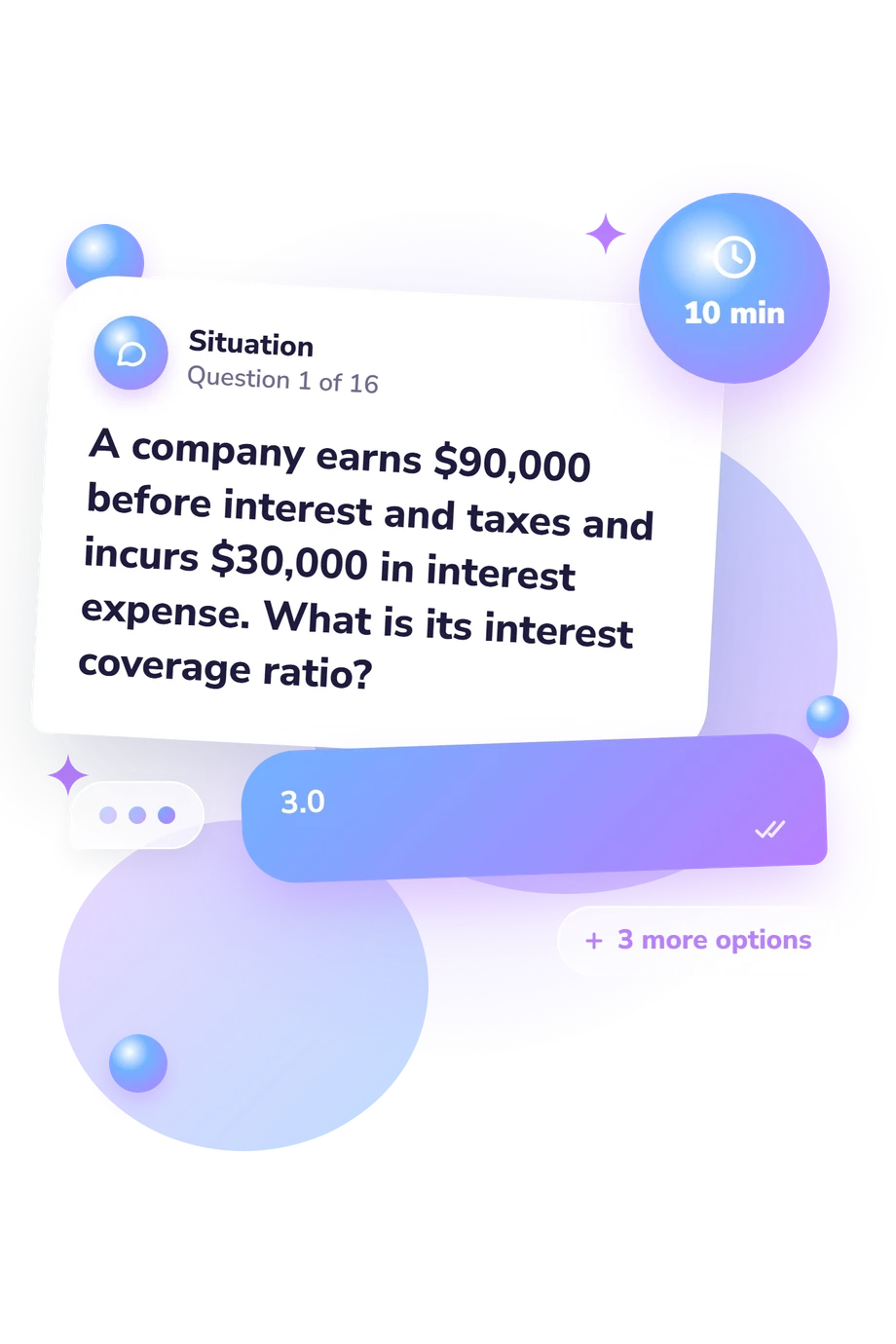
Each item presents a business situation with four answer choices and asks for a calculation or interpretation. The business finance questions cover interest coverage, inventory turnover, variable costs, break-even, payment terms, NPV, liquidity ratios, gross profit, variance, and financing structure. The response format therefore tests recognition and application of core concepts, while the displayed result is the catalogue’s educational classification.
Conceptually, the questionnaire aligns with the OECD/INFE MSME Survey Instrument, which treats financial literacy as knowledge applied to enterprise decisions, but it is not an adaptation of that instrument. Culebro-Martínez, Moreno-García, and Hernández-Mejía provide related context on entrepreneurial financial literacy and company performance. Ranyard, McNair, Nicolini, and Duxbury discuss evaluating brief scales with item-response theory, while Ross, Westerfield, Jaffe, and Jordan supply corporate-finance concepts reflected in the items. These works provide conceptual context, not validation or standardization of this online questionnaire.
Performance can be affected by prior study, familiarity with business examples, attention, and guessing. The displayed bands are catalogue-defined educational descriptors.
- OECD. (2020). OECD/INFE Survey Instrument to Measure the Financial Literacy of MSMEs. OECD Publishing, Paris. 10.1787/97746fba-en
- Culebro-Martínez, R., Moreno-García, E., & Hernández-Mejía, S. (2024). Financial Literacy of Entrepreneurs and Companies’ Performance. Journal of Risk and Financial Management, 17(2), 63. 10.3390/jrfm17020063
- Ranyard, R., McNair, S., Nicolini, G., & Duxbury, D. (2020). An item response theory approach to constructing and evaluating brief and in-depth financial literacy scales. Journal of Consumer Affairs, 54(3), 1121-1156. 10.1111/joca.12322
- Ross, S. A., Westerfield, R. W., Jaffe, J., & Jordan, B. D. (2019). Corporate Finance (12th ed.). McGraw-Hill Education.
Updated: