
AR Verbs Quiz
How the Scales are Structured
Who Usually Takes This Test?
See How You Compare
Below is a preview of how scores are typically distributed across each scale.
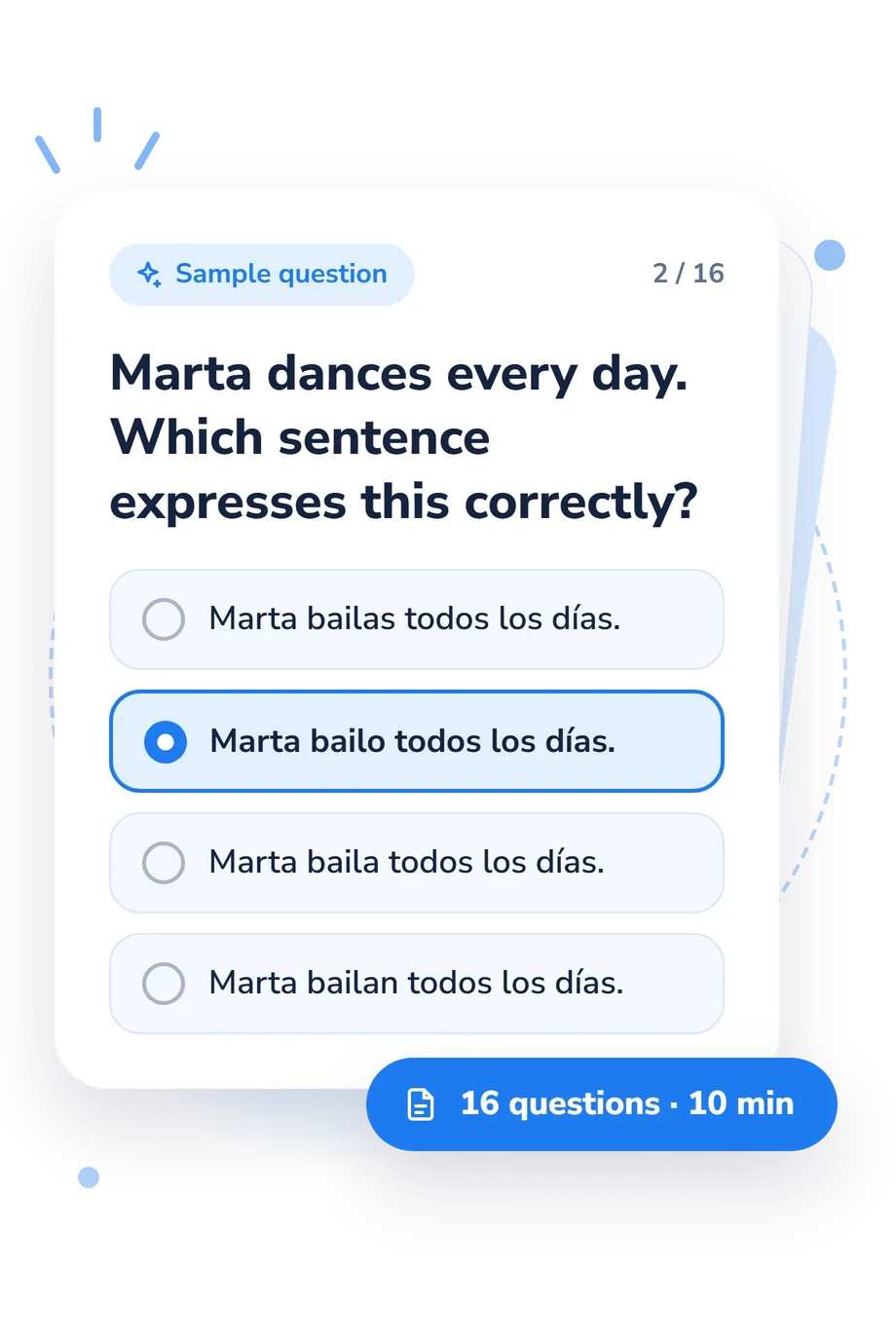
Example Questions From the Test
- llegaba
- llego
- llegaré
- llegué
- Marta bailas todos los días.
- Marta bailo todos los días.
- Marta baila todos los días.
- Marta bailan todos los días.
- compramos
- compran
- compras
- compráis
AR Verbs Quiz - Description and methodology of the test
Before starting a lesson or checking homework, the ar verbs quiz gives a focused way to examine core -ar conjugation patterns. As a Spanish quiz covering -ar verbs, it places those patterns in short contexts, making it easier to decide whether your foundations are ready for the next topic. The result points to patterns worth reinforcing rather than attempting to describe overall fluency.
What This Assessment Explores
The questions focus on regular -ar conjugation, not vocabulary breadth. They cover forms in context, infinitives, subject agreement, routine statements, present-tense stem changes, and selected preterite spelling changes. This set supports regular ar verb practice without requiring broad vocabulary.
The result represents these learning areas:
- Infinitives and stems show whether you identify the base form needed for conjugation.
- Subject endings measure how well you match forms to yo, tú, él/ella, ustedes, and nosotros.
- Present-tense use reflects accuracy in everyday statements, questions, and stem-changing forms.
- Preterite spelling patterns show whether you recognize forms such as busqué and empecé.
Together, these areas contribute to the AR Verbs Knowledge scale, which runs from 0-16: Foundations to review (0-6) indicates forms to revisit; Developing command (7-12) indicates many correct forms with some gaps; Strong command (13-16) indicates accurate, flexible knowledge of the tested patterns.
Methodology and Evidence Base
The method is an online, four-option multiple-choice self-check. Prompts require sentence completion, infinitive recognition, removal of the -ar ending, or subject-form matching. They sample present-tense routines, infinitive complements, and first-person preterite spelling changes, so the task measures recognition and controlled application rather than free production.
Scoring is interpreted through the displayed total and its result bands. That format supports Spanish verb conjugation practice while keeping conclusions tied to the grammar sampled.
Its linguistic reference point is the grammatical treatment by Butt, Benjamin, and Moreira Rodríguez, which supports the distinctions tested here. Guidance from the Spanish language academies (2009) provides complementary guidance on standard usage. The questionnaire is conceptually consistent with these works, not an adaptation of either source.
The bands describe performance on these items rather than a standardized proficiency level. Multiple-choice recognition may miss spontaneous speaking, listening, pronunciation, and forms outside the sample; results can also shift with recent study and careful reading.
- Butt, John, Carmen Benjamin, and Antonia Moreira Rodríguez. A New Reference Grammar of Modern Spanish. 6th ed., Routledge, 2019. 10.4324/9781315648446
- Real Academia Española and Association of Academies of the Spanish Language. Basic Grammar of the Spanish Language. Espasa, 2011.
Updated: