
Are You a Future Serial Killer Quiz
How the Scales are Structured
Who Usually Takes This Test?
See How You Compare
Below is a preview of how scores are typically distributed across each scale.
Example Questions From the Test
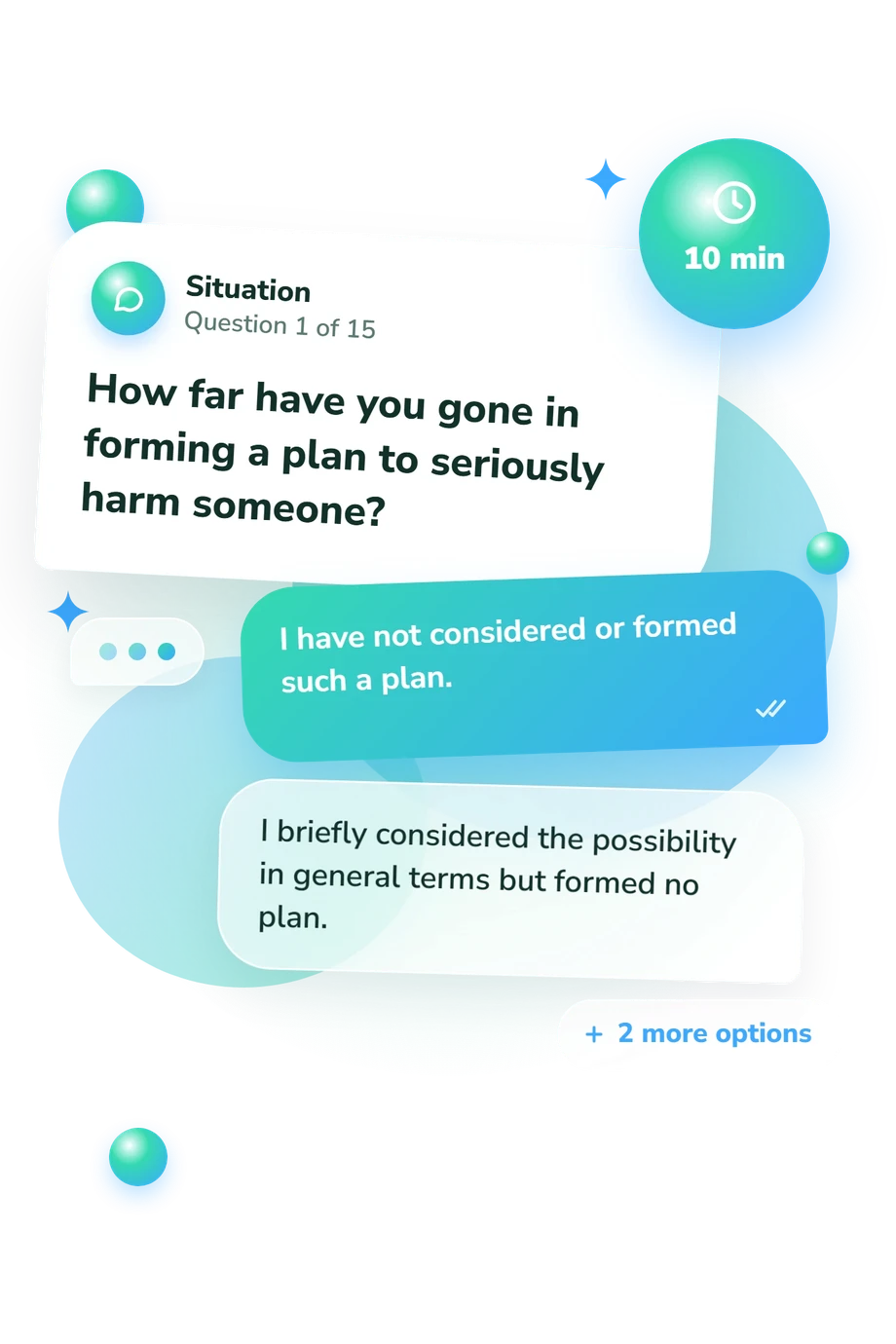
- I have not considered or formed such a plan.
- I briefly considered the possibility in general terms but formed no plan.
- I formed part of a plan or mentally arranged a sequence of actions.
- I have a specific, actionable plan involving a target, time, place, or intended action.
- I have not connected any accessible item with harming someone.
- I noticed access to an item while upset but did not handle or move it.
- I handled or moved an item while thinking about violence, then stopped and created distance.
- I acquired, carried, or positioned an item for the purpose of harming someone.
- They have not entered my mind.
- A brief, unwanted thought occurred and passed quickly.
- The thoughts have returned or have been difficult to shift.
- They have become intense urges or fantasies that I might act on.
Are You a Future Serial Killer Quiz - Description and methodology of the test
People troubled by violent thoughts, urges, or feared loss of control can use this safety self-check to organize current experiences and consider safer next steps. The Are You a Future Serial Killer Quiz covers thoughts, urges, preparation, escalation, and perceived control; it cannot predict future conduct. As a current violence self-check, it highlights reported experiences that may warrant attention or support.
What This Assessment Explores
It examines serious-harm thoughts, violent urges, target focus, preparation, escalation, aggression, and control. It is intended for someone worried about these experiences, especially when anger feels persistent, focused, or difficult to interrupt. The questionnaire is a violent thoughts assessment, distinguishing fleeting imagery from recurring or intense thoughts, target focus, and difficulty resisting urges.
The dimensions are:
- Behavioral Escalation and Control (0-15) records endorsed escalation indicators and difficulty regulating anger or violent impulses; bands are No escalation indicators endorsed (0), Concern present (1-2), and Prompt action needed (3-15).
- Planning and Preparation (0-15) records endorsed planning or preparation indicators; bands are No indicators endorsed (0), Some concern (1-2), and Prompt action (3-15).
- Violent Thoughts and Urges (0-15) records endorsed violent thoughts or urges, including recurrence, intensity, focus, and perceived pull; bands are Zero-score snapshot (0), Concern present (1-2), and Prompt action (3-15).
Methodology and Scientific Basis
Each item offers four ordered choices, moving from no experience toward recurrence, focus, preparation, escalation, reduced control, or proximity to action. Topics include planning, weapons, revenge, threats, aggression, target selection, and loss of control.
Responses are grouped by dimension, with a score for each. It displays scale totals and bands but does not document how many points each response contributes. These bands are reflective summaries, not severity or risk cutoffs; a concerning response can matter independently of the total.
Conceptually, the questionnaire is a violent ideation assessment consistent with I-HAVAT and the Violent Ideations Scale, self-report measures. Its items and scoring display are distinct, so this is a conceptual comparison, not an adaptation or validation claim. Thienhaus and Piasecki describe a framework emphasizing context, intent, access, and current control. The questionnaire cannot determine lethal capacity; it records endorsed thoughts, urges, planning, preparation, and perceived control.
Bands are unvalidated and not clinical or legal determinations. Self-report is affected by honesty, self-awareness, and present circumstances. If danger feels immediate, move away from people and weapons and contact emergency or crisis support.
- Salma Malik, Kevin Young, Sophia Walker, and Mirela Loftus. “A Novel Approach to Assess Violent and Homicidal Ideation: The I-HAVAT©.” Adolescent Psychiatry 9, no. 2 (2019): 100-117. 10.2174/2210676608666181016161516
- Aja Louise Murray, Manuel Eisner, and Denis Ribeaud. “Development and Validation of a Brief Measure of Violent Thoughts: The Violent Ideations Scale (VIS).” Assessment 25, no. 7 (2018): 942-955. 10.1177/1073191116667213
- Ole J. Thienhaus and Melissa Piasecki. “Assessment of Psychiatric Patients’ Risk of Violence Toward Others.” Psychiatric Services 49, no. 9 (1998): 1129-1147. 10.1176/ps.49.9.1129
Updated: