
Biology Inheritance Quiz
How the Scales are Structured
Who Usually Takes This Test?
See How You Compare
Below is a preview of how scores are typically distributed across each scale.
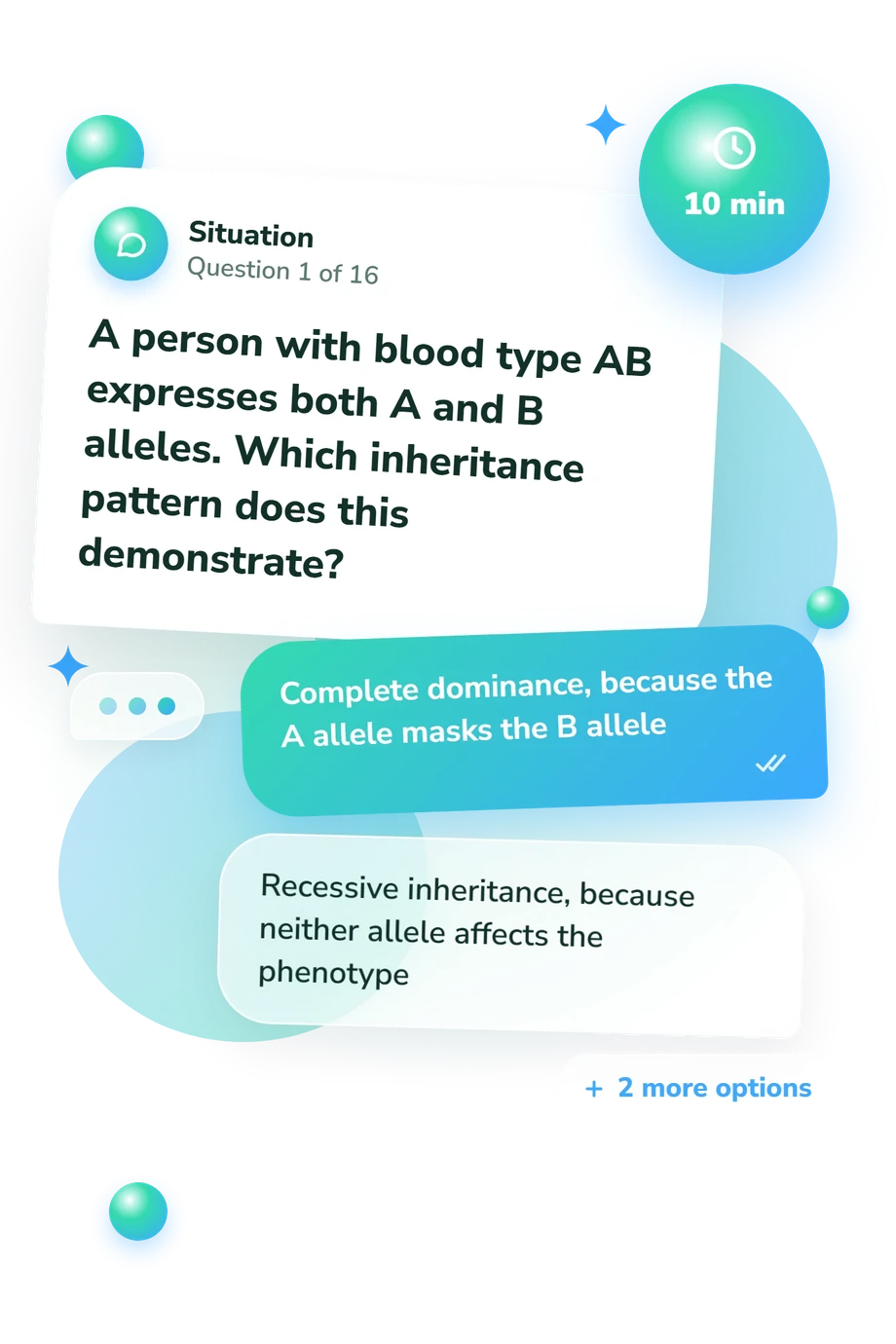
Example Questions From the Test
- A protein that copies DNA before cell division
- A visible characteristic produced only by the environment
- A complete set of chromosomes within a species
- An alternative version of a gene found at a particular locus
- Self-pollinate it once and examine only the parent plant
- Cross it with a homozygous dominant plant, AA
- Cross it with another plant showing the same phenotype
- Cross it with a homozygous recessive plant, aa
- 25%
- 50%
- 0%
- 75%
Biology Inheritance Quiz - Description and methodology of the test
Students reviewing heredity, teachers checking foundational understanding, and curious readers can use this assessment to examine how well they connect inherited information with observable outcomes; birth of jesus quiz questions are outside its subject. The result reveals which genetic terms feel secure and which deserve revision, from core inheritance patterns to pedigrees and probability across the biology topics tested here.
What This Assessment Explores
The questions examine how genetic information is organized, transmitted, and expressed. They move from allele, genotype, phenotype, and chromosome concepts to codominance, incomplete dominance, mitochondrial and X-linked transmission, heritable mutation, and environmental effects on phenotype. Readers can use the result to identify which core ideas need more practice, including allele relationships, rather than relying on isolated definitions.
The thematic areas represented by the items are:
- Alleles and expression show how genetic versions relate to observable traits and dominance patterns.
- Chromosome behavior explains how homologous chromosomes, sister chromatids, meiosis, and linkage affect transmission.
- Crosses and probability test whether genotypes and phenotypes can be predicted from genetic information.
- Pedigrees and inheritance routes distinguish autosomal, X-linked, mitochondrial, and heritable mutation patterns.
Results use Biology Inheritance Knowledge (0-16), with one point for each correct answer. Foundational (0-6) suggests reviewing core concepts, Developing (7-12) reflects partial command with more practice needed, and Strong (13-16) indicates accurate interpretation of most included scenarios.
Methodology and Scientific Basis
Each item uses four answer choices and asks for the best explanation, distinction, prediction, or inheritance pattern. The score totals correct responses rather than measuring agreement with statements, so it reflects performance on defined biology concepts. Questions about crosses and probabilities require applying rules to a scenario, while pedigree and chromosome items emphasize recognition of transmission mechanisms.
The structure is conceptually consistent with Genetics Concept Assessment (Smith et al., 2008), which targets conceptual understanding in genetics. It also overlaps with the focus of the Meiosis Concept Inventory (Kalas et al., 2013) and the Genetics Literacy Assessment (Bowling et al., 2008), especially around meiosis, inheritance reasoning, and interpretation of genetic information. These studies provide conceptual context for those topics, but they do not establish this questionnaire's validity.
The displayed bands are the questionnaire's own performance descriptors for the tested items and concepts. Performance can vary with prior instruction, wording familiarity, attention, and guessing; use the result to target review of alleles, chromosome behavior, genetic crosses, and pedigrees rather than to infer ability beyond the tested concepts.
- Smith MK, Wood WB, Knight JK. The Genetics Concept Assessment: A New Concept Inventory for Gauging Student Understanding of Genetics. CBE-Life Sciences Education. 2008;7(4):422-430. 10.1187/cbe.08-08-0045
- Kalas P, O'Neill A, Pollock C, Birol G. Development of a Meiosis Concept Inventory. CBE-Life Sciences Education. 2013;12(4):655-664. 10.1187/cbe.12-10-0174
- Bowling BV, Acra EE, Wang L, Myers MF, Dean GE, Markle GC, Moskalik CL, Huether CA. Development and Evaluation of a Genetics Literacy Assessment Instrument for Undergraduates. Genetics. 2008;178(1):15-22. 10.1534/genetics.107.079533
Updated: