
Algebraic Expressions Quiz Grade 7
How the Scales are Structured
Who Usually Takes This Test?
See How You Compare
Below is a preview of how scores are typically distributed across each scale.
Example Questions From the Test
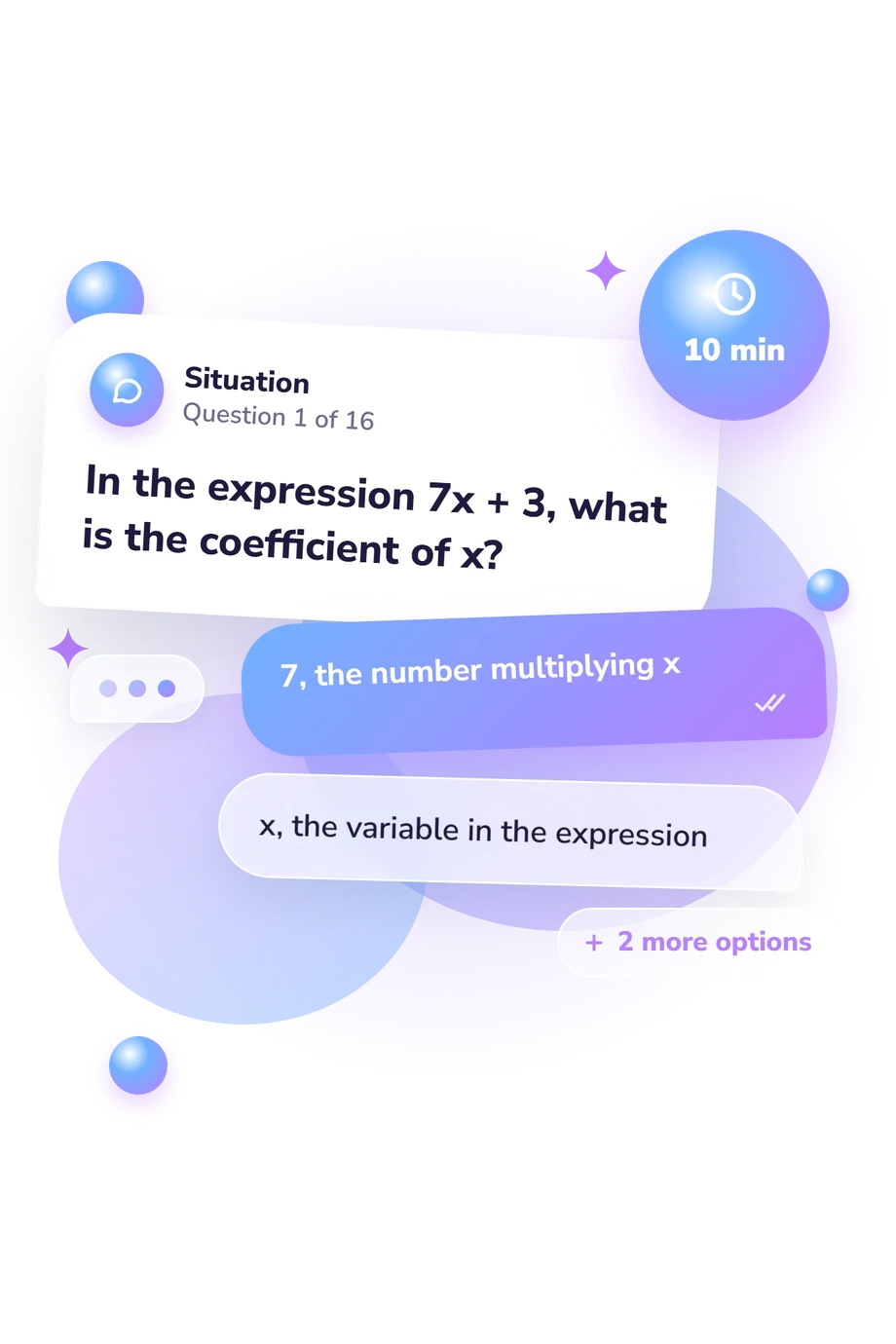
- 7, the number multiplying x
- x, the variable in the expression
- 3, the constant term
- 10, the sum of the two numbers shown
- 4 ÷ x - 2, which divides four by x first
- x ÷ 4 - 2, which divides x by four first
- x ÷ (4 - 2), which subtracts inside the divisor
- 4x - 2, which multiplies x by four first
- 2x + 2
- x² + 2x
- 4x + 2
- 4x + 4
Algebraic Expressions Quiz Grade 7 - Description and methodology of the test
Students who want to check their command of early algebra can use Algebraic Expressions Quiz Grade 7 to review how symbols, numbers, and operations work together. It suits learners preparing for classwork, revision, or a new unit. As a grade 7 algebra quiz, it connects the result to practical study priorities rather than treating one score as a final judgment.
What This Assessment Explores
These questions test whether a learner can read algebraic language, identify parts of an expression, and apply rules in context. The algebraic expressions practice test combines symbolic work with short problems about prices, geometry, points, and patterns.
These question themes contribute to the single overall knowledge result:
- Algebraic Expressions Knowledge runs from 0-16: Foundations to revisit (0-6) signals review; Developing knowledge (7-12) signals further practice; Strong knowledge (13-16) indicates secure Grade 7 understanding and readiness for multistep work.
- Translation questions examine whether verbal phrases become accurate expressions.
- Structure questions show whether variables, coefficients, constants, like terms, and equivalent forms are handled correctly.
- Evaluation questions check substitution and comparison of values.
- Application questions show whether expressions represent quantities, geometric relationships, and patterns.
The overall result gives a learner, parent, or teacher broad revision guidance.
Methodology and Evidence Base
Each item presents a prompt with four answer choices. The questions move from identifying terms and translating language to substitution, error detection, simplification, and practical modelling. Distractors reflect common mistakes, such as reversing a quotient, combining unlike terms, or distributing to one term. Together, the choices ask learners to distinguish correct rules for translating, evaluating, simplifying, and modelling expressions.
Scoring produces one combined result from selected responses, interpreted through the stated performance bands. The questionnaire is conceptually consistent with Lim (2010), whose study examines errors in simplifying expressions. Common Core mathematics standards provide a curricular reference for expressions and equivalence, while Ketterlin-Geller, Gifford, and Perry (2015) show why algebra-readiness measures need validity evidence. As an algebraic expressions assessment for grade 7, it connects these educational ideas with the skills represented in the questions.
Use the result as a curriculum-linked self-check. Recent instruction, attention, confidence, and guessing can affect performance, while one online score cannot capture every aspect of mathematical reasoning. The broad band can guide further practice with the underlying topics, and solving similar problems helps turn the result into useful study.
- Lim, Kok Seng. "An Error Analysis of Form 2 (Grade 7) Students in Simplifying Algebraic Expressions: A Descriptive Study." Electronic Journal of Research in Educational Psychology, vol. 8, no. 1, 2010, pp. 139-162. 10.25115/ejrep.v8i20.1398
- Common Core State Standards Initiative. Common Core State Standards for Mathematics. National Governors Association Center for Best Practices and Council of Chief State School Officers, 2010.
- Ketterlin-Geller, Leanne R., Diane B. Gifford, and Lindsey Perry. "Measuring Middle School Students’ Algebra Readiness: Examining Validity Evidence for Three Experimental Measures." Assessment for Effective Intervention, vol. 41, no. 1, 2015, pp. 28-40. 10.1177/1534508415586545
Updated: