
Bible Quiz on Job
How the Scales are Structured
Who Usually Takes This Test?
See How You Compare
Below is a preview of how scores are typically distributed across each scale.
Example Questions From the Test
- Blameless and upright, fearing God and turning away from evil
- A powerful ruler known primarily for military victories
- A priest appointed to serve at the sanctuary in Shiloh
- A prophet sent to warn the people of Nineveh
- They refused to visit Job during his suffering
- They failed to replace the property Job had lost
- They allowed Elihu to speak before Job had answered them
- They had not spoken rightly about God as Job had
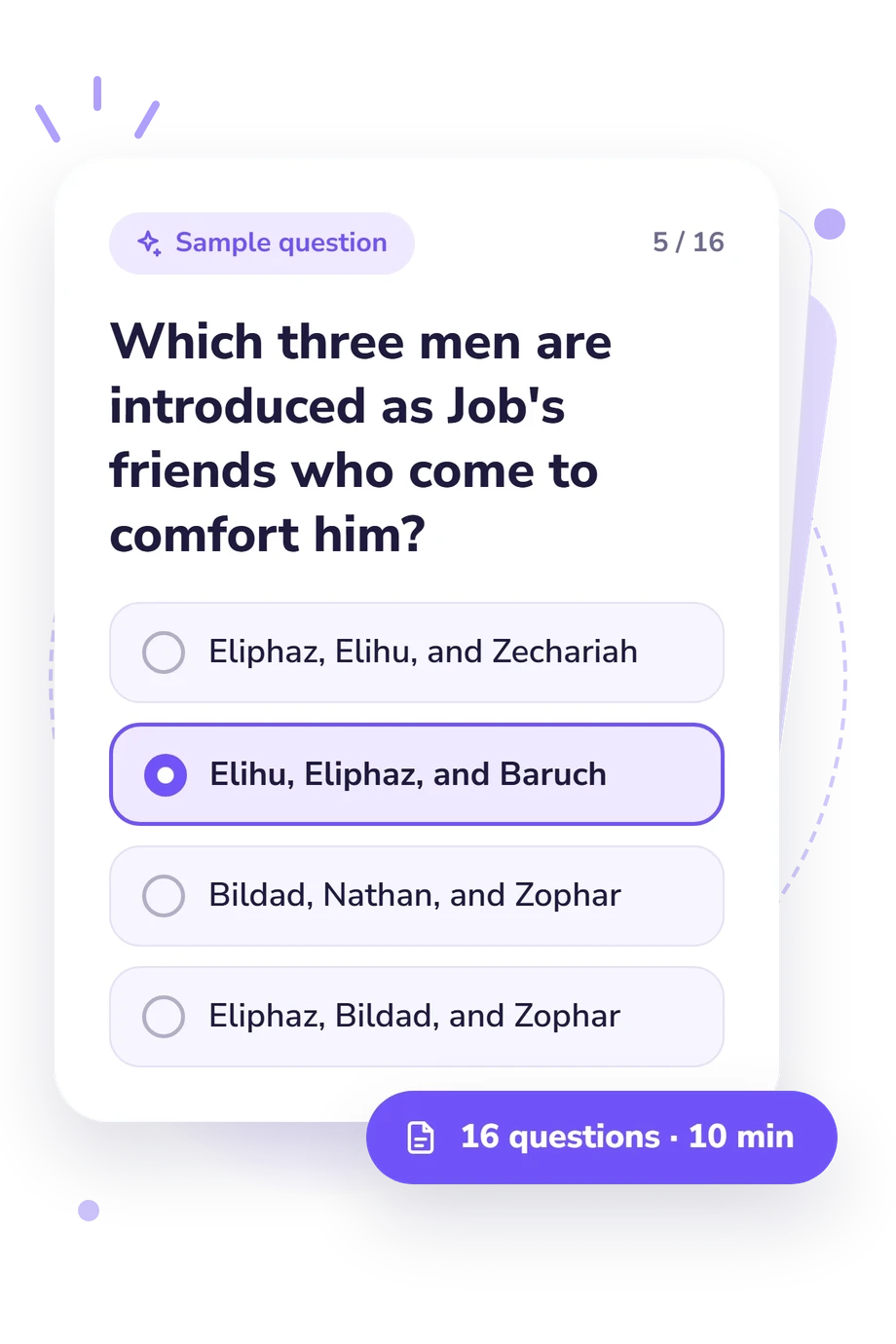
- Eliphaz, Elihu, and Zechariah
- Elihu, Eliphaz, and Baruch
- Bildad, Nathan, and Zophar
- Eliphaz, Bildad, and Zophar
Bible Quiz on Job - Description and methodology of the test
Readers who want to check their understanding of Job can use the Binary Compound Quiz as a focused reading companion rather than a general Bible survey. It suits students, study groups, and independent readers who want to revisit the book’s narrative, speakers, arguments, and theology. A Job Bible quiz result highlights areas that deserve closer reading and can help organize further study.
What This Assessment Explores
The questionnaire measures knowledge of Job as a literary and theological work. It covers the prose frame, poetic speeches, major characters, turning points, and questions about suffering, justice, wisdom, and human limits.
Details such as Uz, the friends, Elihu, and the divine speeches are connected here, making this Bible quiz on Job a check of the book’s overall pattern rather than isolated facts.
The displayed scale is Job Knowledge, 0-16: Foundation to Build (0-6), Developing Knowledge (7-12), and Strong Knowledge (13-16). It considers four related areas:
- Narrative structure shows how framing scenes shape the reading of the dialogue.
- Characters and speakers indicate whether you can distinguish each voice and role.
- Suffering and justice reflect how well you follow the book’s competing explanations.
- Wisdom and creation show your grasp of Job’s limits before divine power.
Methodology and Evidence Base
Each item uses a multiple-choice format with one question stem and four answer choices. The result is based on the respondent’s selected answers compared with the questionnaire’s keyed responses; the displayed description does not specify a separate weighting or penalty system.
The content draws on the Book of Job, while Greenstein’s translation and the commentary by Driver and Gray support attention to wording, structure, speakers, and interpretive context. These works provide a textual and scholarly foundation for the questions without making the online questionnaire an adaptation of either publication.
Newsom’s discussion of Job as a polyphonic text is especially relevant to the method: the speeches can be read as distinct voices in tension, rather than as one undifferentiated explanation. That approach helps explain why the questions ask readers to identify arguments, contrasts, dramatic irony, and changes in perspective.
The result bands are descriptive categories for this online version, not published norms from the cited scholarship. Read the outcome as a snapshot from a Job knowledge test: performance can reflect prior familiarity with a translation, memory for details, and the limited selection of issues represented by the questions. It can guide further reading without establishing complete interpretive mastery.
- National Council of the Churches of Christ in the United States of America. New Revised Standard Version Updated Edition. 2021.
- Greenstein, Edward L. Job: A New Translation. New Haven, CT: Yale University Press, 2020. ISBN 9780300255249.
- Driver, Samuel Rolles, and George Buchanan Gray. A Critical and Exegetical Commentary on the Book of Job. Edinburgh: T. & T. Clark, 1921.
- Newsom, Carol A. “The Book of Job as Polyphonic Text.” Journal for the Study of the Old Testament 26, no. 3 (2002): 87-108. 10.1177/030908920202600305
Updated: