





















Most personality quizzes sort people into a handful of boxes. This Big 5 personality test does something more useful: it measures how much of each core trait you have on a continuous scale, then breaks every trait into six facets. The result is a detailed map of your temperament, built on the model that dominates modern personality research.
What the test measures
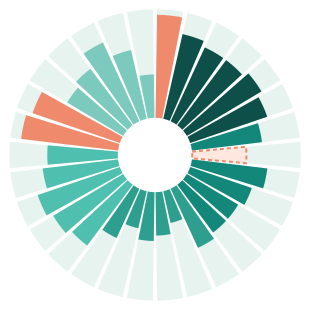
The questionnaire covers the five domains of the five-factor model. Openness to Experience describes imagination, artistic interests, emotional awareness, adventurousness, intellect and openness to values. Conscientiousness covers self-efficacy, orderliness, dutifulness, achievement-striving, self-discipline and cautiousness. Extraversion includes friendliness, gregariousness, assertiveness, activity level, excitement-seeking and cheerfulness. Agreeableness spans trust, straightforwardness, altruism, cooperation, modesty and sympathy. Emotional Sensitivity, known in research as Neuroticism, includes anxiety, anger, proneness to low mood, self-consciousness, immoderation and vulnerability to stress. Every statement describes a concrete situation, such as a queue, a free weekend or a disagreement at work, rather than an abstract quality. Each of the thirty facets is measured by four statements, and every trait score is the sum of its six facets, so two people with the same trait score can still look very different underneath.
How the test works and how to read the results
The structure follows the public-domain IPIP-NEO-120 inventory developed by John A. Johnson, with every statement written in plain, everyday language. You rate 120 statements on a five-point scale from "Very inaccurate" to "Very accurate". About forty percent are phrased in reverse, which keeps answers honest and cancels out the habit of agreeing with everything.
- Trait scores show where you sit on each of the five dimensions: low, moderate or high.
- Facet scores reveal the detail, for example high anxiety combined with low anger.
- Signature facets are your three strongest facets across all traits, the ones people notice first.
- Your lowest trait shows what balances the rest of the profile.
Neither end of a scale is better: low Extraversion is not a flaw, and high Emotional Sensitivity also means fine-tuned perception. Read the profile as a whole, because facets interact with each other.