
Blood Basics Quiz
How the Scales are Structured
Who Usually Takes This Test?
See How You Compare
Below is a preview of how scores are typically distributed across each scale.
Example Questions From the Test
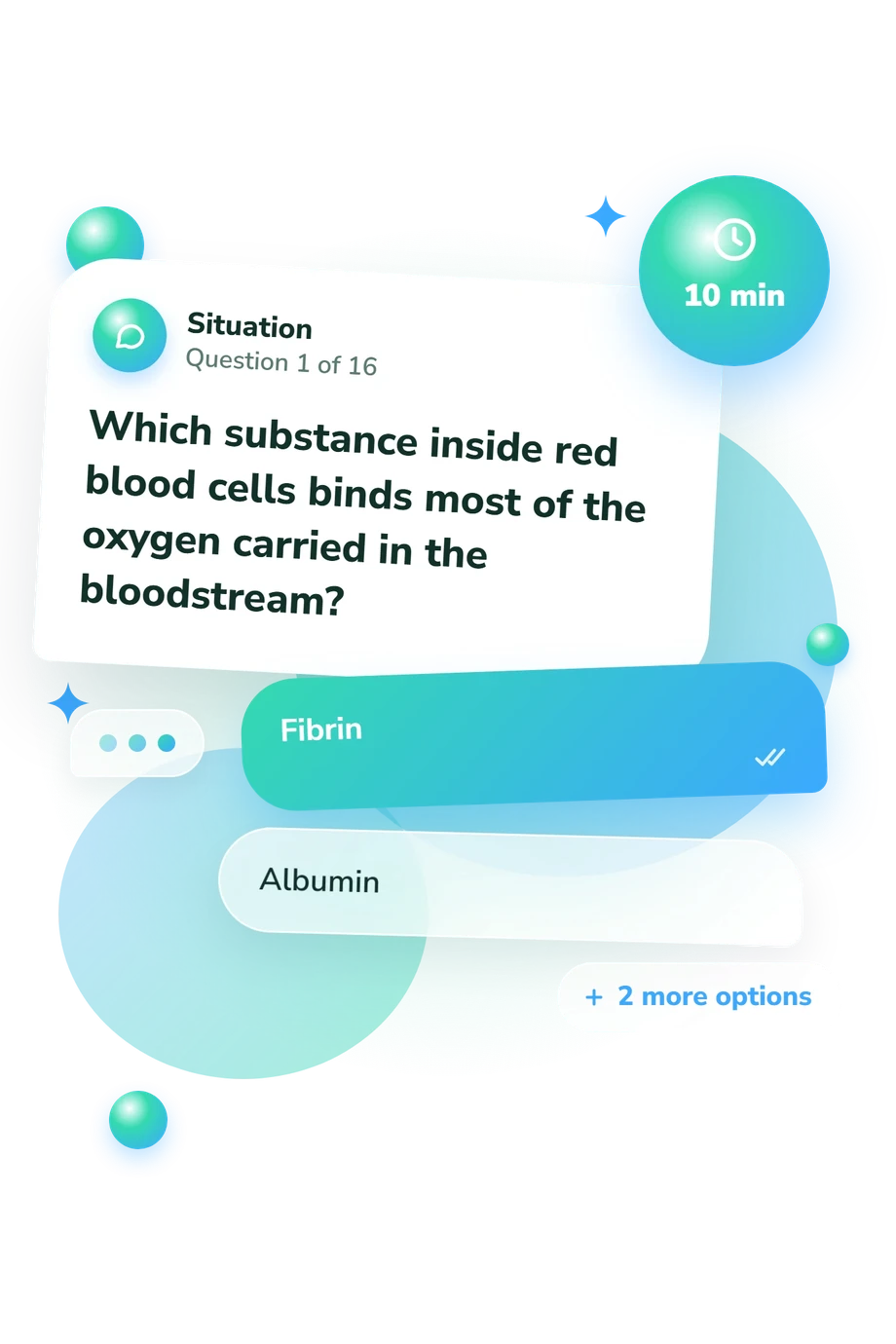
- Fibrin
- Albumin
- Hemoglobin
- Insulin
- A hyaline cartilage model
- A blood-clot model
- A tendon model
- A skeletal-muscle model
- Yellow bone marrow
- Red bone marrow
- Articular cartilage
- The periosteum alone
Blood Basics Quiz - Description and methodology of the test
For students and curious learners reviewing anatomy, this assessment offers a focused check of how blood physiology and skeletal formation fit together. The bone development quiz can show whether core ideas connect rather than remain isolated facts. Its result helps direct revision toward concepts that still feel uncertain. Questions about developing and healing bone make this a quiz about bone formation for reviewing how bone develops and repairs.
What This Assessment Explores
Blood and bone topics are treated as related concepts for introductory anatomy learners. The questions move from plasma, red cells, platelets, hematocrit, circulation, oxygen transport, and ABO compatibility to marrow, growth plates, ossification, remodeling, and fracture repair. Items about bone size distinguish lengthwise from appositional growth, making this a quiz about bone growth.
Four areas are covered:
- Blood components are identified by their roles in transport, clotting, immunity, and fluid balance.
- Circulation items test recognition of vessels and blood-flow direction.
- Marrow and hematopoiesis questions examine where blood cells are made and how formed elements differ.
- Bone development and repair items show whether you can distinguish ossification, growth-plate activity, remodeling, and callus formation.
The displayed Blood and Bone Development Knowledge scale runs from 0 to 16 and reports Foundational (0-6), Developing (7-12), or Strong (13-16). It summarizes knowledge across both domains.
Methodology and Scientific Basis
Each item uses a four-option multiple-choice format built around a short anatomy or physiology problem. The format combines direct knowledge questions, such as identifying hemoglobin or plasma, with short application scenarios involving dehydration and hematocrit, growth-plate injury, and fracture repair. As an online bone development test, it gives a compact knowledge snapshot.
The result is reported on the single displayed knowledge scale. Interpretation should allow for prior coursework, terminology familiarity, guessing, and current concentration, which can affect performance alongside understanding.
The content is conceptually consistent with OpenStax’s anatomy and physiology framework, Guyton and Hall’s treatment of blood and circulation, Marsell and Einhorn’s account of fracture healing, and Kronenberg’s work on growth-plate regulation. The questionnaire is not presented as an adaptation of those publications. The result is educational rather than medical, so use it to prioritize review rather than estimate medical risk.
- Betts, J. Gordon, Kelly A. Young, James A. Wise, Eddie Johnson, Brandon Poe, Dean H. Kruse, Oksana Korol, Jody E. Johnson, Mark Womble, and Peter DeSaix. Anatomy and Physiology 2e. OpenStax, 2022.
- Hall, John E., and Michael E. Hall. Guyton and Hall Textbook of Medical Physiology. 14th ed. Elsevier, 2021.
- Marsell, Richard, and Thomas A. Einhorn. "The Biology of Fracture Healing." Injury 42, no. 6 (2011): 551-555. 10.1016/j.injury.2011.03.031.
- Kronenberg, Henry M. "Developmental Regulation of the Growth Plate." Nature 423, no. 6937 (2003): 332-336. 10.1038/nature01657.
Updated: