
Are You Josh or Tyler Quiz
How the Scales are Structured
Who Usually Takes This Test?
See How You Compare
Below is a preview of how scores are typically distributed across each scale.
Example Questions From the Test
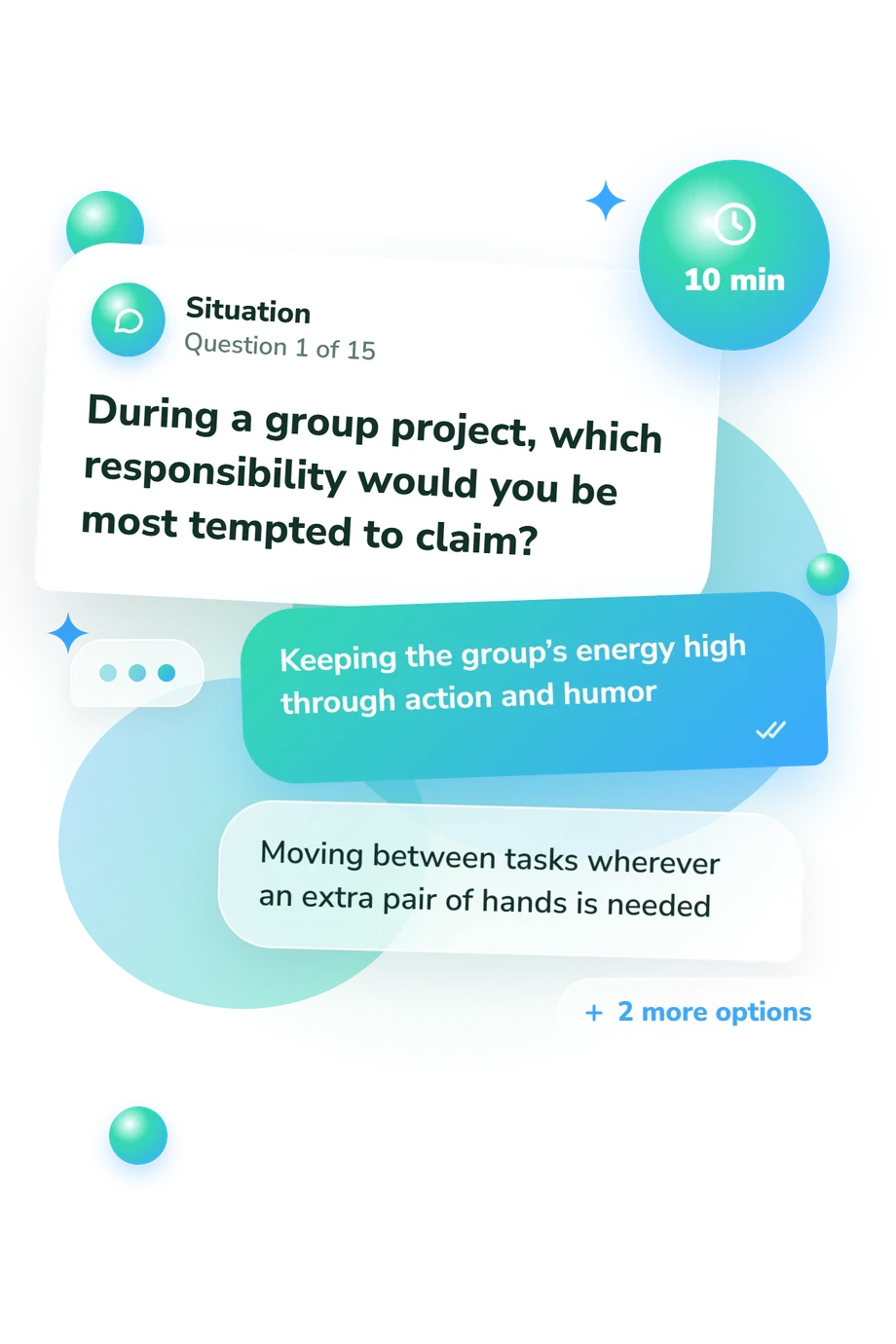
- Keeping the group’s energy high through action and humor
- Moving between tasks wherever an extra pair of hands is needed
- Defining the central message and presenting it to others
- Pairing closely with one collaborator to refine the final result
- Center the lyrics and simplify everything that competes with them
- Build the arrangement around a striking rhythmic pattern
- Add atmospheric details to reinterpret the original mood
- Preserve the back-and-forth between melodic and rhythmic roles
- Writing down the thoughts until their meaning becomes clearer
- Doing something intensely physical with a strong beat behind it
- Talking it through while building a shared playlist with someone
- Taking quiet time with a film, book, or game in another genre
Are You Josh or Tyler Quiz - Description and methodology of the test
Fans comparing what they notice in Twenty One Pilots’ music and performances can use this Twenty One Pilots affinity quiz to organize those impressions. The Are You Josh or Tyler Quiz asks readers to consider lyrics, rhythm, collaboration, and stage presence while deciding which aspects of the band’s artistry hold their attention. It suits listeners curious about the contrast between the two performers and the way they work together.
What This Assessment Explores
The questions sample creative situations involving collaboration, songwriting, stage presence, listening, and emotional expression. The Josh or Tyler Quiz looks beyond a simple member preference, separating rhythmic energy, lyrical and conceptual focus, duo interaction, and the broader identity of the band.
The three result dimensions are:
- Duo Blend (0-15) reflects collaboration, contrast, mutual responsiveness, and the duo’s combined identity: Individual Lens (0-5) emphasizes one member or element, Shared Current (6-10) values interaction, and Combined Force (11-15) values coordinated contrast.
- Josh-Inspired (0-15) reflects rhythm, movement, playful energy, and supporting percussion: Different Beat (0-5) indicates another focus, Rhythmic Spark (6-10) shows some fit, and Kinetic Spirit (11-15) marks strong resonance.
- Tyler-Inspired (0-15) reflects lyrical exploration, conceptual storytelling, instrumental curiosity, and front-facing expression: Alternate Focus (0-5) indicates another connection, Thoughtful Creator (6-10) shows several matches, and Storytelling Mind (11-15) marks strong resonance.
Methodology and Scientific Basis
Each item presents an everyday or creative situation with four answer choices. You select the response closest to your instinct, with scenarios involving group work, arranging music, live performance, listening, and emotional expression. This self-report format captures preferences rather than musical skill or factual knowledge.
Results are comparative: the highest profile shows strongest affinity, and profiles within one point of it form a blended outcome. The labels describe the direction of the response pattern.
The questionnaire is an online self-report format, conceptually consistent with the Musical Engagement Test, which connects musical engagement with personality-related patterns. It is not an adaptation of that instrument. The MUSE questionnaire offers a complementary framework for describing music engagement, but the quiz has no published norms or standardization, so its bands are descriptive rather than population-based.
As a music preference profile, it can help identify preferences and prompt conversation. Mood, current listening habits, self-awareness, and interpretations of hypothetical situations can influence answers, so the result is a context-sensitive snapshot rather than a definitive psychological measurement.
- Greenberg, David M., and Peter J. Rentfrow. “Rules of engagement: The structure of musical engagement and its personality underpinnings.” In Proceedings of the Ninth Triennial Conference of the European Society for the Cognitive Sciences of Music, edited by J. Ginsborg, A. Lamont, M. Phillips, and S. Bramley, Manchester, United Kingdom, 2015.
- Chin, Tan Chyuan, and Nikki Sue Rickard. “The Music USE (MUSE) questionnaire: An instrument to measure engagement in music.” Music Perception 29, no. 4 (2012): 429-446. 10.1525/mp.2012.29.4.429
Updated: