
Biology Quiz for Class 7
How the Scales are Structured
Who Usually Takes This Test?
See How You Compare
Below is a preview of how scores are typically distributed across each scale.
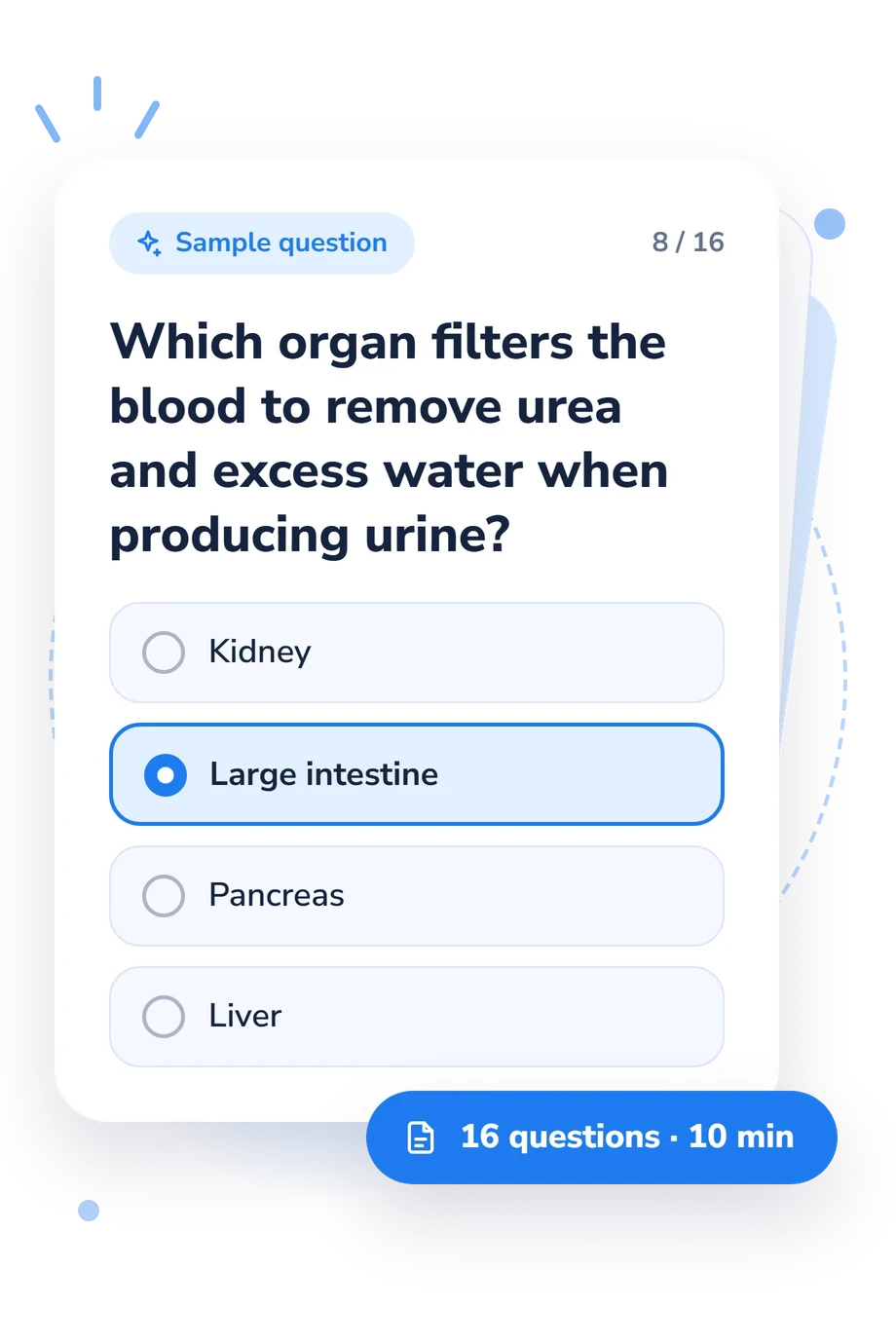
Example Questions From the Test
- In the small intestine, with the action of bile
- In the stomach, with the action of hydrochloric acid
- In the mouth, with the action of salivary amylase
- In the large intestine, with the action of gut bacteria
- The lungs need to digest stored nutrients more quickly
- Working cells stop carrying out respiration
- The body must reduce blood flow to the muscles
- Working cells need more oxygen and produce more carbon dioxide
- They separate hydrogen from water to make food
- They store air in the same way as mammal lungs
- They absorb oxygen dissolved in the water
- They turn carbon dioxide into oxygen
Biology Quiz for Class 7 - Description and methodology of the test
Students reviewing school biology can use this Class 7 biology quiz to examine how confidently they connect facts with biological processes. The Biology Quiz for Class 7 is intended for learners consolidating core concepts, teachers supporting revision, and adults who want a quick view of their subject knowledge. Its questions link structures, processes, and systems, making this biscuit picture quiz useful for seeing connections as well as individual facts.
What This Assessment Explores
The questionnaire combines factual recall with application of biological functions and relationships. Across the sampled topics, this biscuit quiz connects structures, processes, and systems across the human body, plants, animals, cells, and ecosystems.
The questionnaire covers these main areas:
- Cell structures and tissues show whether you link microscopic parts with their functions.
- Human systems cover digestion, breathing, circulation, excretion, and pulse.
- Plant biology examines transport, photosynthesis, stomata, and reproduction.
- Animal biology tests classification, adaptations, and body structures.
- Ecosystem questions address food chains, decomposers, and nutrient cycling.
The single result is reported as Class 7 Biology Knowledge (0-16), with one point for each correct answer. Foundations to Review (0-6) signals that key terms and relationships need review; Developing Knowledge (7-12) indicates many core ideas with connections still developing; Strong Knowledge (13-16) indicates a secure grasp of the covered concepts and applications.
Methodology and Scientific Basis
Four-option multiple-choice items present a biological situation or definition and ask for the best answer. The format checks recall and application, such as linking faster breathing with cellular respiration or identifying xylem as the tissue carrying water upward. As a school biology quiz, this biscuit picture test uses one best answer per item; the result is a raw count of correct responses.
The questionnaire is conceptually consistent with the Life Science Concept Inventory, a published concept inventory for foundational life-science knowledge, but this questionnaire is not adapted from it. Stammen’s MS-LSCI work illustrates Rasch-based concept-inventory development, while a later Malone study examines biological content knowledge. These sources are conceptual comparisons; their norms and validation evidence do not transfer here. No standardization or norms are claimed for this online version, so its result is a descriptive score for the sampled Class 7 items, not a standardized assessment.
Interpret the band descriptively: performance reflects the concepts sampled and can be influenced by guessing, recent instruction, memory, and wording. Reviewing missed ideas with lessons or teacher feedback adds useful context.
- Sadler, Philip M., Harold Coyle, Nancy Cook Smith, Jaimie Miller, Joel Mintzes, Kimberly Tanner, and John Murray. "Assessing the Life Science Knowledge of Students and Teachers Represented by the K-8 National Science Standards." CBE-Life Sciences Education 12, no. 3 (2013): 553-575. 10.1187/cbe.12-06-0078.
- Stammen, Andria. "The Development and Validation of the Middle School-Life Science Concept Inventory (MS-LSCI) Using Rasch Analysis." Doctoral dissertation, The Ohio State University, 2018.
- Malone, Kathy L., William J. Boone, Andria Stammen, Anita Schuchardt, Lin Ding, and Zakee Sabree. "Construction and Evaluation of an Instrument to Measure High School Students Biological Content Knowledge." EURASIA Journal of Mathematics, Science and Technology Education 17, no. 12 (2021): em2048. 10.29333/ejmste/11376.
Updated: