
Bike Safety Quiz for Kids
How the Scales are Structured
Who Usually Takes This Test?
See How You Compare
Below is a preview of how scores are typically distributed across each scale.
Example Questions From the Test
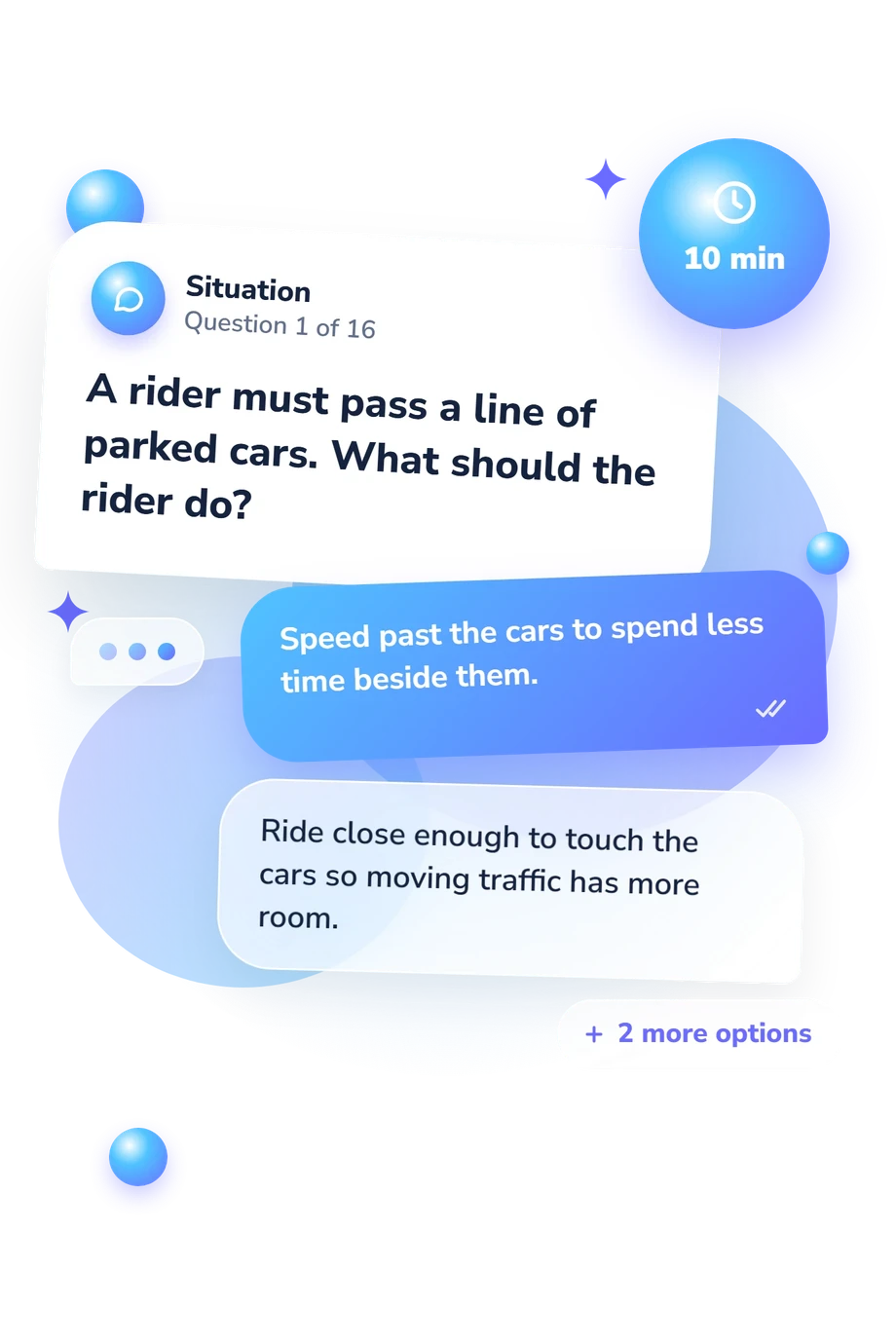
- Speed past the cars to spend less time beside them.
- Ride close enough to touch the cars so moving traffic has more room.
- Watch only the parked cars' wheels because doors cannot open while a car is still.
- Leave space for doors to open and watch for drivers, passengers, and pedestrians.
- Brake later because wet tires grip more strongly.
- Reduce speed, allow more stopping distance, and brake and steer smoothly.
- Make quick turns to spend less time on slippery sections.
- Lower tire pressure during the ride without checking the manufacturer's range.
- Bell, paint, basket, and kickstand
- Seat colour, reflectors, pedals, and water bottle
- Tire air, brakes, chain or cranks, and secure wheels
- Handlebar grips, decorations, mudguards, and frame stickers
Bike Safety Quiz for Kids - Description and methodology of the test
Children who are learning to ride, and the adults guiding them, can use this questionnaire to check practical decisions before more independent cycling. Although the label is biology quiz for class 8 with answers, the content concerns bicycle safety rather than biology. It works as a cycling safety assessment by showing which rules a young rider understands and which deserve discussion or supervised practice.
What This Assessment Explores
The questions cover helmet fit and replacement, bicycle checks, visibility, hearing, wet surfaces, railway crossings, intersections, driveways, parked cars, turns, group riding, road direction, and crash response. Despite the grade 8 biology quiz wording, the intended reader is a child learning or practising bicycle riding with adult guidance.
Short scenarios show whether the respondent recognizes hazards and chooses safer actions. The result describes knowledge of practical rules, not behaviour in every traffic situation.
The result is reported on Bike Safety Knowledge (0-16), with these displayed bands:
- Starting (0-6) signals that core rules need review with a trusted adult.
- Developing (7-12) shows that many essentials are understood but uncertain situations merit practice.
- Strong (13-16) reflects broad knowledge of safer riding habits while still requiring attention to local rules and supervision.
Methodology and Evidence Base
Each item presents a practical riding scenario with four answer choices. The respondent selects the safest action, so the format examines hazard recognition, preventive habits, communication, and emergency priorities rather than feelings or symptom frequency. The score condenses performance across these situations into one knowledge result; its bands are descriptive guidance, not published norms or a standardized measure of riding behaviour.
BikeSafe (Hooshmand et al., 2014) is the closest named comparison because it evaluated learning in a bicycle-safety program. This questionnaire is conceptually consistent with that work, not an adaptation of its instrument. Lachapelle et al. (2013) and McLaughlin and Glang (2010) also examined bicycle-safety education, knowledge, and behaviour. Their findings support the educational relevance of these topics without validating this exact online questionnaire.
The biology quiz for eighth grade label does not change the content: children must interpret hazards and select appropriate action. Answers can be affected by guessing, memory, confidence, and previous practice, so uncertain results are best discussed with a trusted adult and checked through supervised, traffic-free practice. The score cannot establish independent riding readiness.
- Hooshmand J, Hotz G, Neilson V, Chandler L. BikeSafe: Evaluating a Bicycle Safety Program for Middle School Aged Children. Accident Analysis & Prevention. 2014;66:182-186. 10.1016/j.aap.2014.01.011
- Lachapelle U, Noland RB, Von Hagen LA. Teaching Children About Bicycle Safety: An Evaluation of the New Jersey Bike School Program. Accident Analysis & Prevention. 2013;52:237-249. 10.1016/j.aap.2012.09.015
- McLaughlin KA, Glang A. The Effectiveness of a Bicycle Safety Program for Improving Safety-Related Knowledge and Behavior in Young Elementary Students. Journal of Pediatric Psychology. 2010;35(4):343-353. 10.1093/jpepsy/jsp076
Updated: