
Cloning Quiz
How the Scales are Structured
Who Usually Takes This Test?
See How You Compare
Below is a preview of how scores are typically distributed across each scale.
Example Questions From the Test
- The need for DNA inside each new animal's cells
- A lack of genetic diversity among the remaining animals
- The inheritance of any nuclear genes from the donor
- The ability of cells to divide during development
- Transferring an adult somatic-cell nucleus into an enucleated egg
- Editing a fertilized egg to contain selected sheep genes
- Splitting a naturally fertilized embryo into several embryos
- Fertilizing an egg with sperm from a genetically related sheep
- Fraternal twins developing from two separately fertilized eggs
- Offspring produced by two closely related parents
- Identical twins developing after one embryo splits
- A hybrid plant produced by crossing two varieties
Cloning Quiz - Description and methodology of the test
Students, educators, and curious readers who want to understand how cloning works can use this cloning quiz to test core genetics concepts. The result focuses on whether you can distinguish molecular, reproductive, and therapeutic methods and connect them with DNA inheritance, development, and environmental effects. This cloning knowledge test provides a broad indication of your overall understanding and whether review may be useful.
What This Assessment Explores
This questionnaire measures conceptual understanding rather than laboratory skill. Its scenarios ask how DNA is copied, how nuclear transfer changes genetic contributions, and why clones can differ in traits, development, or behavior. It suits foundational-genetics learners. Readers reviewing cloning can compare DNA-level procedures with embryo and whole-organism approaches. That distinction matters during molecular cloning review because PCR amplifies DNA apart from plasmid copying.
These items cover four areas:
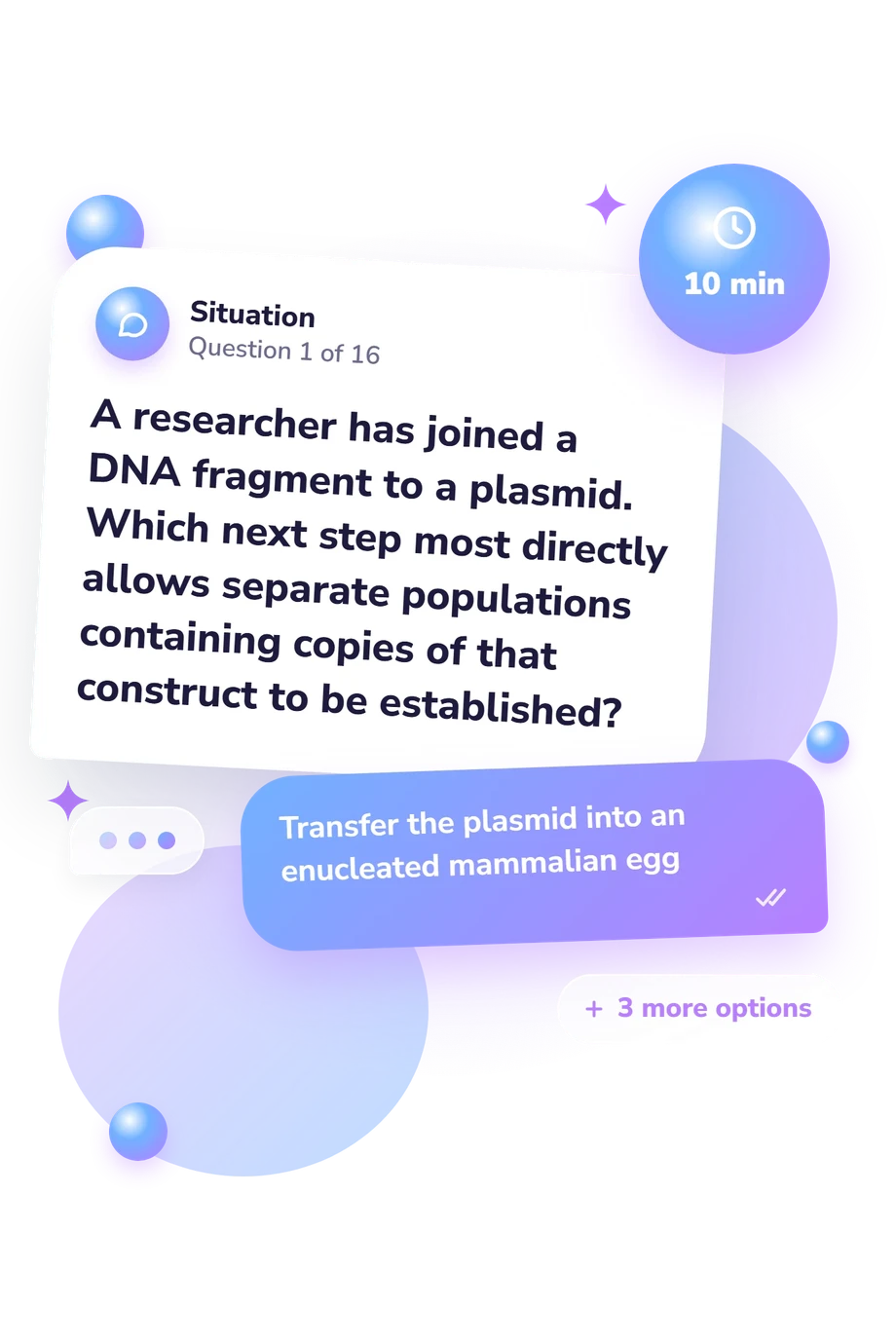
- Molecular cloning covers plasmids, host cells, and colonies, while PCR amplifies selected DNA without a plasmid vector.
- Nuclear-transfer cloning traces donor nuclei and the nuclear and mitochondrial DNA associated with enucleated eggs.
- Embryo splitting and natural cloning show how similar organisms can develop without identical traits.
- Cloning Knowledge (0-16) gives the overall band: Foundational (0-6), Developing (7-12), or Strong (13-16).
The bands reflect understanding of methods, inheritance, development, and limitations.
Methodology and Evidence Base
Each item presents a short biological problem with four answer choices, requiring the best explanation. Topics span plasmid copying, PCR, nuclear transfer, embryo splitting, therapeutic aims, conservation, and biological variation. The format tests concept recognition and application rather than agreement or personal experience.
The scoring display presents one knowledge result with descriptive bands. That overall result can indicate whether broad review may be useful, but it cannot show separate topic scores; performance may also reflect prior study, attention, guessing, or unfamiliar terminology.
The original Dolly nuclear-transfer study, research on somatic-cell nuclear-transfer reprogramming, and a study of embryo splitting and mammalian cloning provide conceptual context for the questions. Work on plasmids, vectors, bacterial hosts, and PCR supports the distinctions among DNA-copying methods. The questionnaire is conceptually consistent with these works, but they provide context for its topics rather than evidence that this online questionnaire is adapted from or validated against them. A cloning assessment therefore works best as a broad educational check, not a profile of specific strengths.
- Rahbaran M, Razeghian E, Maashi MS, Jalil AT, Widjaja G, Thangavelu L, Kuznetsova MY, Nasirmoghadas P, Heidari F, Marofi F, Jarahian M. Cloning and Embryo Splitting in Mammalians: Brief History, Methods, and Achievements. Stem Cells International. 2021;2021:2347506. 10.1155/2021/2347506
- Brown TA. Gene Cloning and DNA Analysis: An Introduction. 8th ed. Wiley-Blackwell; 2020. ISBN 978-1-119-64078-3
- Wilmut I, Schnieke AE, McWhir J, Kind AJ, Campbell KHS. Viable offspring derived from fetal and adult mammalian cells. Nature. 1997;385(6619):810-813. 10.1038/385810a0
- Matoba S, Zhang Y. Somatic Cell Nuclear Transfer Reprogramming: Mechanisms and Applications. Cell Stem Cell. 2018;23(4):471-485. 10.1016/j.stem.2018.06.018
Updated: