
China Quiz
How the Scales are Structured
Who Usually Takes This Test?
See How You Compare
Below is a preview of how scores are typically distributed across each scale.
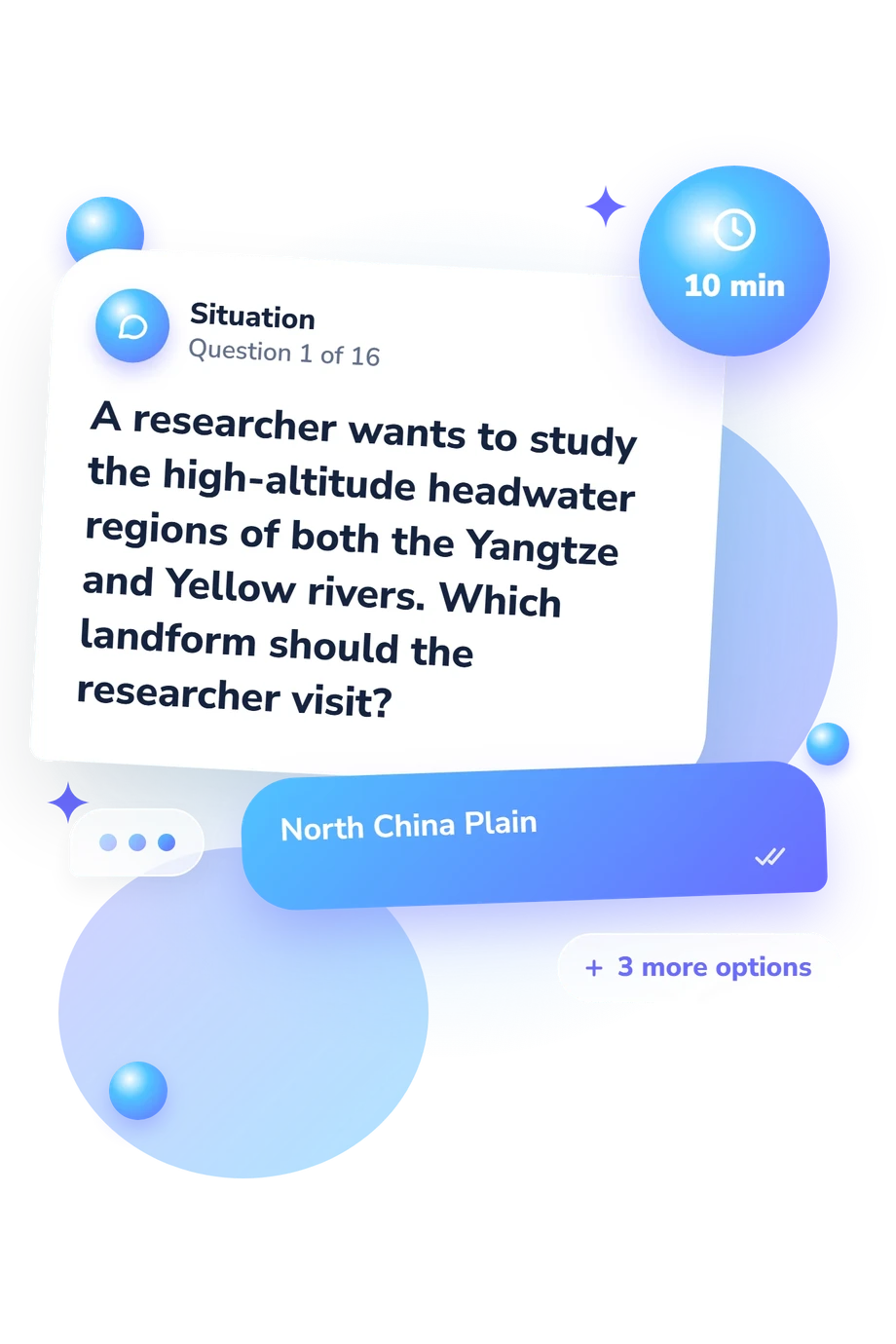
Example Questions From the Test
- Jilin
- Heilongjiang
- Liaoning
- Hebei
- Hainan
- Fujian
- Zhejiang
- Jiangsu
- Hunan
- Yunnan
- Sichuan
- Fujian
China Quiz - Description and methodology of the test
For readers who want to check their understanding of China’s physical and human geography, the China Quiz offers a focused knowledge exercise. It suits curious learners, travelers, students, and anyone building a regional framework. As a China geography quiz, it connects factual recall with applied reasoning, helping the result point to subjects that deserve closer study.
What This Assessment Explores
Rather than measuring personality or opinion, the assessment checks whether major features of China fit into a coherent geographic picture. It suits learners testing knowledge or identifying gaps.
Its content makes this a China geography test linking natural systems with human geography. It asks whether places, rivers, climate, landforms, provinces, cities, borders, and economic regions fit together.
The item themes show what contributes to the result:
- Physical geography shows how landforms, climate, rivers, deserts, and karst processes form connected systems.
- Regional geography shows whether cities, provinces, corridors, deltas, and borders can be located in relation to one another.
- Spatial reasoning shows how well geographic relationships are applied to routes, rainfall, official time, and river systems.
China Geography Knowledge (0-16) reports Foundations to build (0-6), Developing knowledge (7-12), and Strong knowledge (13-16). The bands describe understanding reflected in the answers.
Methodology and Evidence Base
Each item presents a factual or scenario-based prompt with four answer choices and one best response. The format combines recall with applied reasoning about climate, routes, rivers, regional location, and human geography. The responses are combined into the displayed total; because no item weighting or correction rule is stated, no extra scoring system should be inferred.
The approach is conceptually consistent with the Knowledge of Geography test (Nelson et al., 1999), a published precedent for assessing geographic knowledge. Veeck et al. (2021) provides subject context for China’s physical, political, economic, and social geography, while Lee and Bednarz’s work supports the attention to spatial relationships and applied geographic thinking. This questionnaire is not presented as an adaptation of any of those works or as a standardized administration.
For study planning, the quiz questions about China can reveal strengths in factual knowledge and connections between regions. The result should still be read cautiously: performance may vary with prior study, language familiarity, guessing, and the respondent’s current context. It is a descriptive learning check, not a clinical or educational placement assessment.
- Nelson, Burton D., Robert H. Aron, and Debra A. Poole. "Underprediction of Female Performance from Standardized Knowledge Tests: A Further Example from the Knowledge of Geography Test." Sex Roles 41, no. 7-8 (1999): 529-540.
- Veeck, Gregory, Clifton W. Pannell, Xiaoping Shen, and Youqin Huang. China's Geography: Globalization and the Dynamics of Political, Economic, and Social Change. 4th ed. Lanham, MD: Rowman & Littlefield, 2021.
- Lee, Jongwon, and Robert Bednarz. "Components of Spatial Thinking: Evidence from a Spatial Thinking Ability Test." Journal of Geography 111, no. 1 (2012): 15-26. 10.1080/00221341.2011.583262
Updated: