
Chemistry Quiz
How the Scales are Structured
Who Usually Takes This Test?
See How You Compare
Below is a preview of how scores are typically distributed across each scale.
Example Questions From the Test
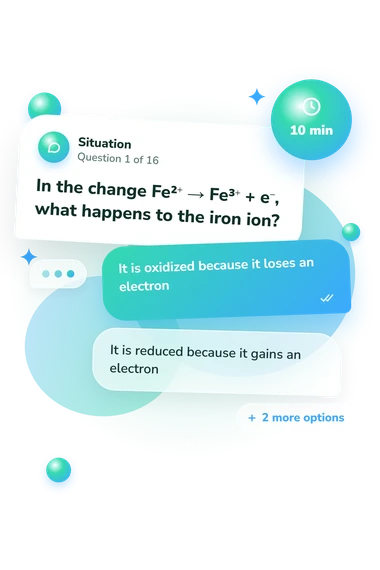
- It is oxidized because it loses an electron
- It is reduced because it gains an electron
- It is reduced because it gains a proton
- It is oxidized because it gains an electron
- They have identical atomic masses
- They have similar valence-electron arrangements
- They contain the same number of occupied electron shells
- They have equal numbers of protons and neutrons
- It permanently shifts the equilibrium toward the products
- It provides an alternative pathway with lower activation energy
- It is consumed to provide energy to the reactants
- It raises the temperature of the reacting mixture
Chemistry Quiz - Description and methodology of the test
Students reviewing introductory chemistry, curious learners, and anyone preparing for further study can use this chemistry quiz to connect core ideas with practical reasoning. The result offers a focused snapshot of current understanding rather than a label about ability. A chem quiz can help reveal where confidence is supported by concepts and where targeted review may make future learning more efficient.
What This Assessment Explores
The questionnaire checks introductory knowledge through atomic structure, periodic patterns, bonding, reactions, quantities, energy, acids and bases, safety, and equilibrium. It suits learners seeking an academic self-check.
Learners use a chemistry practice quiz to apply rules by identifying oxidation, balancing equations, calculating amounts, predicting pH changes, and explaining equilibrium effects.
The result covers these dimensions and bands:
- Chemistry Knowledge (0-16) summarizes performance: Foundations to Build (0-6) signals review needs; Developing Knowledge (7-12) reflects central understanding with gaps; Strong Knowledge (13-16) indicates reliable introductory command.
- Atomic structure and molecular behavior show how the respondent connects particles, periodic patterns, bonding, and physical properties.
- Reactions and quantitative reasoning show how the respondent handles equations, energy, concentrations, moles, pH, limiting reactants, and equilibrium.
Methodology and Evidence Base
Each item presents a concept or scenario with four answer choices. The chemistry questions ask the respondent to select the best explanation or calculation through recognition, reasoning, or application. This single-best-answer format does not show partial knowledge.
The displayed result is one overall knowledge score. Because no weighting scheme or subscale calculation is stated, it is a summary of selected responses rather than a normed estimate or profile of separate abilities.
Its evidence base is conceptually consistent with Chemical Concepts Inventory (Mulford & Robinson, 2002), a published measure of introductory chemistry conceptions, but this questionnaire is not presented as its adaptation. Barbera (2013) examined the inventory psychometrically, while Schwartz and Barbera (2014) evaluated content and response-process validity. Those studies support attention to concept understanding and item interpretation; they do not establish norms or validation for this online version.
Guessing, wording interpretation, prior instruction, and current context can affect performance, so broader evidence from coursework or laboratory work remains useful.
- Mulford, Douglas R., and William R. Robinson. "An Inventory for Alternate Conceptions among First-Semester General Chemistry Students." Journal of Chemical Education 79, no. 6 (2002): 739-744. 10.1021/ed079p739
- Barbera, Jack. "A Psychometric Analysis of the Chemical Concepts Inventory." Journal of Chemical Education 90, no. 5 (2013): 546-553. 10.1021/ed3004353
- Schwartz, Paul, and Jack Barbera. "Evaluating the Content and Response Process Validity of Data from the Chemical Concepts Inventory." Journal of Chemical Education 91, no. 5 (2014): 630-640. 10.1021/ed400716p