
Cheese Quiz
How the Scales are Structured
Who Usually Takes This Test?
See How You Compare
Below is a preview of how scores are typically distributed across each scale.
Example Questions From the Test
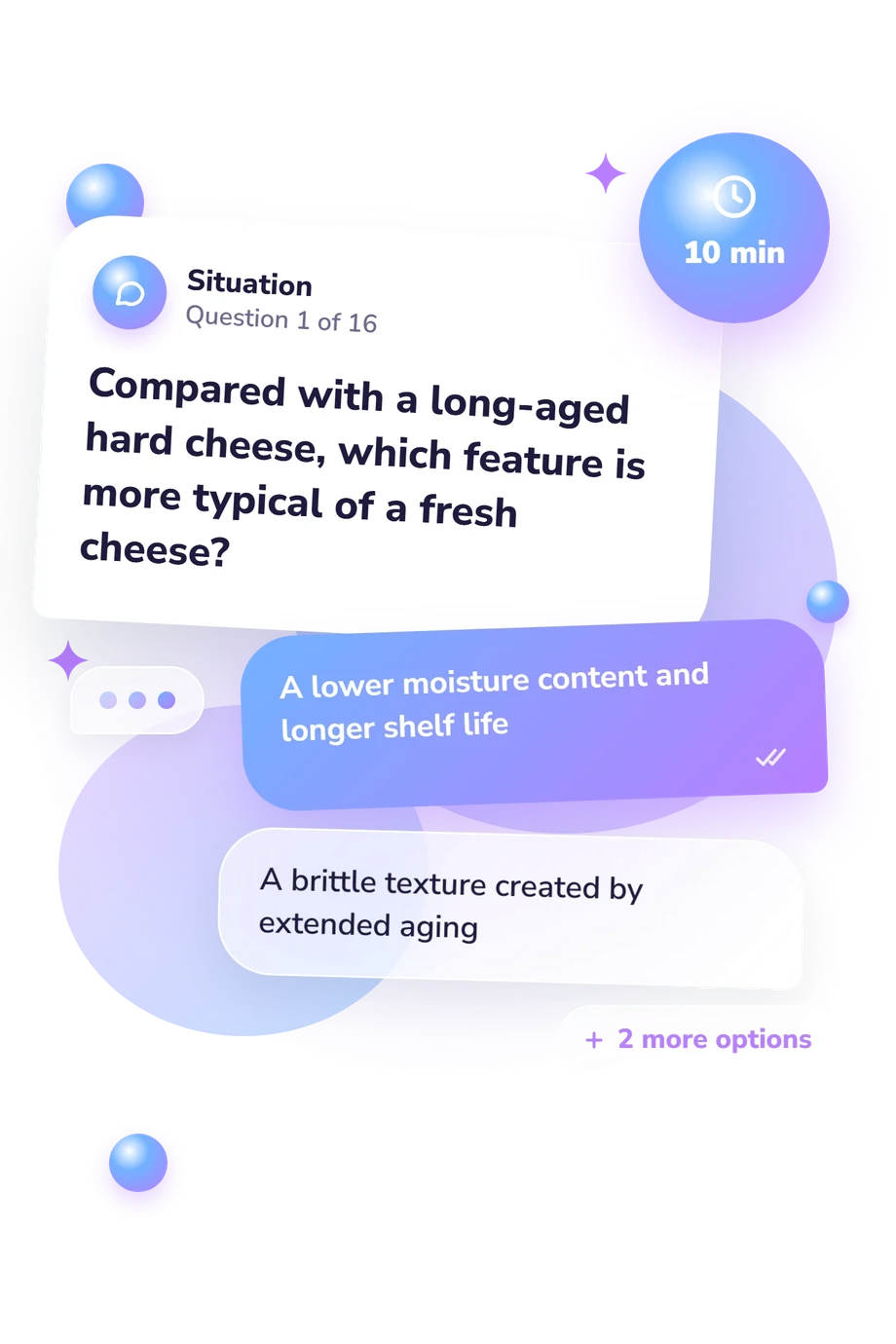
- A lower moisture content and longer shelf life
- A brittle texture created by extended aging
- A thick natural rind and concentrated flavor
- A higher moisture content and shorter shelf life
- It coagulates milk so curds can form.
- It adds the holes found in Swiss-style cheeses.
- It creates a protective wax coating.
- It removes all moisture from the curd.
- A deliberately cultivated white mold
- A layer of crystallized milk sugar
- Salt pressed out from the cheese's center
- Butterfat rising to the surface
Cheese Quiz - Description and methodology of the test
Designed for curious home cooks, food lovers, students, and anyone who wants to understand cheese beyond familiar labels, the cheese quiz checks practical knowledge of how cheese is made, matured, selected, and handled. Across the questionnaire, you encounter questions and answers about cheese, milk treatment, curd formation, cultures, ripening, tasting, storage, and cooking behavior. Your result can highlight familiar foundations and point toward topics worth exploring more closely.
What This Assessment Explores
This assessment suits readers who want a practical picture of cheese literacy rather than a personality profile. It covers how cheese is made, matured, selected, cooked, and stored.
Although approachable as a cheese trivia quiz, the result is best read as a map of subject knowledge. It shows which core ideas are familiar and which may reward further study.
The result includes these areas:
- Cheese Knowledge (0-16) measures correct answers: Foundations to Build is 0-6, Developing Connoisseur is 7-12, and Strong Cheese Knowledge is 13-16.
- Cheesemaking fundamentals show whether you understand milk, cultures, curds, and coagulation.
- Styles and ripening show whether you recognize rinds, molds, aging changes, crystals, and eyes.
- Practical use and care show whether you can judge labels, pairings, cooking behavior, and storage.
Methodology and Evidence Base
Each item presents a cheese situation or concept with four choices and asks for the best explanation. Topics span milk chemistry, coagulation, ripening, rind ecology, labeling, pairing, storage, and heat behavior. The displayed score is the count of correct answers, so it reflects knowledge rather than self-rating.
The content is conceptually consistent with the ACS Body of Knowledge (2017) and technical principles described by Fox and colleagues in 2017 and 2004. It is not presented as an adaptation of those publications; those works provide context for the subject matter, not validation of this version.
In practice, this is a cheese knowledge quiz: an educational knowledge check, not a norm-referenced clinical measure. Its fixed bands are guidance rather than population norms or proof of professional cheesemaking ability. Results may vary with prior exposure, technical vocabulary, and familiarity with styles.
Read the result as a snapshot of recognition. A strong band suggests broad command of tested concepts; a lower band highlights subjects for review. The score cannot capture sensory discrimination, manual technique, or cheese diversity, and fixed choices limit what it reveals.
- American Cheese Society. Body of Knowledge. Revised 2017.
- Fox, Patrick F., Timothy P. Guinee, Timothy M. Cogan, and Paul L. H. McSweeney. Fundamentals of Cheese Science. 2nd ed. Springer, 2017. 10.1007/978-1-4899-7681-9
- Fox, Patrick F., Paul L. H. McSweeney, Timothy M. Cogan, and Timothy P. Guinee, editors. Cheese: Chemistry, Physics and Microbiology. 3rd ed., volumes 1-2. Elsevier, 2004.
Updated: