
Cell Transport Quiz
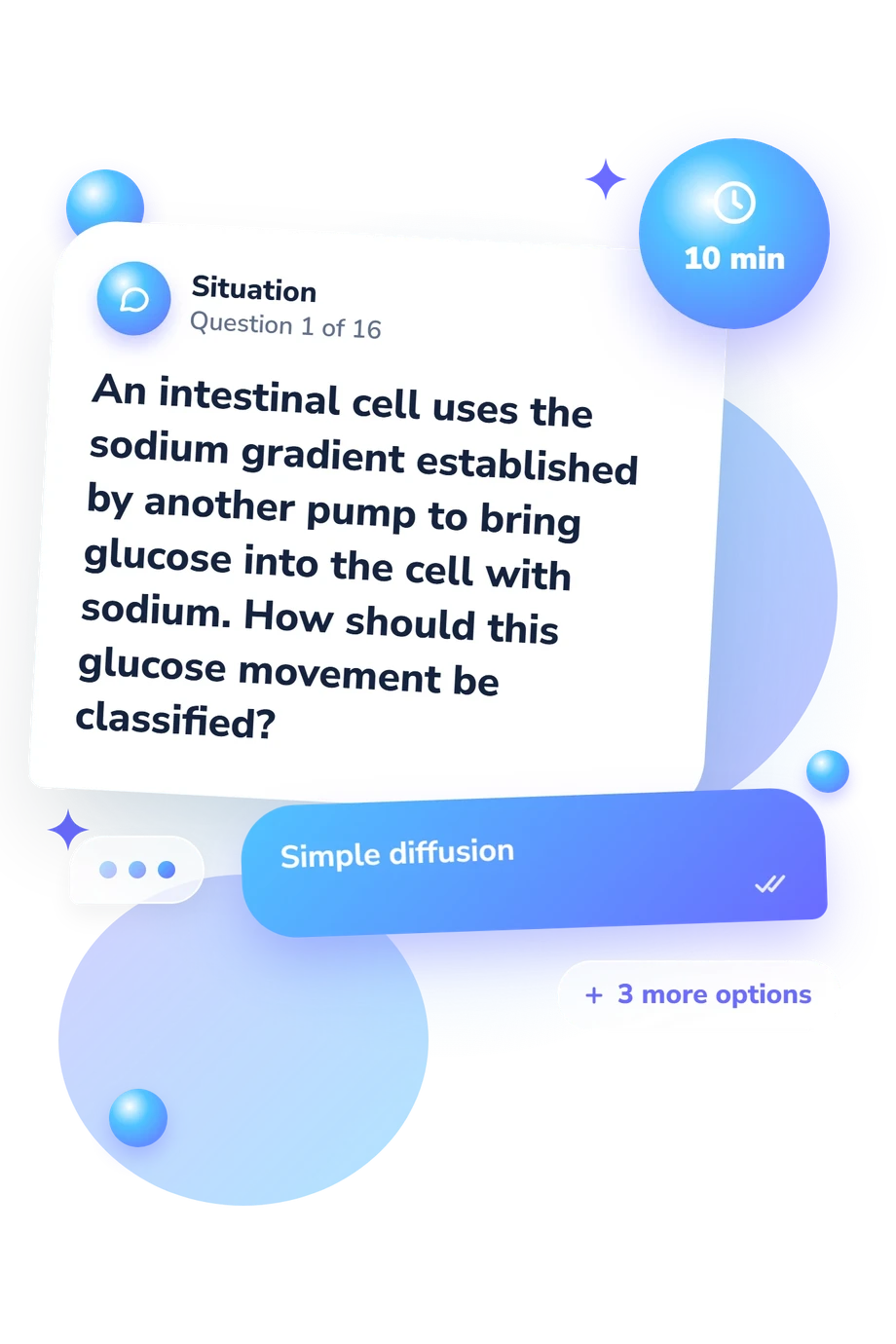
How the Scales are Structured
Who Usually Takes This Test?
See How You Compare
Below is a preview of how scores are typically distributed across each scale.
Example Questions From the Test
- Simple diffusion through the lipid bilayer
- Facilitated diffusion
- Exocytosis
- Primary active transport
- Phagocytosis
- Receptor-mediated exocytosis
- Facilitated diffusion
- Osmosis
- Active transport
- Endocytosis
- Diffusion
- Exocytosis
Cell Transport Quiz - Description and methodology of the test
Students reviewing membrane physiology, preparing for biology class, or checking a recently learned topic can use this cell transport quiz as a classroom knowledge check. Classroom situations involving gradients, pumps, and membrane movement turn this cellular transport quiz into a focused knowledge check, with an overall result that reflects performance on the concepts tested.
What This Assessment Explores
Questions cover gradients, water balance, membrane proteins, ATP use, vesicles, and surface-area-to-volume relationships. They help learners classify transport processes and predict how changing conditions affect cell behavior. Because the questions ask learners to apply these distinctions to different solutions and membrane conditions, this biology quiz on cell transport tests more than recall.
The main knowledge areas are:
- Diffusion and gradients show whether you recognize movement down a concentration or electrochemical gradient.
- Osmosis and tonicity show whether you can predict water movement in different solutions.
- Transport proteins and energy show whether you distinguish channels, carriers, and active transport.
- Vesicular transport and exchange capacity show whether you identify bulk movement and the importance of surface area.
Cell Transport Knowledge (0-16) is the displayed scale. Its bands are Foundations to Build (0-6), Developing Knowledge (7-12), and Strong Knowledge (13-16), showing increasingly connected understanding.
Methodology and Evidence Base
Each item presents a cell-based scenario or definition with four answer choices. The score is the number of correct responses, so the result from this membrane transport quiz reflects performance on the tested concepts rather than a personality profile. A general review can use the overall result to revisit gradients, tonicity, transport proteins, and vesicle processes covered by the questions.
The questions are conceptually consistent with the Diffusion and Osmosis Diagnostic Test (Odom and Barrow, 1995), especially its attention to gradients, water movement, and conceptual misunderstandings. They are also conceptually consistent with the Cell Biology Concept Inventory described by Fisher, Williams, and Lineback (2011), while textbooks by Clark, Douglas, and Choi and by Alberts and colleagues support standard cell-biology terminology and mechanisms rather than serving as sources of this questionnaire. This questionnaire is not an adaptation of either published instrument.
Interpretation is oriented toward review: a lower result points to foundational terms needing attention, while a higher result indicates stronger integration of mechanisms and predictions. The questionnaire has no stated standardized norms, and answers depend on prior instruction, wording, attention, and current understanding, so the score is best treated as a learning snapshot rather than a standardized placement measure.
- Odom, Arthur Louis, and Lloyd H. Barrow. "Development and application of a two-tier diagnostic test measuring college biology students' understanding of diffusion and osmosis after a course of instruction." Journal of Research in Science Teaching 32(1) (1995): 45-61. 10.1002/tea.3660320106
- Fisher, Kathleen M., Kathy S. Williams, and Jennifer Evarts Lineback. "Osmosis and Diffusion Conceptual Assessment." CBE-Life Sciences Education 10(4) (2011): 418-429. 10.1187/cbe.11-04-0038
- Clark, Mary Ann, Matthew Douglas, and Jung Choi. Biology 2e. Houston, TX: OpenStax, 2018.
- Alberts, Bruce, Rebecca Heald, Alexander Johnson, David Morgan, Martin Raff, Keith Roberts, and Peter Walter. Molecular Biology of the Cell. 7th ed. New York: W. W. Norton & Company, 2022.
Updated: