
Car Quiz
How the Scales are Structured
Who Usually Takes This Test?
See How You Compare
Below is a preview of how scores are typically distributed across each scale.
Example Questions From the Test
- Replace the catalytic converter
- Inspect and clean the terminal connections safely
- Lower the tire pressures
- Drain the engine coolant
- To let driven wheels rotate at different speeds while cornering
- To prevent the suspension from moving independently
- To regulate fuel pressure during acceleration
- To synchronize the engine’s intake and exhaust valves
- Starter motor
- Radiator
- Flywheel
- Alternator
Car Quiz - Description and methodology of the test
Drivers who want to check practical automotive understanding can use this car quiz with answers to see how confidently they recognize common systems, maintenance decisions, and safety responses. Its cars quiz questions and answers connect technical terms with situations a driver may meet during ownership or travel. It is suitable for learners, new or returning drivers, and vehicle owners who want a focused learning snapshot.
What This Assessment Explores
It checks whether respondents recognize vehicle principles and choose sensible responses to operating, maintenance, and road-safety situations. The test uses quiz questions on cars with answers to reflect recall and application.
The main themes are:
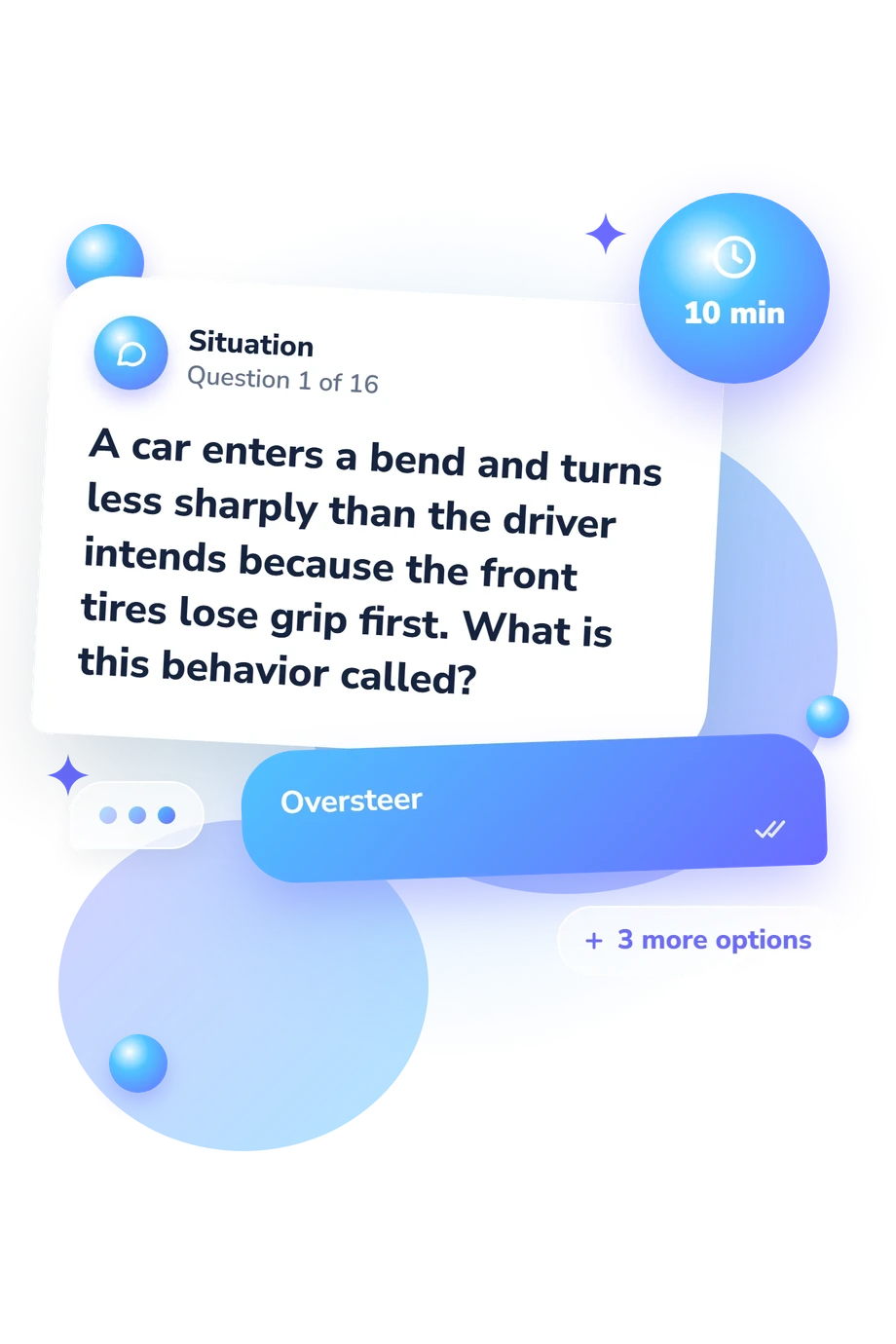
- Vehicle dynamics shows recognition of grip loss, understeer, torque, braking, and traction limits.
- Maintenance awareness indicates whether you choose sensible checks for tires, battery terminals, coolant, oil warnings, and tread wear.
- Vehicle systems knowledge reflects familiarity with the alternator, clutch, differential, catalytic converter, and anti-lock braking.
- Safety and identification knowledge shows understanding of hydroplaning responses, octane rating, and VIN purpose.
Car Knowledge is the displayed scale, ranging from 0-16. Foundation Builder (0-6) signals partial fundamentals; Developing Knowledge (7-12) signals useful working understanding; Automotive Expert (13-16) signals broad knowledge of operation, handling, and care. The result describes knowledge, not driving skill.
Methodology and Evidence Base
Every item presents a technical question or practical scenario. Each item offers four choices; auto quiz questions and answers ask for the best answer. The displayed rule awards one point for each correct answer, so the total counts correct responses. This format tests recognition and simple application without written explanations.
A report by Williams on vehicle monitoring addresses vehicle information relevant to monitoring and operation, rather than measuring general car knowledge. Mayer and Laux provide a related discussion of maintenance awareness and driver safety readiness, while Gillespie covers concepts involving handling, torque, braking, and traction. The questionnaire is conceptually consistent with these works, not a reproduction or validated adaptation of them.
Interpret the result as a learning snapshot: missed items can identify topics for review, while correct answers show areas of stronger knowledge. Performance may be affected by guessing, prior exposure, and current attention, and a single score cannot capture every aspect of vehicle competence. Use the pattern of answers to choose further study in systems, maintenance, handling, or safety rather than treating it as a complete measure of driving ability.
- Williams, Marie, Eileen Hoekstra, and Paul Green. Development and Evaluation of a Vehicle Monitor Driver Interface. Technical Report UMTRI-93-22. Ann Arbor, MI: University of Michigan Transportation Research Institute, 1993.
- Mayer, D. L., and L. F. Laux. “Automotive Maintenance and Safety Preparedness among Drivers: Aspects of Age and Gender.” Proceedings of the Human Factors Society Annual Meeting 34, no. 14 (1990): 993-997. 10.1177/154193129003401407
- Gillespie, Thomas D. Fundamentals of Vehicle Dynamics. Warrendale, PA: Society of Automotive Engineers, 1992. 10.4271/R-114
Updated: