
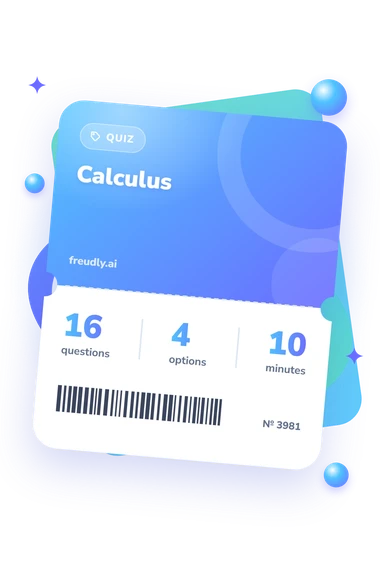
Calculus Quiz
How the Scales are Structured
Who Usually Takes This Test?
See How You Compare
Below is a preview of how scores are typically distributed across each scale.
Example Questions From the Test
- 0
- 3
- 9
- 6
- The graph is concave down there.
- The graph is concave up there.
- The graph has an inflection point there.
- The graph has zero concavity there.
- 1 unit by 9 units
- 2 units by 8 units
- 5 units by 5 units
- 4 units by 6 units
Calculus Quiz - Description and methodology of the test
Students reviewing introductory differentiation or deciding what to study next can use this calculus quiz to connect rules, concepts, graphs, and applications. This online assessment turns selected-response performance into an aggregate result showing whether foundational review is warranted, understanding is developing, or command appears strong. As a calculus assessment, it gives a focused snapshot of current understanding and points toward broad revision across the sampled concepts.
What This Assessment Explores
The questions sample whether learners can recognize and apply ideas, not only recall formulas. They connect symbolic work with derivative meaning, graph behavior, rates, and optimization. This calculus practice quiz can indicate whether sampled concepts need more practice.
The main areas are:
- Limits and derivatives show whether formulas are connected to instantaneous change.
- Differentiation rules indicate how procedures are chosen for powers, products, composites, quotients, and inverses.
- Applications show how calculus is transferred to optimization, related rates, marginal cost, tangents, and linearization.
- Graphs and theorems reveal understanding of concavity, continuity, critical numbers, and mean-value reasoning.
The sole scale, Calculus Knowledge, ranges from 0-16: Foundations to review (0-6) marks core ideas needing practice; Developing command (7-12) reflects understanding with gaps; Strong command (13-16) reflects consistent understanding of derivatives and common applications. It is a practice summary, not a formal assessment.
Methodology and Scientific Basis
Each item presents four answer choices. Numerical prompts sit alongside questions about what a derivative, graph, theorem, or modeling step means, so the format samples conceptual recognition as well as applied calculation.
Results appear as one aggregate practice summary with no separate subscores. The displayed bands are therefore best used to choose revision priorities, not to rank the respondent against a norm.
Conceptually, the questionnaire is consistent with the Calculus Concept Inventory, a published measure of foundational calculus understanding. A later psychometric analysis of that inventory examines its measurement use, while Schoenfeld's work places assessment within broader educational practice. Conceptual consistency does not establish validity, norms, or adaptation status for this online questionnaire; its displayed result is descriptive and treated as a practice summary rather than a standardized measure.
This online quiz for calculus uses selected responses and one aggregate score, so the result reflects current preparation, attention to wording, and confidence; proof, open-ended modeling, and sustained problem-solving require broader evidence.
- Epstein, Jerome. "The Calculus Concept Inventory-Measurement of the Effect of Teaching Methodology in Mathematics." Notices of the American Mathematical Society, vol. 60, no. 8, 2013, pp. 1018-1026. 10.1090/noti1033
- Gleason, Jim, Spencer Bagley, Matthew Thomas, Lisa Rice, and Diana White. "The calculus concept inventory: a psychometric analysis and implications for use." International Journal of Mathematical Education in Science and Technology, vol. 50, no. 6, 2019, pp. 825-838. 10.1080/0020739X.2018.1538466
- Schoenfeld, Alan H., ed. Student Assessment in Calculus: A Report of the NSF Working Group on Assessment in Calculus. MAA Notes, no. 43, Mathematical Association of America, 1997. ISBN 0-88385-152-0