
British Political Quiz
How the Scales are Structured
Who Usually Takes This Test?
See How You Compare
Below is a preview of how scores are typically distributed across each scale.
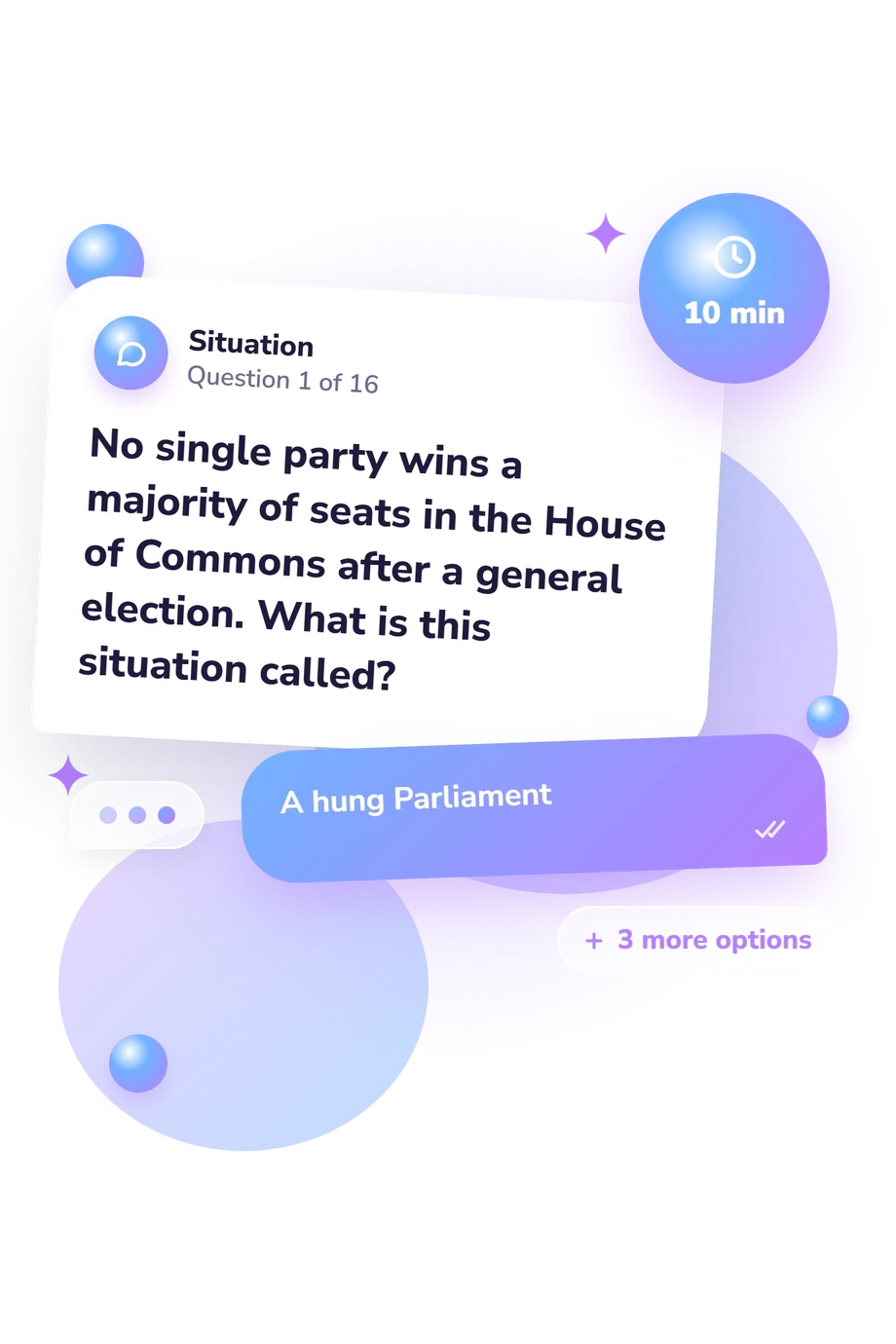
Example Questions From the Test
- A hung Parliament
- A constitutional referendum
- A royal prorogation
- A devolved legislature
- Members of Parliament for House of Commons constituencies
- The Prime Minister in a separate nationwide contest
- All members of the House of Lords
- The justices of the Supreme Court
- School education
- National defence
- Most health services
- Local government services
British Political Quiz - Description and methodology of the test
Readers who want to understand how authority is organised in the United Kingdom can use this British Political Quiz to check civic knowledge rather than political preference. Learners, voters and anyone revisiting Parliament, elections and devolution can use this concise UK political quiz to review civic knowledge. The total result indicates overall knowledge and may show where review is useful, making it a practical starting point for civic learning.
What This Assessment Explores
Practical knowledge of UK institutions, constitutional principles, elections and authority among Westminster, devolved bodies, courts and councils is the focus. The questions concern how the system works, not approval or policy preference.
Situations cover confidence votes, representation, lawmaking, judicial review and public decisions. They ask readers to identify institutions, processes or constitutional conventions. Party affiliation and voting preference are outside the scope of this political knowledge quiz.
British Political Knowledge (0-16) is the sole scale: Foundations to build (0-6) marks basic recognition needing review; Developing knowledge (7-12) indicates understanding with some gaps; Strong knowledge (13-16) indicates a well-developed grasp of UK institutions and processes.
The questions cover these themes:
- Parliament and government show how public decisions are made and scrutinised.
- Elections and representation connect votes with constituencies and MPs.
- Devolution, courts and councils clarify divided powers and local decisions.
Methodology and Scientific Basis
Each item is a four-option multiple-choice question, combining facts with constitutional or administrative scenarios. This format tests recognition and application of civic knowledge, although unfamiliar details or guesses can affect performance.
Scoring assigns one point per correct answer and places the raw total into the displayed bands. This British political knowledge test interprets the raw total through those bands, so the result describes performance on these questions.
The references provide conceptual and contextual support for interpreting political-knowledge questions: Sturgis, Allum, and Smith (2008) examined survey design and political-knowledge measurement; Pattie and Johnston (2003) add UK context on civic literacy and electoral participation; and Mondak (2001) discusses knowledge-scale construction. They do not establish this questionnaire's reliability or validity, and the questionnaire is not presented as an adaptation of any study.
It measures institutional knowledge rather than political affiliation and does not predict voting. Prior exposure or familiarity with UK institutions, recall, interpretation of wording and guessing can affect performance, so the result is best used to guide further civic learning rather than represent complete political understanding.
- Sturgis, Patrick, Nick Allum, and Patten Smith. “An Experiment on the Measurement of Political Knowledge in Surveys.” Public Opinion Quarterly 72, no. 1 (2008): 90-102. 10.1093/poq/nfm032
- Pattie, C. J., and R. J. Johnston. “Civic Literacy and Falling Electoral Turnout: The United Kingdom 1992-1997.” Canadian Journal of Political Science 36, no. 3 (2003): 579-599. 10.1017/S0008423903778779
- Mondak, Jeffery J. “Developing Valid Knowledge Scales.” American Journal of Political Science 45, no. 1 (2001): 224-238. 10.2307/2669369
Updated: