
Blackjack Quiz
How the Scales are Structured
Who Usually Takes This Test?
See How You Compare
Below is a preview of how scores are typically distributed across each scale.
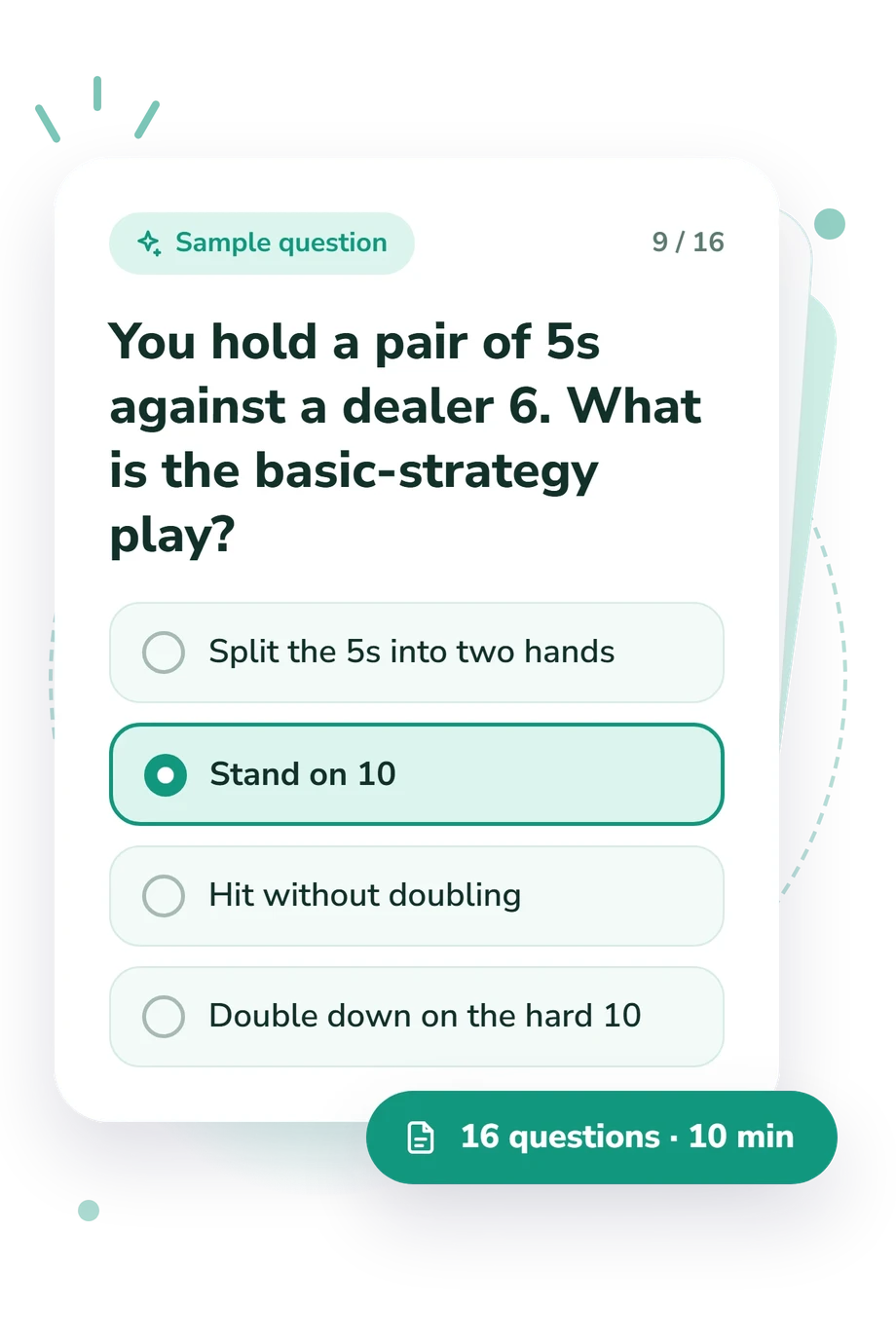
Example Questions From the Test
- Stand on 16
- Split the 8s
- Hit without splitting
- Double the original 16
- Stand because every 18 should stand
- Hit
- Split the ace and 7
- Double down
- The dealer wins the wager
- You win an even-money payout
- The result is a push and your wager is returned
- The same hand is played again
Blackjack Quiz - Description and methodology of the test
For players who want to check whether they understand the decisions behind common casino hands, this blackjack quiz offers a focused way to test practical knowledge. It suits learners reviewing rules as well as experienced players who want to use a blackjack basic strategy quiz to check their recall. The result identifies areas of confidence and topics that deserve closer study before decisions are made at the table.
What This Assessment Explores
The questionnaire tests the rules and choices that determine how a hand is played. It covers card values, soft and hard totals, natural blackjack, pushes, splitting, doubling, dealer actions, and insurance.
The situations fall into three practical areas:
- Hand values and table rules show whether you can identify totals and understand split, double, push, and blackjack outcomes.
- Strategic actions show whether you can choose hit, stand, split, or double for common matchups.
- Dealer and wager outcomes show whether you understand soft 17, insurance, and settlement of the main bet.
For learners revising standard decisions, this format functions as a basic strategy quiz. Blackjack Knowledge (0-16) has three bands: Foundations to build (0-6), Developing knowledge (7-12), and Strong knowledge (13-16). Table variations can change the correct play.
Methodology and Evidence Base
Each item presents a blackjack situation with four answer choices. The respondent selects the option that best matches the stated rules: six decks, dealer stands on soft 17, doubling is allowed on any first two cards and after splitting, and surrender is unavailable. This tests applied recognition rather than general opinion.
The result is a bounded knowledge score reflecting performance across the decision set. It indicates familiarity with common rules and basic-strategy choices, not session results. A strong result does not remove the house edge, and a different table rule can make another action correct.
The framework described by Baldwin et al. (1956) supplies the closest published basis for the rule-specific decisions tested here. Thorp (1961) adds a mathematical perspective on expected return. The questionnaire is conceptually consistent with these works, but it is not a standardized reproduction of either study. Its displayed bands function as learning categories rather than population norms.
For structured learning, this blackjack strategy quiz helps focus review. Attention, memory, and familiarity with the assumptions can affect performance, so use the result to examine less intuitive matchups rather than infer guaranteed profitability.
- Baldwin, Roger R., Wilbert E. Cantey, Herbert Maisel, and James P. McDermott. "The Optimum Strategy in Blackjack." Journal of the American Statistical Association 51, no. 275 (1956): 429-439. 10.1080/01621459.1956.10501334.
- Thorp, Edward O. "A Favorable Strategy for Twenty-One." Proceedings of the National Academy of Sciences 47, no. 1 (1961): 110-112. 10.1073/pnas.47.1.110.
Updated: