
Bird Song Quiz
How the Scales are Structured
Who Usually Takes This Test?
See How You Compare
Below is a preview of how scores are typically distributed across each scale.
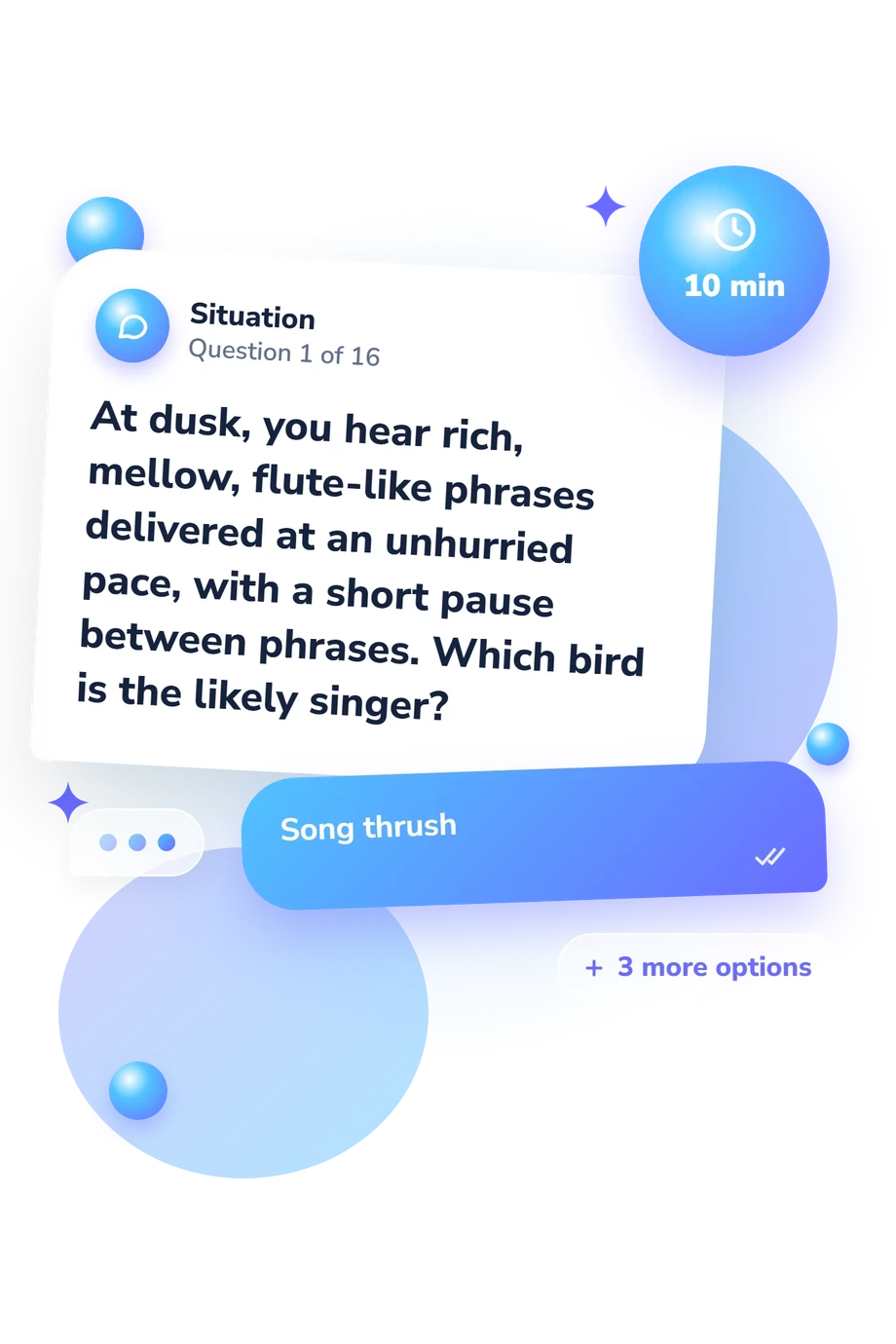
Example Questions From the Test
- Woodpigeon
- Collared dove
- Stock dove
- Feral pigeon
- Goldfinch
- Greenfinch
- Chaffinch
- Bullfinch
- Great tit
- Blue tit
- Coal tit
- Dunnock
Bird Song Quiz - Description and methodology of the test
People who want to recognise familiar garden birds can use this bird song quiz to test how accurately they connect written descriptions with likely species. It suits curious listeners, beginning birdwatchers, and anyone building a practical vocabulary for birdsong. In this written-clue bird sound quiz, recognition depends on comparing descriptions of rhythm, tone, repetition, and context rather than hearing recordings, while the result gives an overall gauge of recognition.
What This Assessment Explores
The questions measure recognition rather than hearing sensitivity. Each clue presents a vocal pattern or setting-such as dusk, winter, rooftop mimicry, or dense vegetation-and asks which familiar British garden bird best fits. Some items also distinguish song from calls and use familiar mnemonics.
This birdsong identification test combines rhythm, phrase shape, repetition, and context. The clues cover four thematic groups:
- Species matching shows how a described voice points to one likely bird.
- Song structure captures pace, phrasing, repetition, and note quality.
- Call-versus-song knowledge separates longer organised sequences from shorter signals.
- Contextual cues use season, time, place, and behaviour to narrow choices.
These groups contribute to one overall result: Bird Song Knowledge (0-16), with Emerging 0-6, Developing 7-12, and Strong 13-16. This score reflects recognition of common British garden birdsongs from written clues; it does not measure listening acuity.
Methodology and Evidence Base
Each item presents a written clue and four answer choices. You compare descriptions of rhythm, tone, repetition, and context with the likely species; the task does not involve hearing a recording. One total score is reported, with interpretation guided by its displayed bands; no separate subscores are presented.
The species and song descriptions are consistent with the content of Moss and Westwood (2008), while Thomas (2019) offers complementary guidance on song structure, calls, mnemonics, and species patterns. These guides serve as conceptual content references; the online questionnaire is a written-clue knowledge exercise, not an adaptation of either published guide.
As a British birdsong test, it indicates overall recognition within the written-clue format, without inferring performance on individual species or song patterns.
Performance may reflect prior exposure to British bird names, mnemonic familiarity, reading interpretation, and current attention. Interpret the result as recognition within this format, not as a measure of listening acuity or a clinical or educational norm.
- Moss, Stephen, and Brett Westwood. A Guide To British Garden Birds: And Their Songs. BBC Physical Audio, 2008. ISBN 9781405689311.
- Thomas, Adrian. RSPB Guide to Birdsong. Bloomsbury Publishing, 2019. ISBN 9781472955876.
- Venier, Lisa A., Marc J. Mazerolle, Anna Rodgers, Ken A. McIlwrick, Stephen Holmes, and Dean Thompson. Comparison of semiautomated bird song recognition with manual detection of recorded bird song samples. Avian Conservation and Ecology 12, no. 2 (2017): 2. 10.5751/ACE-01029-120202
Updated: