
Baddie Quiz
How the Scales are Structured
Who Usually Takes This Test?
See How You Compare
Below is a preview of how scores are typically distributed across each scale.
Example Questions From the Test
- Spray extra fragrance onto clothing instead of skin.
- Layer several scents so no single fragrance dominates.
- Apply fragrance immediately before entering so it smells fresh.
- Use much less than usual or skip fragrance for that visit.
- Coat the nail plate with hand cream immediately beforehand.
- Soak the nails and apply polish while they are still wet.
- Skip preparation and compensate with one very thick color coat.
- Start with clean, dry nails free of surface oil.
- They sit directly beside each other on the wheel.
- They sit opposite each other on the wheel.
- They are lighter and darker versions of one hue.
- They form three evenly spaced points on the wheel.
Baddie Quiz - Description and methodology of the test
Readers who want a practical check of everyday beauty, style, conduct, and online-safety knowledge can use this questionnaire to identify familiar decisions and topics that deserve review. The baddie quiz suits curious self-learners who want a clearer profile of applied know-how, not a verdict on attractiveness. Viewed as a practical beauty knowledge quiz, it frames the result through choices and habits rather than appearance.
What This Assessment Explores
This assessment examines practical judgment in beauty care, clothing, presentation, social conduct, and digital safety. It asks whether choices are workable, considerate, protective, and suited to everyday situations.
For a reader using this baddie knowledge test, the result shows which applied guidance feels familiar. Scenarios address cosmetics, fit and color, photo consent, boundaries, disclosure, verification codes, and account protection.
The questions group into four areas:
- Beauty and cosmetic care shows recognition of safer product use and controlled routines.
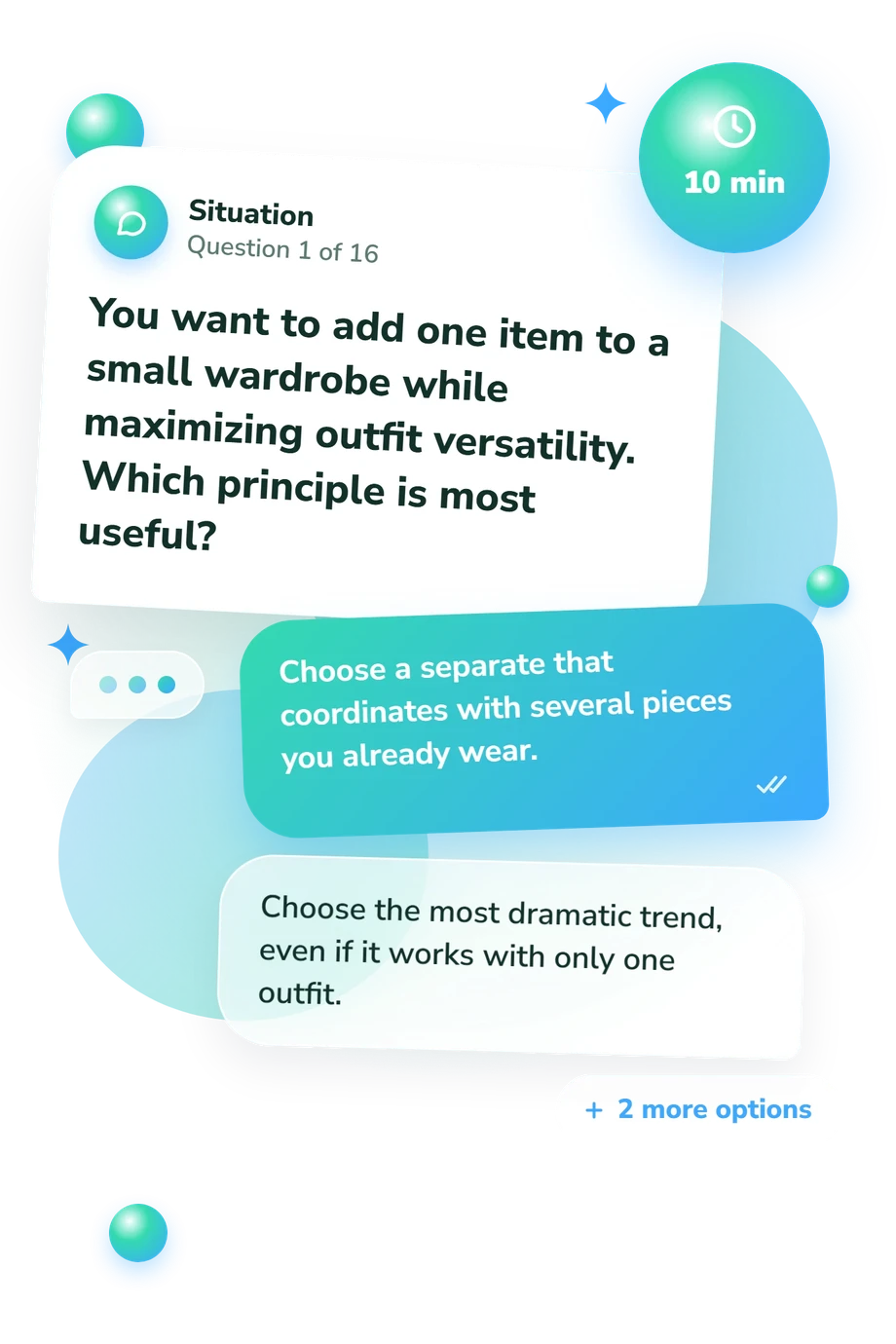
- Wardrobe and presentation indicates understanding of versatility, fit, color, and camera perspective.
- Etiquette, consent, and boundaries reflects consideration, permission, disclosure, and personal limits.
- Digital safety and account protection measures practices that reduce avoidable exposure and account-takeover risk.
Baddie Knowledge is reported on a 0-16 scale: Foundations to build (0-6), Developing know-how (7-12), or Strong baddie literacy (13-16). These bands describe practical knowledge, not attractiveness or worth.
Methodology and Scientific Basis
Each item presents a short scenario with four answer choices. Selecting the option that best matches practical guidance tests recognition and judgment rather than taste or self-description. The mixed content covers cosmetic safety, styling, social conduct, disclosure, authentication, and account protection.
As a beauty and style knowledge quiz, keyed responses produce one catalogue score rather than separate clinical or personality scales. Its displayed bands are descriptive categories, not population norms or diagnostic thresholds.
Cosmetic-safety items are conceptually consistent with CSAS (Jairoun et al., 2022), a published measure of cosmetic-safety knowledge. Clothing and responsible-consumption items align conceptually with Frank et al. (2026), while password, verification-code, and multi-factor items are consistent with NIST SP 800-63B-4. These sources support the domains, but this questionnaire is not an adaptation or validation of them.
Self-reported answers can be influenced by attention, current habits, prior exposure to beauty content, and the wish to choose socially approved responses, so the profile is best read as a focused reflection on applied knowledge rather than a complete account of behavior.
- Jairoun AA, Al-Hemyari SS, Shahwan M, Jamshed S, Bisgwa J. Development and validation of a novel cosmetics safety assessment scale (CSAS): Factual understanding of cosmetic safety and fostering international awareness. PLoS ONE. 2022;17(11):e0276938. 10.1371/journal.pone.0276938
- Frank L, Gossen M, Otto S. A scale for measuring consumer knowledge of fashion sustainability. International Journal of Fashion Design, Technology and Education. 2026:1-9. 10.1080/17543266.2026.2693686
- Temoshok D, Fenton J, Choong Y-Y, Lefkovitz N, Regenscheid A, Galluzzo R, Richer J. Digital Identity Guidelines: Authentication and Authenticator Management. NIST Special Publication 800-63B-4. Gaithersburg, MD: National Institute of Standards and Technology; 2025. 10.6028/NIST.SP.800-63b-4
Updated: