
Attitudes Toward Death Scale Test
How the Scales are Structured
Who Usually Takes This Test?
See How You Compare
Below is a preview of how scores are typically distributed across each scale.
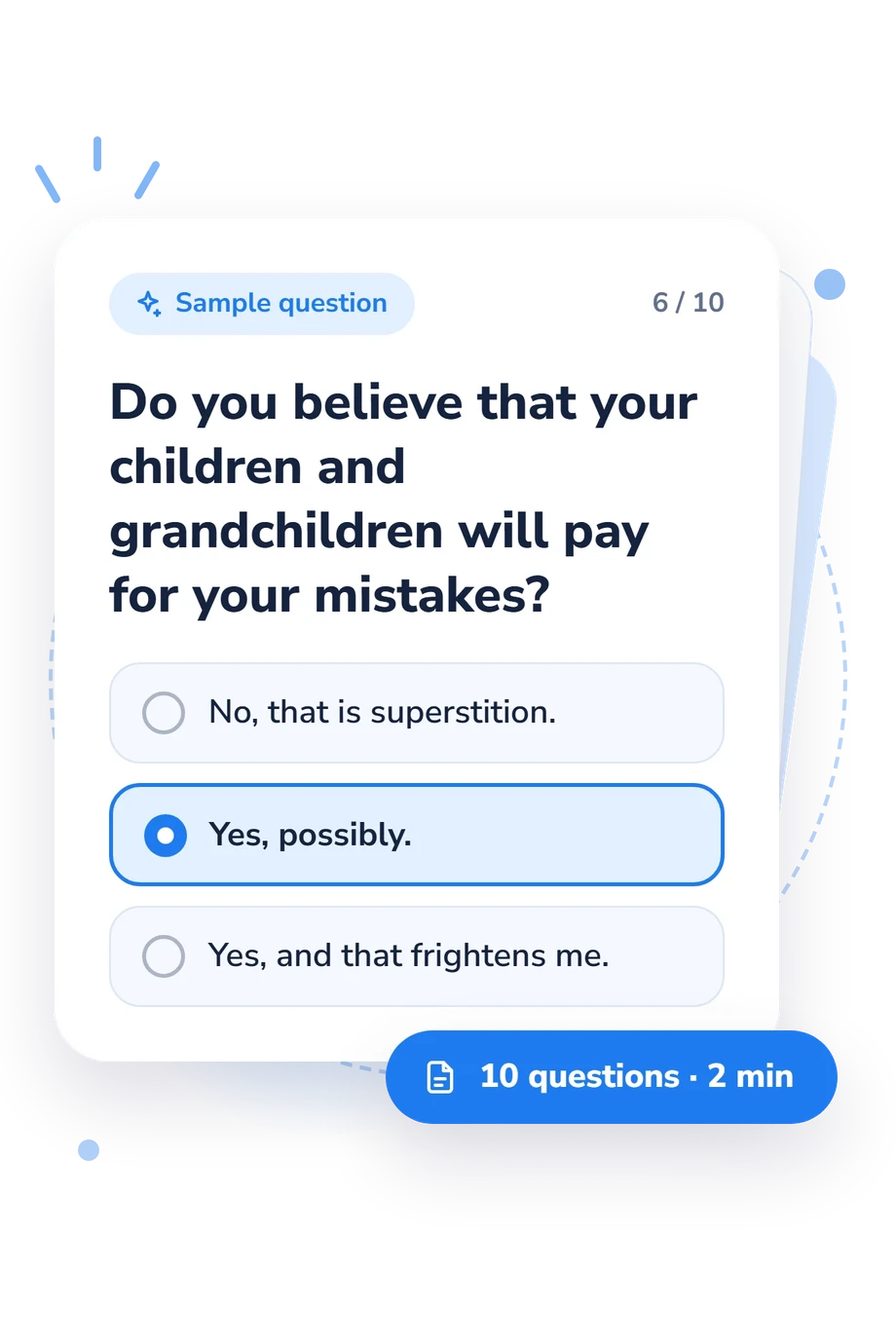
Example Questions From the Test
- As joyful and remarkable
- As worthless and without meaning
- As a series of troubles, suffering, and losses
- Life is difficult, and there is nothing that can be done about it
- I try to overcome them; otherwise I will not achieve success
- Difficulties build character and make me stronger
- A) Uncertainty about the afterlife
- B) Losing this world
- C) Physical suffering before death
Attitudes Toward Death Scale Test - Description and methodology of the test
People who want to examine the beliefs and emotional meanings they attach to mortality can use the Attitudes Toward Death Scale Test as a structured starting point. An attitudes toward death questionnaire can help readers reflect on how they understand life, dying, loss, responsibility, and what may follow death. The result offers one broad profile rather than a detailed account of every experience or belief.
What This Assessment Explores
Mortality is considered through meanings assigned to life, hardship, dying, loss, and the afterlife. As an attitude toward death test, it can indicate whether these themes are organized around hope, conflict, fear, burden, or acceptance. It suits readers examining their outlook without treating one belief as fixed.
Attitudes Toward Death is the only displayed scale, scored from -13 to 13. Its bands are Pessimistic (-13--1), Ambivalent (0-3), and Optimistic (4-13). They describe the direction of the outlook, not a person’s character or future behavior.
The questions group into three areas:
- Views of life and hardship show whether difficulties seem meaningless, manageable, or strengthening.
- Afterlife, moral consequences, and death fears show how guilt, uncertainty, suffering, relief, reunion, or hope shape the outlook.
- Images of dying and loved ones show how courage, despair, care, rejection, or acceptance are understood.
Methodology and Evidence Base
Most items ask the respondent to choose one verbal option from several alternatives rather than rate a statement on a numerical agreement scale. The choices cover personal beliefs, emotional reactions, imagined end-of-life behavior, and views of how people respond to death. This is a guided self-report task, not a test of factual knowledge.
Responses are combined into one overall result. The scoring display gives an interpretive category, but it does not provide separate scores for each theme or disclose a point value for every answer. A death attitude assessment can therefore orient reflection while offering limited detail about any single belief.
The questionnaire's themes are conceptually consistent with Kulagina and Senkevich's published Attitude to Death method, but this online questionnaire is not identified as a validated adaptation of it.
The displayed bands are interpretive categories, and no normative or clinical thresholds are stated for this online result. Current stress, grief, personal beliefs, and openness in responding may influence the result, so it should be read as a contextual self-report profile rather than a complete psychological assessment.
- Kulagina, I. Y., & Senkevich, L. V. (2013). Attitudes towards Death: Age, Regional and Gender Differences. Cultural-Historical Psychology, 9(4), 58-64.
- Yanovskaya, S., Turenko, R., & Timchenko, V. (2020). Attitudes to Death of Middle-Aged in the Context of the Covid-19 Pandemic. Visnyk of V. N. Karazin Kharkiv National University. Series Psychology, 69, 55-63. 10.26565/2225-7756-2020-69-08.
- Yanovskaya, S., Turenko, R., Kononenko, N., Bilous, N., & Timchenko, V. (2022). To the Question of Attitude to Death of Middle-Aged People during the War in Ukraine. Visnyk of V. N. Karazin Kharkiv National University. Series Psychology, 73, 75-83. 10.26565/2225-7756-2022-73-09.
Updated: