
Astronomy Quiz
How the Scales are Structured
Who Usually Takes This Test?
See How You Compare
Below is a preview of how scores are typically distributed across each scale.
Example Questions From the Test
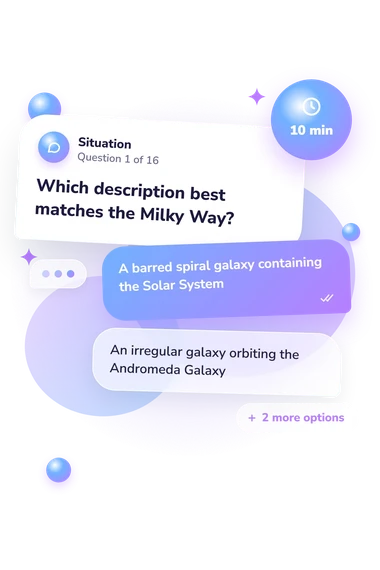
- A barred spiral galaxy containing the Solar System
- An irregular galaxy orbiting the Andromeda Galaxy
- A spiral galaxy with no central bar
- An elliptical galaxy containing only old stars
- A meteoroid
- An asteroid belt
- A meteorite
- A meteor
- It would become longer.
- It would become shorter.
- It would stay the same because the star's mass is unchanged.
- It would vary only with the planet's rotation rate.
Astronomy Quiz - Description and methodology of the test
When someone wants to check a grasp of astronomy before a lesson or after an introduction to the subject, this astronomy quiz provides a focused snapshot of performance. Taken as an online quiz about astronomy, it links familiar sky phenomena with core ideas and helps clarify whether more practice should target concepts, vocabulary, or observation. The outcome can guide a next step without reducing the subject to a single fact.
What the Test Measures
Questions ask you to identify objects, interpret light, apply orbital relationships, and explain sky observations. The emphasis is conceptual understanding: recognizing why a phenomenon occurs rather than recalling an isolated term. Learners can use this astronomy practice quiz to check an introductory grasp before moving to more advanced material.
The main thematic groups represented by the items are:
- Galaxies and cosmic structure identify the Milky Way and read redshift as evidence of recession.
- Stars and spectra connect color, spectral lines, life cycles, and changing brightness with physical processes.
- Planetary motion covers orbits, periods, retrograde motion, and transits.
- Earth-Moon observation covers seasons, phases, eclipses, and changing sky position.
The single result, Astronomy Knowledge, spans 0-16: Foundational (0-6) reflects basic recognition; Developing (7-12) a solid base still needing some strengthening; and Strong (13-16) broad, accurate knowledge across observation, planetary science, stars, and galaxies.
Methodology and Scientific Basis
Each prompt uses a single-best-answer multiple-choice format with four options. Items require recognition, interpretation, or application, such as reading a spectrum, explaining retrograde motion, and distinguishing mass from weight. This science quiz about astronomy can reveal which concepts deserve another look and where further explanation may help.
Conceptually, the questionnaire is consistent with the Astronomy Diagnostic Test, which used diagnostic astronomy questions, and with later standards-oriented work associated with TOAST. This relationship is conceptual: the online questionnaire is not presented as a reproduction, translation, or validated adaptation of either instrument.
The result display reports a total band, but the questionnaire does not state how each option is weighted or whether guessing is corrected. It also provides no population norms, reliability coefficients, or independent validation for this version. Interpret the outcome as current performance on these concepts. Prior instruction, familiarity with textbook wording, attention, and uncertainty between options can all affect one attempt, making the result most useful as a focused learning snapshot.
- Beth Hufnagel, Timothy Slater, Grace Deming, Jeff Adams, Rebecca L. Adrian, Christine Brick, and Michael Zeilik. "Pre-course Results from the Astronomy Diagnostic Test." Publications of the Astronomical Society of Australia 17, no. 2 (2000): 152-155. 10.1071/AS00152.
- Beth Hufnagel. "Development of the Astronomy Diagnostic Test." Astronomy Education Review 1, no. 1 (2002): 47-51. 10.3847/AER2001004.
- Stephanie J. Slater. "The Development And Validation Of The Test Of Astronomy STandards (TOAST)." Journal of Astronomy & Earth Sciences Education 1, no. 1 (2014): 1-22. 10.19030/jaese.v1i1.9102.
Updated: