
ASL Alphabet Quiz
How the Scales are Structured
Who Usually Takes This Test?
See How You Compare
Below is a preview of how scores are typically distributed across each scale.
Example Questions From the Test
- H
- Q
- R
- P
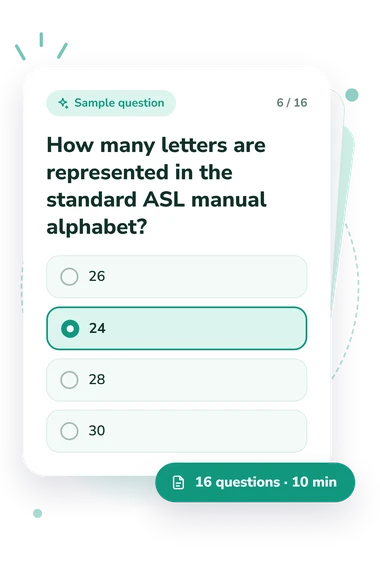
- 26
- 24
- 28
- 30
- I
- L
- Y
- W
ASL Alphabet Quiz - Description and methodology of the test
People who want to check their grasp of the manual alphabet can use the ASL Alphabet Quiz as a focused learning snapshot. It suits beginners, students, and anyone reviewing fingerspelling before practicing with a signer. Because it uses written descriptions and answer choices, this sign language alphabet quiz examines knowledge of handshapes and conventions without evaluating live signing performance.
What This Assessment Explores
The questionnaire focuses on text-based knowledge of the manual alphabet rather than broad ASL fluency. It asks you to distinguish similar handshapes, identify letters from finger-position descriptions, and notice orientation or movement changes. Practical items address spelling an unfamiliar name, using a consistent dominant hand, and keeping letters clear.
The question groups cover these areas:
- Handshape contrasts show whether you separate letters that share a fist, raised fingers, or thumb position.
- Orientation and movement show whether you connect a letter with direction or tracing.
- Fingerspelling conventions show whether you understand clarity, rhythm, hand choice, and name spelling.
The result is ASL Alphabet Knowledge: 0-16, with Building Foundations (0-6), Developing Knowledge (7-12), and Strong Knowledge (13-16). These bands describe text-based alphabet knowledge, not visual recognition, expressive fluency, or broader ASL ability. The score helps identify useful areas for ASL alphabet practice.
Methodology and Scientific Basis
Each item uses four-option multiple choice. The choices test distinctions such as crossed versus separated fingers, moving versus stationary forms, and conventions that make fingerspelling easier to follow. Responses are summarized in one displayed knowledge score rather than separate topic scores; the item-weighting method is not specified.
Tennant and Brown (2010) provide the closest reference for the ASL handshape distinctions and alphabet descriptions. The questionnaire is conceptually consistent with that work, but is not the published dictionary or a documented adaptation of it. Wilcox (1992) adds a phonetic perspective, while Geer and Keane (2018) support attention to clarity and learner comprehension.
Occhino and colleagues (2024) offer a related comprehension-testing framework through the ASL FaN-CT, but that instrument is separate from this quiz. Performance can also reflect recent ASL fingerspelling practice, familiarity with written descriptions, guessing, and momentary attention, especially when similar handshapes are described in words. No norms or reliability estimates are reported for this quiz, so its bands are descriptive rather than population-based. The result remains a focused learning snapshot for choosing what to practice next, rather than a measure of broader signing ability.
- Tennant, Richard A., and Marianne Gluszak Brown. The American Sign Language Handshape Dictionary. 2nd ed. Washington, DC: Gallaudet University Press, 2020.
- Geer, Leah C., and Jonathan Keane. “Improving ASL fingerspelling comprehension in L2 learners with explicit phonetic instruction.” Language Teaching Research 22, no. 4 (2018): 439-457. 10.1177/1362168816686988
- Occhino, Corrine, Ryan Lidster, Leah C. Geer, Jason Listman, and Peter C. Hauser. “Development of the American Sign Language Fingerspelling and Numbers Comprehension Test (ASL FaN-CT).” Language Testing 41, no. 1 (2024): 135-161. 10.1177/02655322231179494
- Wilcox, Sherman. The Phonetics of Fingerspelling. Studies in Speech Pathology and Clinical Linguistics, vol. 4. Amsterdam and Philadelphia: John Benjamins, 1992. 10.1075/sspcl.4