
Area of Composite Figures Quiz
How the Scales are Structured
Who Usually Takes This Test?
See How You Compare
Below is a preview of how scores are typically distributed across each scale.
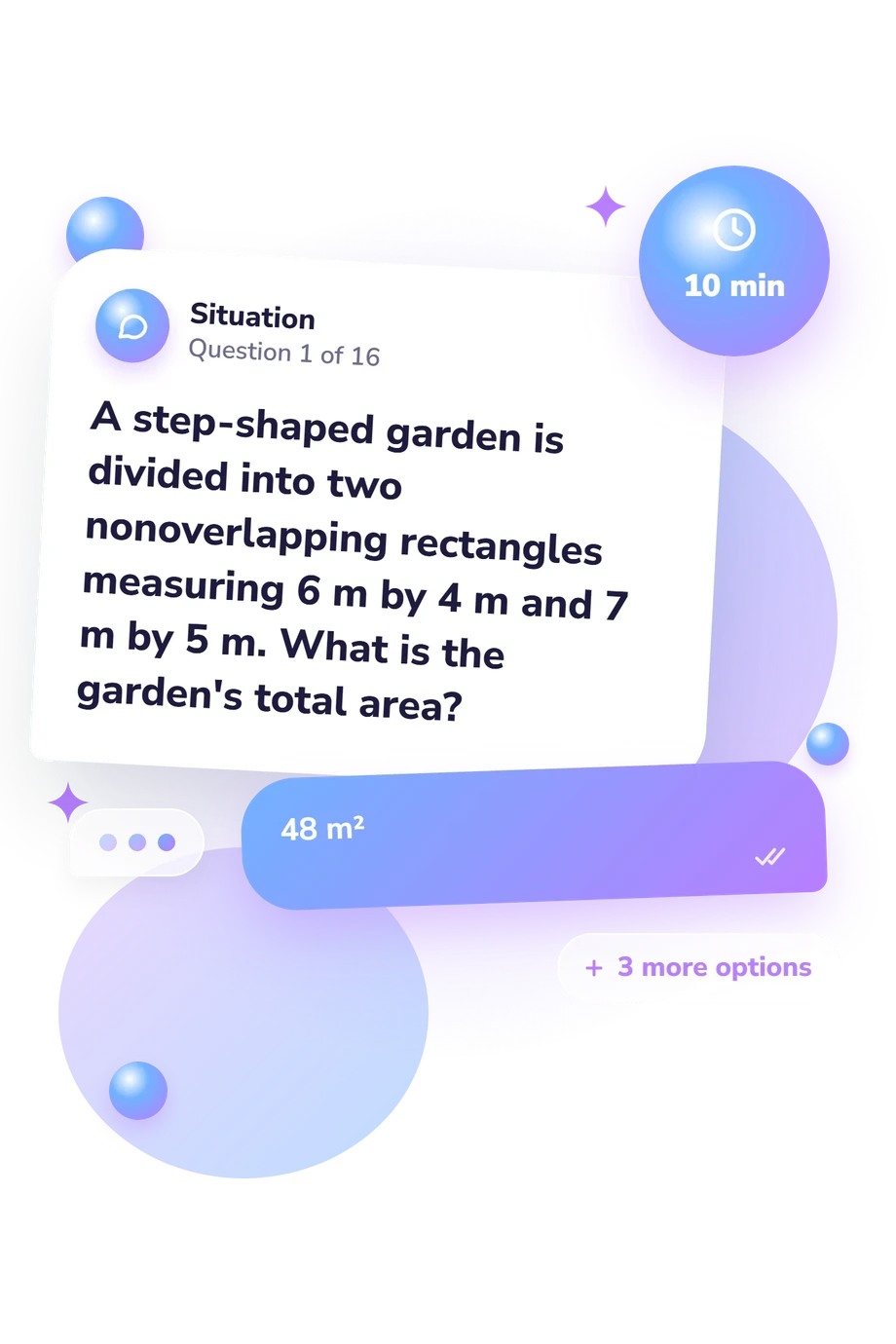
Example Questions From the Test
- 22 m²
- 19 m²
- 20 m²
- 10 m²
- 150 m²
- 90 m²
- 126 m²
- 174 m²
- 240 m²
- 228 m²
- 216 m²
- 264 m²
Area of Composite Figures Quiz - Description and methodology of the test
Students, teachers, and independent learners can use this assessment to check whether they can break irregular figures into manageable parts and choose an appropriate area formula. The area of composite figures quiz focuses on reasoning that supports accurate calculation rather than memorizing isolated formulas. The questions offer practice with composite figures, covering decomposition, overlap, and arithmetic.
What This Assessment Measures
The questions test how well a learner decomposes, combines, compares, and adjusts areas.
They use rectangles, cutouts, overlaps, triangles, trapezoids, circles, and missing dimensions, emphasizing a match between the described figure and the chosen operation.
This matters in composite area problems because solutions may require addition, subtraction, or both. The score summarizes performance across varied composite figures, including shared regions and removed parts.
The displayed scale is Area of Composite Figures Knowledge (0-16), with one point for each correct answer:
- Foundations to build (0-6) indicates a need to review basic formulas and splitting figures into nonoverlapping parts.
- Developing knowledge (7-12) indicates that standard figures are manageable, but cutouts, overlaps, curved sections, or missing dimensions need more care.
- Strong knowledge (13-16) indicates consistent selection and combination of appropriate area methods across varied composite figures.
Methodology and Scientific Basis
Each item presents a described figure and four answer choices. Questions ask the respondent to calculate totals, compare figures, account for overlaps, subtract cutouts, solve for missing dimensions, or correct a setup. Some require a standard formula; others test whether regions are added, removed, or counted once.
The scoring is direct: the scale assigns one point for each correct answer, and the total is interpreted through the displayed bands. It is a criterion-based knowledge check with one aggregate scale, so it reports an overall category rather than separate subscores.
Lehmann (2023) provides the closest conceptual comparison because it examines reasoning about measuring composite shapes, including decomposition and recombination. Baturo and Nason (1996) offer relevant background on subject-matter knowledge in area measurement. The present quiz is conceptually consistent with these papers, not an adaptation or validation of either.
Because it records selected answers rather than full working, arithmetic slips, interpretation of figure descriptions, and current familiarity with formulas can affect performance. Use the score to target practice in area of composite shapes and review formulas and area operations for missed items.
- Lehmann, Timothy H. (2023). Learning to measure the area of composite shapes. Educational Studies in Mathematics, 112(3), 531-565. 10.1007/s10649-022-10191-z
- Baturo, Annette R., & Nason, Rodney A. (1996). Student teachers' subject matter knowledge within the domain of area measurement. Educational Studies in Mathematics, 31(3), 235-268. 10.1007/BF00376322
Updated: