
Are You a Wizard or a Muggle Quiz
How the Scales are Structured
Who Usually Takes This Test?
See How You Compare
Below is a preview of how scores are typically distributed across each scale.
Example Questions From the Test
- Track where it goes and retrieve the key without using magic.
- Consult a creature guide before approaching it.
- Use another shiny object to coax it back into view.
- React quickly with my wand and summon the key using Accio.
- Choose a ground-based activity that suits me better.
- Ask for a precise explanation of balance and control.
- Watch a successful classmate, then copy their technique.
- Feel out the broom's movement and adjust as I fly.
- Wait until an enchanted object or spell can direct me.
- Follow a student who already knows the castle.
- Ask portraits for guidance and write down their directions.
- Build my own route system using landmarks, timing, and notes.
Are You a Wizard or a Muggle Quiz - Description and methodology of the test
Readers interested in wizarding life can turn to the open quiz for muggle to imagine how they might respond when magic, unfamiliar customs, or practical challenges enter everyday situations. As a quiz for muggle readers, it suits people who enjoy considering whether they would experiment, observe, ask for guidance, or solve a problem with ordinary tools, without requiring detailed lore knowledge.
What This Assessment Explores
This wizard or Muggle quiz turns imagined situations into four styles of engagement. Its scenarios cover experimentation, magical culture, practical problem-solving, and structured study rather than fictional trivia. The result is a preference profile rather than a fixed identity. The displayed affinities and their bands are:
- Instinctive Wizard (0-12) measures spontaneous action: Deliberate Approach (0-4), Emerging Magical Instinct (5-8), or Instinctive Wizard Affinity (9-12).
- Magic-Curious Muggle (0-12) measures cultural interest: Limited Observer Interest (0-4), Interested Guest (5-8), or Magic-Curious Muggle Affinity (9-12).
- Resourceful Muggle (0-12) measures practical ingenuity: Magic-Leaning Solutions (0-4), Flexible Problem-Solver (5-8), or Resourceful Muggle Affinity (9-12).
- Scholarly Wizard (0-12) measures study orientation: Learning Elsewhere (0-4), Engaged Apprentice (5-8), or Scholarly Wizard Affinity (9-12).
Methodology and Evidence Base
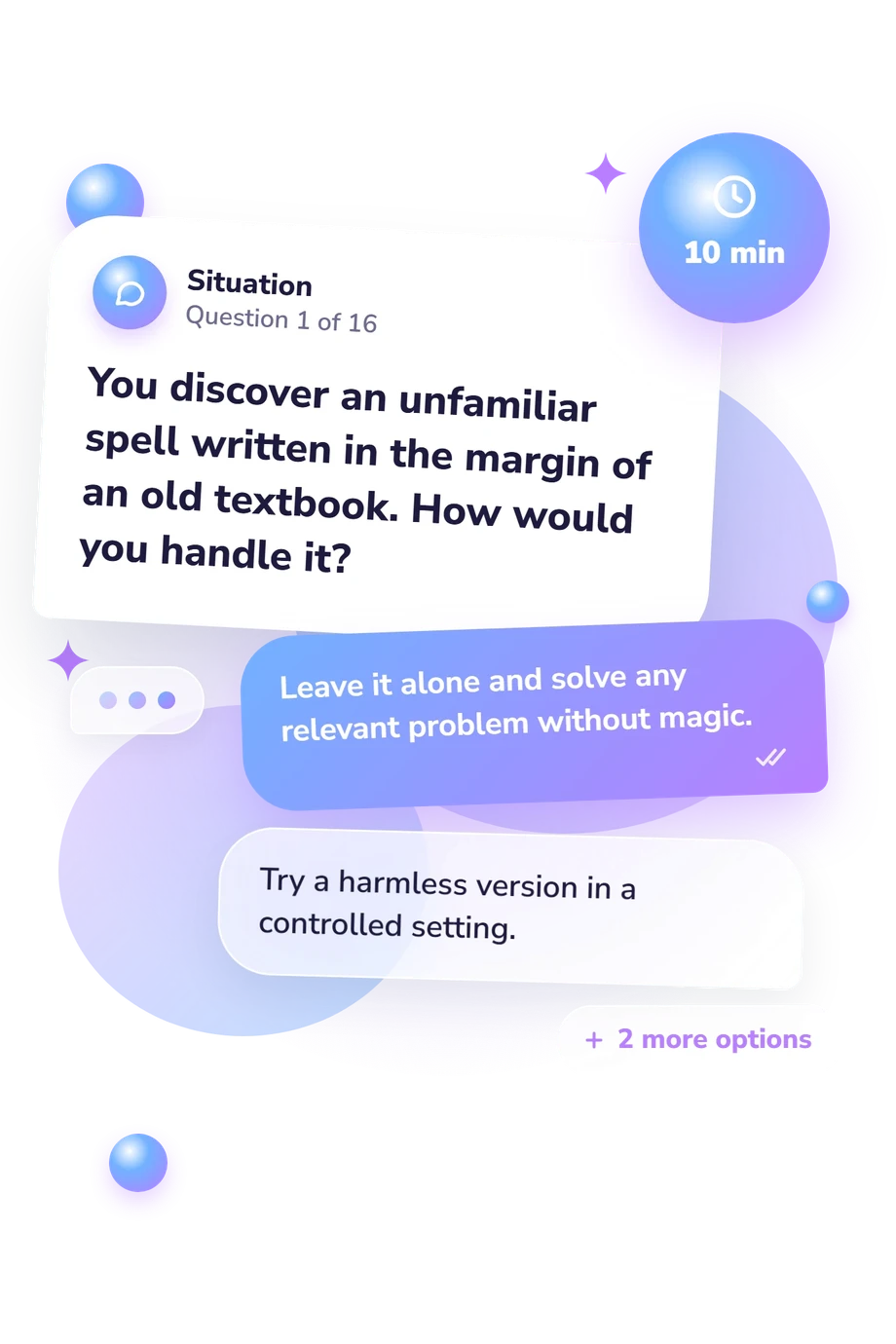
Each of the 16 prompts presents a fictional situation with four responses. Options contrast avoiding magic, experimenting, seeking guidance, investigating carefully, or solving problems independently. The format is a structured self-report exercise: choices feed four comparative scores. The reader sees scores and bands rather than a per-answer point rule; the highest score marks the strongest affinity, and scores within one point produce a blended result.
Conceptual context comes from the Sorting Hat Quiz research by Jakob and colleagues, which related a Harry Potter sorting format to personality and human values, and from Hogwarts house-identification research by Crysel and colleagues, which examined links with personality traits. These studies do not establish reliability, norms, validity, or standardization for this questionnaire. The four affinities are the result types used by this Muggle quiz, so they should be read as custom playful categories rather than as measures established by that related research. Current mood, self-presentation, and familiarity with the fictional world can influence responses, so close scores are best read as playful tendencies rather than stable psychological facts.
- Lea Jakob, Eduardo Garcia-Garzon, Hannes Jarke, and Fabian Dablander. (2019). The Science Behind the Magic? The Relation of the Harry Potter “Sorting Hat Quiz” to Personality and Human Values. Collabra: Psychology, 5(1), Article 31. 10.1525/collabra.240
- Laura Crysel, Corey Cook, Tatiana Orozco Schember, and Gregory Daniel Webster. (2015). Harry Potter and the measures of personality: Extraverted Gryffindors, agreeable Hufflepuffs, clever Ravenclaws, and manipulative Slytherins. Personality and Individual Differences, 83, 174-179. 10.1016/j.paid.2015.04.016
- J. K. Rowling. (1997). Harry Potter and the Philosopher’s Stone. London: Bloomsbury.
Updated: