
Are We Meant to Be Together Quiz
How the Scales are Structured
Who Usually Takes This Test?
See How You Compare
Below is a preview of how scores are typically distributed across each scale.
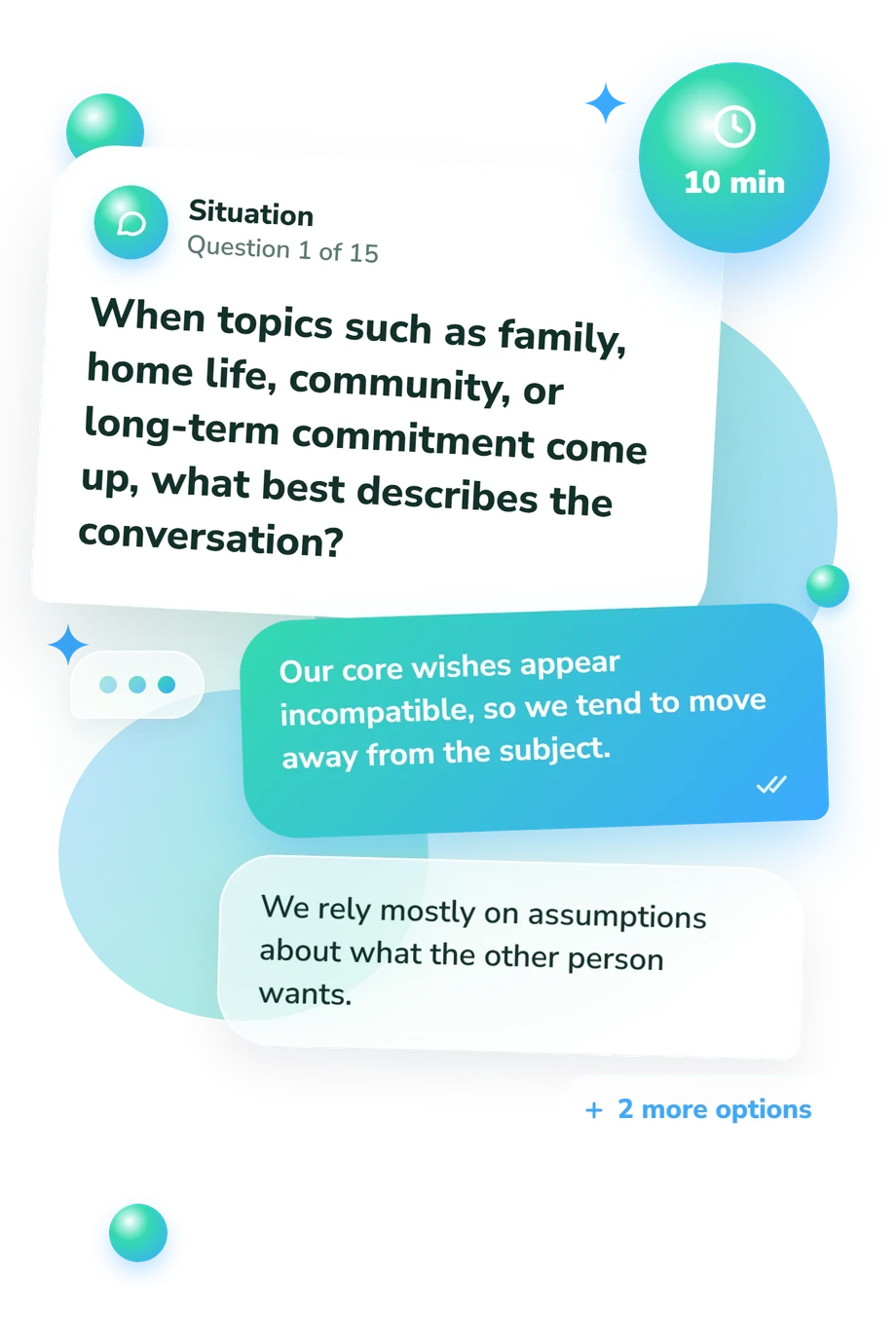
Example Questions From the Test
- Our core wishes appear incompatible, so we tend to move away from the subject.
- We rely mostly on assumptions about what the other person wants.
- We have found meaningful common ground, with a few unresolved questions.
- We understand each other's wishes, including the points that may require difficult choices.
- The person with the offer would probably decide independently, and we would deal with the consequences afterward.
- One of us would likely give way quickly to avoid making the choice harder.
- We would compare the main benefits and costs, even if some personal priorities stayed unspoken.
- We would openly weigh both people's goals and decide what trade-offs we could genuinely accept.
- We resume normal routines and assume that time will smooth things over.
- Affection returns, but the central disagreement is usually left alone.
- We confirm that we understand each other, even if part of the issue remains open.
- We can name what happened, agree on what comes next, and restore warmth without erasing the disagreement.
Are We Meant to Be Together Quiz - Description and methodology of the test
For couples trying to understand whether trust, cooperation, and compatible plans support their bond, the Are We Meant to Be Together Quiz provides a structured relationship reflection. Partners or individuals can use this do we belong together quiz to examine recurring interaction patterns rather than seek a verdict. It can help partners consider whether they belong together while highlighting topics worth discussing about closeness, conflict, and future choices.
What This Assessment Explores
The questionnaire examines vulnerability, boundaries, conflict, practical demands, and future decisions. The are we good together quiz result summarizes three dimensions; each band identifies areas to explore, not whether a couple should stay together.
Situations include expressing opinions, asking for space, repairing hurt, sharing household work, discussing money, and weighing a move. Together, these themes let the is it meant to be quiz assess respect, accountability, and compromise.
The result reports three dimensions:
- Emotional Safety and Authenticity (0-15) shows Guarded connection (0-5), Partial openness (6-10), or Secure authenticity (11-15) in self-expression and boundaries.
- Repair and Teamwork (0-15) shows Strained repair (0-5), Inconsistent teamwork (6-10), or Resilient partnership (11-15) in conflict recovery and shared effort.
- Shared Direction and Values (0-15) shows Different paths (0-5), Emerging alignment (6-10), or Strong shared direction (11-15) in priorities and future choices.
Methodology and Evidence Base
Each item presents a relationship situation with four response options, moving from guarded or unresolved patterns toward openness, accountability, cooperation, and compromise. Responses are organized into displayed dimensions; the ranges describe bands, but no separate point value for each answer is stated.
It is conceptually consistent with the Sound Relationship House Scales, particularly their focus on emotional connection and relationship functioning, and it touches conflict themes measured by the Romantic Partner Conflict Scale. It is an online self-reflection tool with displayed interpretive bands.
Readers wondering whether their relationship is meant to be should read it as a snapshot of current interaction patterns, not a forecast. Self-report scores can shift with mood, memory, recent conflict, context, and candor. People using the are we right for each other quiz should consider the situations behind the result and discuss them together; the bands are reflective feedback, not clinical norms or a diagnosis.
- Gottman, John M. Reliability and Validity of the Sound Relationship House Scales. Unpublished document, n.d.
- Gottman, John M., and Nan Silver. The Seven Principles for Making Marriage Work. Crown Publishers, 1999.
- Chonody, Jill M., Jacqui Gabb, Mike Killian, and Priscilla Dunk-West. Measuring Relationship Quality in an International Study: Exploratory and Confirmatory Factor Validity. Research on Social Work Practice, 28(8), 920-930, 2018. 10.1177/1049731516631120.
- Zacchilli, Tammy L., Clyde Hendrick, and Susan S. Hendrick. The Romantic Partner Conflict Scale: A New Scale to Measure Relationship Conflict. Journal of Social and Personal Relationships, 26(8), 1073-1096, 2009. 10.1177/0265407509347936
Updated: