
Are My Needs Being Met Quiz
How the Scales are Structured
Who Usually Takes This Test?
See How You Compare
Below is a preview of how scores are typically distributed across each scale.
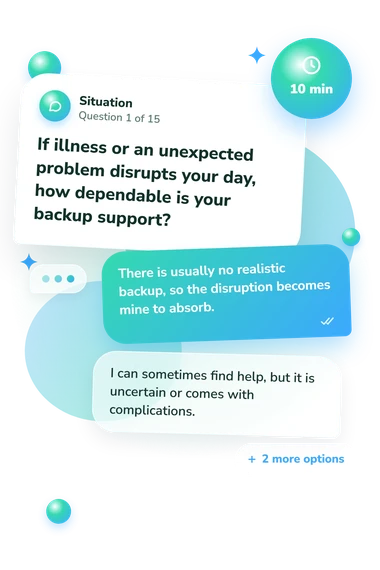
Example Questions From the Test
- There is usually no realistic backup, so the disruption becomes mine to absorb.
- I can sometimes find help, but it is uncertain or comes with complications.
- I have a few workable options, although coverage may be incomplete.
- I can generally rely on a clear, dependable source of practical help.
- I can adjust priorities or access enough help to keep the load manageable.
- I manage the essentials, but some needs are postponed.
- I usually handle everything alone, even when important needs go unmet.
- Some help is available, though only after considerable effort or delay.
- It is acknowledged briefly, without much shared enthusiasm.
- People engage with my excitement and seem genuinely pleased for me.
- Responses vary widely depending on the person or situation.
- I often feel ignored, dismissed, or reluctant to share at all.
Are My Needs Being Met Quiz - Description and methodology of the test
People uncertain about balance in a close relationship may use the Are My Needs Being Met Quiz to organize that uncertainty into specific areas for reflection. It suits anyone reviewing whether choices and boundaries are respected, emotional understanding and connection are available, and dependable practical support is present. This emotional needs quiz can offer language for patterns that are hard to describe.
What This Assessment Explores
The questions examine choice, emotional reciprocity, practical help, routines, and recovery, supporting an identifying your needs quiz approach.
This questionnaire suits structured reflection about experiences that may be difficult to describe.
The result shows what your emotional needs are through a what are my emotional needs quiz format. It describes your current experience, not another person’s intentions or your entire relationship.
Three dimensions are:
- Autonomy and Boundaries (0-15) shows whether choices, limits, privacy, and changing preferences are respected: Autonomy needs attention (0-5), Respect is inconsistent (6-10), or Autonomy well supported (11-15).
- Emotional Connection and Understanding (0-15) shows how consistently you experience empathy, belonging, attention, and emotional responsiveness: Needs attention (0-5), Mixed (6-10), or Well supported (11-15).
- Practical Support and Stability (0-15) shows whether help, routines, manageable responsibilities, and recovery time are available: Needs attention (0-5), Uneven support (6-10), or Well supported (11-15).
Methodology and Evidence Base
Each item presents a concrete situation with four response options. Answers are organized into three displayed scores; the four response options are presented, but their point weighting is not stated, so individual answers cannot be converted into points from the article alone. The four-option self-report format keeps this what are my needs quiz focused on structured reflection.
The themes are conceptually consistent with the Emotional Needs Scale and the Human Givens framework. Relationship content also overlaps with the Relational Needs Satisfaction Scale, while practical support parallels the MOS Social Support Survey. These references do not make the questionnaire an adaptation of those instruments.
Use the bands to compare areas and identify the situations behind a score. This questionnaire can provide useful language for discussion about what your needs are and which situations affect them. Self-report is affected by mood, memory, current conflict, and self-awareness, and the catalogue presents the results as an unvalidated reflection.
- Culham, Brett. 2009. The Emotional Needs Scale. Human Givens Journal 16(1): 36-41.
- Zvelc, Gregor, Karolina Jovanoska, and Masa Zvelc. 2020. Development and Validation of the Relational Needs Satisfaction Scale. Frontiers in Psychology 11: 901. 10.3389/fpsyg.2020.00901
- Sherbourne, Cathy D., and Anita L. Stewart. 1991. The MOS Social Support Survey. Social Science & Medicine 32(6): 705-714. 10.1016/0277-9536(91)90150-B
- Griffin, Joe, and Ivan Tyrrell. 2003. Human Givens: A New Approach to Emotional Health and Clear Thinking. HG Publishing.