
AOT Character Quiz
How the Scales are Structured
Who Usually Takes This Test?
See How You Compare
Below is a preview of how scores are typically distributed across each scale.
Example Questions From the Test
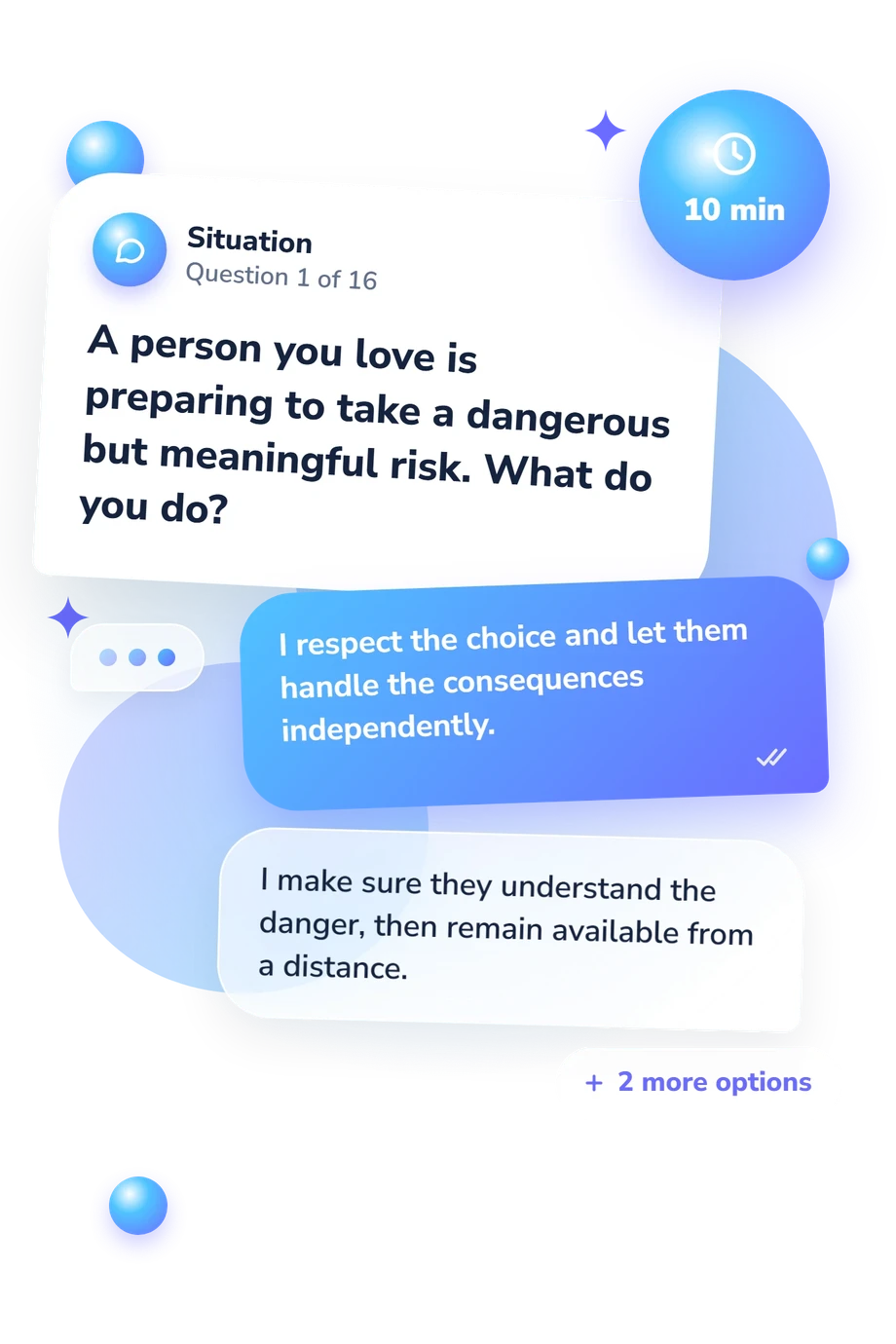
- I respect the choice and let them handle the consequences independently.
- I make sure they understand the danger, then remain available from a distance.
- I help them prepare and stay close enough to intervene if needed.
- I go with them because protecting them matters more than avoiding the danger.
- I let it go unless the shortcuts cause a visible problem.
- I explain why consistency matters and ask them to correct the pattern.
- I watch for a while to determine whether the procedure itself is unnecessary.
- I address it directly; reliable execution cannot depend on luck.
- By consistently noticing needs and taking practical action without much display.
- By sharing thoughts and feelings openly so the bond stays mutual.
- By creating enjoyable experiences without making the bond too intense.
- By staying dependable during hard moments, even when words are difficult.
AOT Character Quiz - Description and methodology of the test
People who want to connect their everyday choices with the world of Attack on Titan can use the AOT Character Quiz as a guided self-reflection exercise. It suits fans interested in loyalty, danger, authority, uncertainty, and responsibility, rather than anyone seeking a match based only on appearance or favorite scenes. The result offers a nuanced answer to which AOT character you are by linking fictional traits with decisions you may recognize in yourself.
What This Assessment Explores
Across scenarios about loyalty, freedom, pressure, setbacks, and judgment, the questionnaire reads character affinity as a pattern of choices rather than literal identity. It is useful for fans seeking a reflective answer to which Attack on Titan character you are, especially when several profiles feel relatable.
Four dimensions appear in the profile:
- Armin Arlert (0-12) reflects strategic imagination: Practical Observer (0-4) favors evidence, Thoughtful Planner (5-8) analyzes motives, and Visionary Strategist (9-12) spots possibilities.
- Eren Yeager (0-12) reflects freedom and persistence: Measured Independence (0-4) balances autonomy, Restless Resolve (5-8) resists constraints, and Freedom-Driven Force (9-12) acts intensely.
- Levi Ackerman (0-12) reflects disciplined judgment: Flexible Operator (0-4) values adaptability, Focused Professional (5-8) prioritizes competence, and Exacting Captain (9-12) demands precision.
- Mikasa Ackerman (0-12) reflects protective loyalty: Broad Allegiance (0-4) keeps wider commitments, Steady Protector (5-8) stays dependable, and Devoted Guardian (9-12) defends close bonds.
Methodology and Evidence Base
Each scenario offers four response options about pressure, relationships, uncertainty, or goals. Choose the response closest to your usual pattern. The exercise turns what AOT character you are into a question about tendencies rather than trivia.
Separate affinity scores show relative fit: the highest is strongest, and scores within one point form a blended profile. Bands describe increasing resemblance, not a complete personality definition.
Rarity et al. (2022) supplies relevant evidence that identification with media characters can relate to perceived personality similarity. Cohen’s framework explains why a fictional figure may become personally meaningful, while Isayama’s guidebook anchors the character portrayals.
This questionnaire is conceptually consistent with those sources, but it is not an adaptation of their published measures or a documented standardized instrument. For someone asking what Attack on Titan character you are, results remain context-sensitive: current circumstances, self-awareness, and favorable self-presentation can influence answers. The profile works best as a prompt for reflection about recurring choices.
- Rarity, Erica C., Matthew R. Leitao, and Abraham M. Rutchick. “Identification With Characters in Parasocial Relationships Predicts Sharing Their Personality Traits.” Psychology of Popular Media, vol. 11, no. 2, 2022, pp. 111-116. 10.1037/ppm0000389
- Isayama, Hajime. Attack on Titan Guidebook: INSIDE & OUTSIDE. Kodansha Comics, 2014. ISBN 9781612629452
- Cohen, Jonathan. “Defining Identification: A Theoretical Look at the Identification of Audiences With Media Characters.” Mass Communication and Society, vol. 4, no. 3, 2001, pp. 245-264. 10.1207/s15327825mcs0403_01
Updated: