
Anatomical Position Quiz
How the Scales are Structured
Who Usually Takes This Test?
See How You Compare
Below is a preview of how scores are typically distributed across each scale.
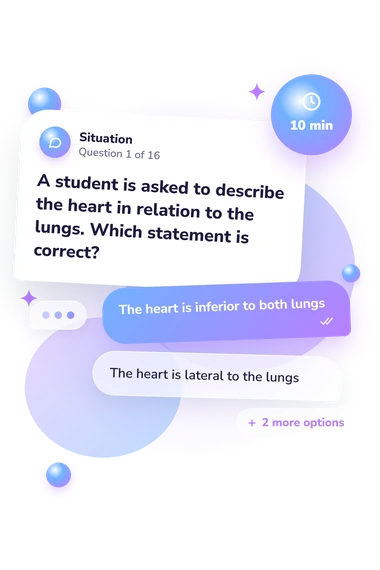
Example Questions From the Test
- The heart is inferior to both lungs
- The heart is lateral to the lungs
- The heart is superficial to the lungs
- The heart is medial to the lungs
- Deep
- Distal
- Superficial
- Inferior
- The femur is superficial to the quadriceps
- The femur is deep to the quadriceps
- The femur is distal to the quadriceps
- The femur is lateral to the quadriceps
Anatomical Position Quiz - Description and methodology of the test
Students, trainees, and curious readers can use this assessment to check how confidently they apply standard anatomical language in practical descriptions. Rather than testing recall in isolation, this anatomical position quiz connects terms with structures, planes, positions, and movements. The emphasis is on choosing the relationship that best fits each situation. With four answer choices, this quiz on anatomical position with answers gives one overall knowledge result, not item-by-item feedback.
What This Assessment Explores
The questionnaire checks whether a respondent can apply anatomical terminology when comparing structures or identifying a standard position. It covers superior/inferior, medial/lateral, anterior/posterior, proximal/distal, superficial/deep, and ipsilateral/contralateral relationships. It also tests midsagittal, frontal, transverse, and other planes, plus supine, prone, and basic shoulder movement.
Because the items place terms in relationships, this anatomical position terms quiz suits learners reviewing introductory anatomy or practical medical vocabulary. The result indicates overall performance on the tested relationships and applications, rather than broader anatomical competence.
The displayed Anatomical Position Knowledge scale (0-16) uses these result bands:
- Foundation to build (0-6) indicates basic concepts are present but need review.
- Developing knowledge (7-12) shows many core relationships are understood with some application gaps.
- Strong command (13-16) reflects consistent identification of directions, planes, and positions.
Methodology and Scientific Basis
Each item is a selected-response question with four answer choices. Some ask for a definition; others place a structure or movement in relation to another body part. The respondent selects the best-fitting term, and the test presents performance as one aggregate knowledge score.
By requiring directional language to be applied in context, this anatomical terms of location quiz examines the terminology. The terminology is consistent with FIPAT's international framework (2019). Parra Gámez et al. (2015) offers related medical-education evidence on recognizing basic clinical concepts through standardized anatomical terminology, while Choudhury and Freemont (2017) discuss structured approaches to assessing anatomical knowledge.
These sources support the content focus; the questionnaire is conceptually consistent with that work, not an adaptation or validated copy of a cited instrument. Its bands are the test's knowledge categories rather than population norms or diagnostic thresholds. Recent coursework, wording, and familiarity with English terms can affect performance, so one score is best read as a snapshot of current knowledge.
- Parra Gámez, Leticia; Ibarra Ramírez, Víctor Hugo; González Ríos, Jacquelina; García Hidalgo, Alejandro. "Recognition of Basic-Clinical Concepts Under International Anatomical Terminology in Medical Education." Investigación en Educación Médica. 2015;4(15):139-144. 10.1016/j.riem.2014.11.002
- Federative International Programme for Anatomical Terminology. "Terminologia Anatomica: International Anatomical Terminology." 2nd ed. Federative International Programme for Anatomical Terminology; 2019.
- Choudhury, Bipasha; Freemont, Anthony. "Assessment of Anatomical Knowledge: Approaches Taken by Higher Education Institutions." Clinical Anatomy. 2017;30(3):290-299. 10.1002/ca.22835
Updated: