
Am I Sapiosexual Quiz
How the Scales are Structured
Who Usually Takes This Test?
See How You Compare
Below is a preview of how scores are typically distributed across each scale.
Example Questions From the Test
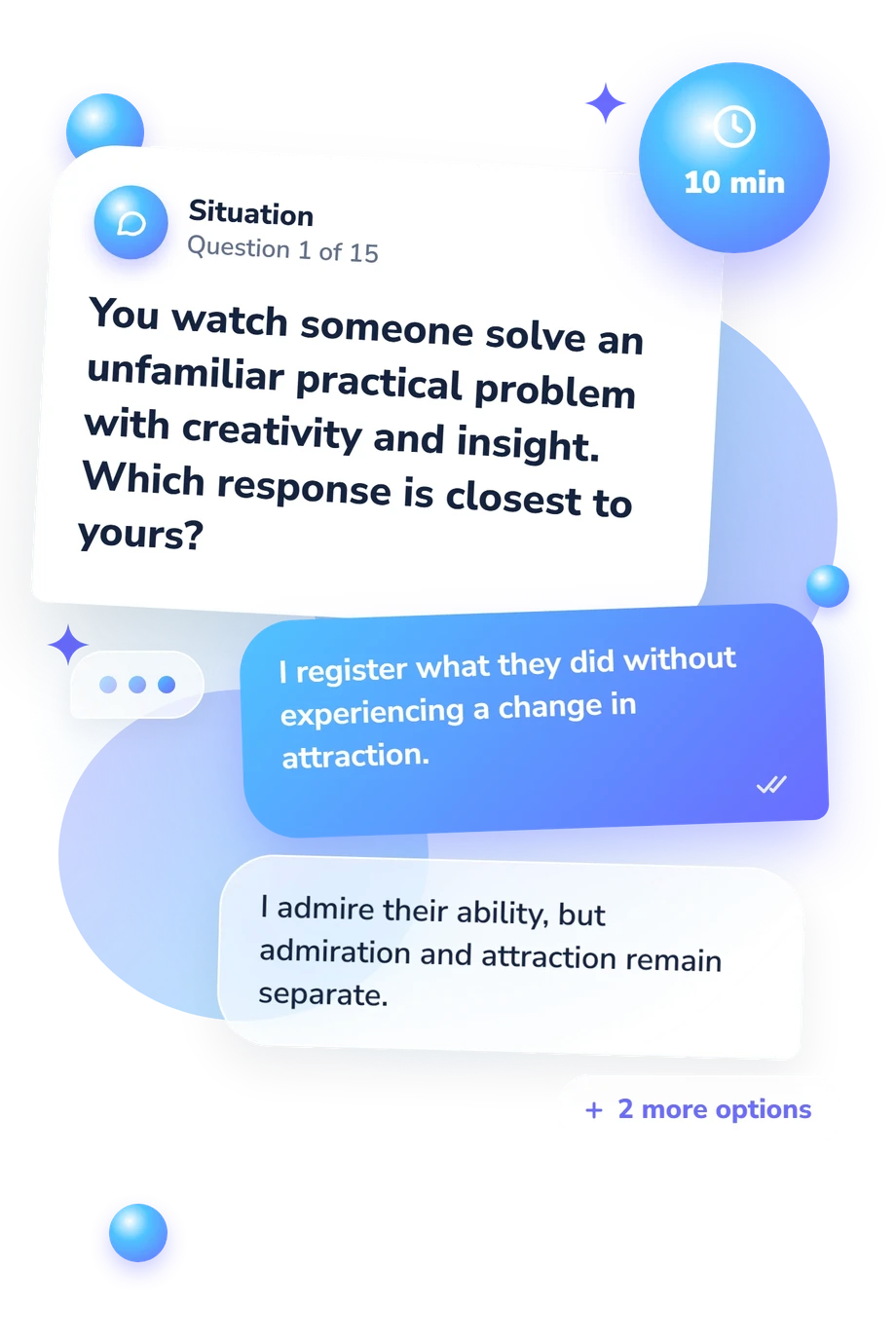
- I register what they did without experiencing a change in attraction.
- I admire their ability, but admiration and attraction remain separate.
- That display of intelligence could make them noticeably more attractive to me.
- Seeing their mind at work would likely create a strong sense of attraction.
- It has rarely or never been a defining theme.
- It appears in a few experiences but not as a stable pattern.
- It is a recurring theme, though its importance varies.
- It is one of the clearest and most consistent themes in how I experience attraction.
- It does not meaningfully describe my pattern of attraction.
- I recognize a small part of myself in it, but the label feels too strong.
- It describes much of my experience, though not in every situation.
- It feels like a highly accurate description of a central attraction pattern.
Am I Sapiosexual Quiz - Description and methodology of the test
People who are unsure whether intelligence repeatedly shapes their attraction can use the Am I Sapiosexual Quiz to organize that reflection. It is intended for readers examining romantic or sexual interest, not for assigning an identity from one reaction. This sapiosexual quiz groups recurring responses to mental stimulation, conversation, and rapport. The result highlights patterns that may help you choose language that feels accurate.
What This Assessment Explores
These items examine whether another person's reasoning, curiosity, originality, or conversational depth changes attraction, whether mental exchange keeps it alive, and whether the label feels personally useful. As an intellectual attraction test, it separates initial spark, ongoing connection, and self-description without assuming intelligence is the only basis of compatibility.
The three scales separate these dimensions:
- Intellectual Spark (0-15) shows attraction triggered or intensified by thinking: Appreciation Without Strong Spark (0-5), Situational Spark (6-10), Powerful Spark (11-15).
- Need for Mental Connection (0-15) shows the importance of ongoing mental exchange: One Element Among Many (0-5), Meaningful Ingredient (6-10), Core Requirement (11-15).
- Sapiosexual Label Fit (0-15) shows how well the label describes a recurring pattern: Limited Label Fit (0-5), Partial/Flexible Fit (6-10), Strong Personal Fit (11-15).
Different combinations are possible, such as strong initial attraction with less need for sustained discussion.
Methodology and Scientific Basis
Each item pairs a brief scenario or self-description with four ordered responses, moving from little or no influence on attraction toward a stronger, more central influence. The situations cover new encounters, dating preferences, and established relationships, addressing both how attraction begins and how mental engagement sustains it.
In practical terms, this sapiosexuality test converts responses into three profile scores. The bands are interpretive summaries from a reflective questionnaire, not standardized norms, clinical cutoffs, or proof of an official category. Since the questionnaire does not specify each option's point contribution, read the displayed pattern rather than infer a scoring formula.
Its conceptual reference is the Sapiosexuality Inventory described and evaluated by Gignac et al. (2018), which examines attraction to intelligence; this questionnaire is conceptually consistent with that work, not an adaptation of it. Jonason et al. (2019) add evidence that relative intelligence can influence mate preferences, without making it universally important.
Self-report can vary with current relationships, mood, expectations, and interpretation of the situations. The dimensions can diverge: a strong intellectual spark does not necessarily mean sustained mental connection is required, while ongoing mental rapport can matter without creating immediate attraction to intelligence.
- Gignac, Gilles E., Joey Darbyshire, and Michelle Ooi. “Some people are attracted sexually to intelligence: A psychometric evaluation of sapiosexuality.” Intelligence, vol. 66, 2018, pp. 98-111. 10.1016/j.intell.2017.11.009
- Jonason, Peter K., Kristine Marsh, Omir Dib, Danielle Plush, Mark Doszpot, Ewing Fung, Kathleen Crimmins, Michael Drapski, and Katrina Di Pietro. “Is smart sexy? Examining the role of relative intelligence in mate preferences.” Personality and Individual Differences, vol. 139, 2019, pp. 53-59. 10.1016/j.paid.2018.11.009
Updated: